Loading...
Jean-Jacques Rousseau vs John Locke
John Locke leads by 9.5 pts · 2 figures compared
…
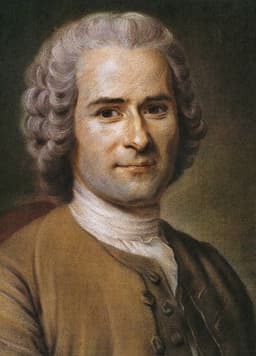
Jean-Jacques Rousseau
Philosopher · Modern
43.5Total

John Locke
Philosopher · Modern
53.0Total
Basic Information
Born
1712
1632
Died
1778
1704
Era
Modern
Modern
Nationality
France
England
Occupation
Philosopher
Philosopher
Civilization
Western
Western
Score Comparison
Military (10%)
9.1
9.1
Political (20%)
33.8
35.1
Influence (20%)
65.0
75.0
Legacy (20%)
40.0
70.0
Leadership (15%)
45.4
40.9
Strategy (15%)
44.4
44.2
TOTAL
43.5
53.0
Jean-Jacques Rousseau — Complete Timeline
1755 AD
Publication of Discourse on the Origin and Basis of Inequality Among MenCultural◆ Major
Rousseau argued that human inequality originated with the establishment of private property and civil society, corrupting natural human goodness. This work challenged Enlightenment optimism about progress and laid the groundwork for Romanticism and critiques of modern civilization.
InequalityPhilosophyRomanticism
Impact: globalconstructive
1762 AD
Publication of The Social ContractCultural
Rousseau published his political treatise arguing that legitimate political authority rests on a social contract formed by the general will of the people. The work's ideas of popular sovereignty and direct democracy influenced the French Revolution and modern democratic theory.
Political PhilosophySocial ContractGeneral Will
Impact: globalconstructive
Publication of Émile, or On EducationCultural◆ Major
Rousseau published a treatise on education advocating for natural development and learning through experience rather than rote instruction. The book was condemned by the Paris Parliament and the Catholic Church for its religious views, and Rousseau fled France to avoid arrest.
EducationPhilosophyCensorship
Impact: globalconstructive
1766 AD
Exile in EnglandPolitical Action
After the condemnation of
ExileEnglandParanoia
Impact: nationaltragic
John Locke — Complete Timeline
1683 AD
Exile in the NetherlandsPolitical Action
Locke fled to the Netherlands due to suspicion of involvement in the Rye House Plot against King Charles II. During his exile, he wrote his major works and associated with Dutch intellectuals. He returned to England after the Glorious Revolution in 1688.
ExileNetherlandsGlorious Revolution
Impact: national
1689 AD
Publication of An Essay Concerning Human UnderstandingCultural◆ Major
Locke published his major philosophical work arguing that the human mind at birth is a tabula rasa (blank slate) and that all knowledge comes from sensory experience. This work established empiricism as a foundation of modern philosophy and influenced the Enlightenment.
PhilosophyEmpiricismKnowledge
Impact: globalconstructive
Publication of Two Treatises of GovernmentCultural
Locke published his political treatise arguing for natural rights to life, liberty, and property, and the right of revolution against tyranny. The work justified the Glorious Revolution and later profoundly influenced the American Declaration of Independence and Constitution.
Political PhilosophyNatural RightsRevolution
Impact: globalconstructive
Publication of A Letter Concerning TolerationCultural◆ Major
Locke argued for the separation of church and state and for religious toleration, except for Catholics and atheists. He maintained that civil government should not interfere with matters of conscience. This work became a foundational text for religious freedom in liberal democracies.
TolerationChurch and StateLiberalism
Impact: globalconstructive
Expert Analysis
Origins
Jean-Jacques Rousseau (1712–1778) was born in Geneva, a city-state with a strong tradition of republicanism. His mother died shortly after his birth, and his father, a watchmaker, raised him until abandoning him around age 10. Rousseau had little formal education; he was apprenticed to an engraver but fled at 16, embarking on a wandering life. His early experiences of hardship and social exclusion shaped his later critiques of civilization and inequality.
John Locke (1632–1704) was born in Wrington, Somerset, England, into a Puritan family. His father, a lawyer and clerk to justices of the peace, provided a comfortable upbringing. Locke attended Westminster School and then Christ Church, Oxford, where he studied medicine and philosophy. His education in the classics and science gave him a rational, empirical approach to knowledge.
Rise to Power
Rousseau rose to prominence through his essays and treatises. In 1750, his *Discourse on the Arts and Sciences* won a prize from the Academy of Dijon, arguing that civilization corrupts natural virtue. This essay made him famous. His *Discourse on Inequality* (1755) further criticized private property and social hierarchy. The turning point came in 1762 with *The Social Contract* and *Émile*, which were condemned by Paris authorities for their religious and political views. Rousseau fled to Switzerland, then to England under David Hume's protection, but suffered paranoia and broke with Hume.
Locke's rise was more gradual and politically engaged. He served as secretary to the Earl of Shaftesbury, a key Whig figure, and was involved in colonial administration. His *Two Treatises of Government* (1689) was written to justify the Glorious Revolution and limit royal power. The work was published anonymously, but its arguments for natural rights and consent of the governed became foundational. His *Essay Concerning Human Understanding* (1689) established him as a leading philosopher. Locke's exile in the Netherlands (1683–1688) due to suspected involvement in the Rye House Plot allowed him to write freely.
Leadership & Governance
Rousseau's political philosophy centers on the 'general will'—the collective interest of the people. He argued that legitimate sovereignty resides in the people, who must directly participate in lawmaking. In *The Social Contract*, he wrote, 'Man is born free, and everywhere he is in chains.' He advocated for a direct democracy where citizens assemble to decide laws. However, he also warned that the general will could be mistaken, and that a 'legislator' might be needed to guide it. His ideas influenced the French Revolution, but his distrust of representative government made him skeptical of parliamentary systems.
Locke's *Two Treatises* laid out a liberal theory of government based on natural rights—life, liberty, and property. He argued that people form governments to protect these rights, and if a government violates them, citizens have a right to revolt. Locke favored a constitutional monarchy with a separation of powers, particularly between the executive and legislative branches. His ideas directly influenced the U.S. Declaration of Independence and the U.S. Constitution. In governance, Locke's emphasis on property rights and limited government has been more practically applied than Rousseau's general will.
Triumph & Tragedy
Rousseau's greatest triumph was his influence on modern political and educational thought. *The Social Contract* became a cornerstone of democratic theory, and *Émile* revolutionized education by advocating child-centered learning. His idea of the 'noble savage' and critique of progress resonated with Romanticism. However, his personal life was tragic: he abandoned his five children to an orphanage, a fact that haunted him. His later years were marked by paranoia and poverty. He died in 1778, likely from a stroke, but his works were posthumously celebrated.
Locke's triumph was his foundational role in empiricism and liberalism. His *Essay Concerning Human Understanding* argued that the mind is a blank slate (tabula rasa), shaping modern psychology and education. His political ideas provided the philosophical basis for the Glorious Revolution and later democratic movements. However, Locke's legacy is marred by his involvement in drafting the Fundamental Constitutions of Carolina, which permitted slavery. He also invested in the slave trade. His views on toleration excluded Catholics and atheists, reflecting the limits of his liberalism.
Character & Destiny
Rousseau was passionate, emotional, and prone to conflict. He saw himself as a victim of society, which fueled his critiques. His decision to abandon his children contradicted his advocacy of natural education, revealing a gap between his ideals and actions. His paranoia led to broken friendships, even with Hume. Yet his sincerity and depth of feeling moved readers. His destiny was to be a revolutionary thinker whose ideas outlived his troubled life.
Locke was cautious, methodical, and diplomatic. He cultivated powerful patrons and avoided direct confrontation, often publishing anonymously. His rational temperament allowed him to synthesize ideas into systematic works. He died in 1704 at Oates, Essex, respected as a philosopher and physician. His destiny was to be the 'father of liberalism,' with his ideas embedded in Western political systems.
Legacy
Rousseau's legacy is profound in political theory, education, and literature. His concept of the general will influenced the French Revolution and later thinkers like Kant and Hegel. In education, his emphasis on natural development inspired progressive educators. However, his ideas have also been criticized for enabling totalitarianism if the general will is misused. His score of 65.0 in influence and 40.0 in legacy reflects his mixed but enduring impact.
Locke's legacy is more concrete: his ideas directly shaped the U.S. Declaration of Independence, the U.S. Constitution, and modern liberal democracy. His empiricism laid the groundwork for the scientific revolution and Enlightenment. His scores of 75.0 in influence and 70.0 in legacy underscore his foundational role. Yet his association with slavery and limited toleration remains a stain.
Conclusion
While Rousseau's ideas were revolutionary and inspirational, Locke's practical impact on political systems is greater. Locke scored 53.0 overall compared to Rousseau's 43.5, a gap of 9.5 points. Locke's political philosophy provided the framework for constitutional government and individual rights that still dominate Western democracies. Rousseau's general will, though influential, has been harder to implement without authoritarian risks. Therefore, John Locke had the greater impact on the formation of modern liberal societies.
Rankings
🥇
John LockeLeader
Mil: 9.1Pol: 35.1Inf: 75.0
53.0
🥈
Jean-Jacques Rousseau
Mil: 9.1Pol: 33.8Inf: 65.0
43.5
+9.5 behind
How This Comparison Works
Algorithm
Each figure is scored on 6 dimensions (0—100 scale) based on structured historical data: Military (10%), Political (20%), Influence (20%), Legacy (20%), Leadership (15%), Strategy (15%). The weighted total produces the final ranking.
Data Sources
Scores are computed from structured sub-indicators in the database. Scale factors adjust for era (Ancient ×0.85, Modern ×1.0) and civilization size (Eastern ×1.05, Other ×0.80) to account for differences in population and military scale.
Maximum 3 Figures
Comparisons are limited to 2—3 figures to ensure readability and statistical meaningfulness.
Error Margins
±5 points per dimension — Sub-scores are derived from historical records with inherent uncertainty. Two figures within 5 points on a dimension should be considered roughly equivalent in that area.
Total Score Accuracy
±3 points overall — The weighted combination of 6 dimensions produces a total score with approximately ±3 points of uncertainty. Differences of less than 3 points are not statistically significant— the figures are effectively tied.
Known Limitations
- Historical records are incomplete and uneven across civilizations
- Figures from oral-tradition societies may be underrepresented
- Occupation labels can misclassify multi-role figures
- Scores measure capability and impact, not moral character
- Quantitative scoring is a comparison tool, not absolute truth
Capability Radar
Military (10%) — Battles & Warfare
Battles
18
12
Win Rate
21
21
Expansion
19
24
Political (20%) — Governance & Reform
Reform
60
85
Diplomacy
64
40
Economy
67
70
Influence (20%) — Cultural & Global Reach
Cultural
85
85
Global
75
85
Legacy (20%) — Historical Impact
Historical
80
90
Longevity
85
90
Leadership (15%) — Power & Stability
Tenure
53
10
Stability
69
30
Strategy (15%) — Tactics & Innovation
Strategy
24
26
Tactics
25
26
Reform
32
28
Similar Comparisons
Comments & Discussion
No comments yet. Be the first to share your thoughts!