Loading...
Jayavarman II vs Louis IV
Jayavarman II leads by 12.7 pts · 2 figures compared
…
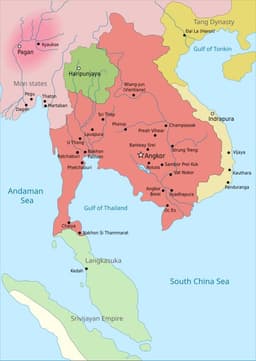
Jayavarman II
Emperor · Medieval
59.2Total

Louis IV
Emperor · Medieval
46.5Total
Basic Information
Born
770
1282
Died
835
1347
Era
Medieval
Medieval
Nationality
Cambodia
Holy Roman Empire
Occupation
Emperor
Emperor
Civilization
Eastern
Western
Score Comparison
Military (10%)
60.0
10.0
Political (20%)
72.0
45.1
Influence (20%)
68.0
52.5
Legacy (20%)
40.0
45.8
Leadership (15%)
66.0
65.7
Strategy (15%)
55.0
43.3
TOTAL
59.2
46.5
Jayavarman II — Complete Timeline
802 AD
Proclaimed Devaraja CultCultural
Jayavarman II performed a ritual on Mount Mahendraparvata proclaiming himself a 'devaraja' (god-king), establishing the cult of the divine ruler. This act unified the Khmer principalities and founded the Khmer Empire, legitimizing his rule through Hindu cosmology.
Khmer EmpireDevarajaFounding
Impact: regionalconstructive
Founded the Khmer EmpirePolitical Action
Jayavarman II unified the warring Khmer states under his rule, establishing the Khmer Empire with its capital at Mahendraparvata. This marked the beginning of a powerful empire that would dominate Southeast Asia for centuries.
Khmer EmpireUnificationFounding
Impact: regionalconstructive
Established Capital at MahendraparvataPolitical Action◆ Major
Jayavarman II established his capital at Mahendraparvata, a mountain temple complex in the Kulen Hills. This site became the ceremonial and political center of the early Khmer Empire.
Khmer EmpireCapitalMahendraparvata
Impact: regionalconstructive
Louis IV — Complete Timeline
1314 AD
Elected King of GermanyPolitical Action◆ Major
Louis IV of Bavaria was elected King of Germany by a faction of prince-electors, opposing Frederick the Fair. This election was part of a double election that led to a civil war between the Wittelsbach and Habsburg dynasties.
ElectionWittelsbachDouble Election
Impact: regional
1322 AD
Defeated Frederick the Fair at the Battle of MühldorfWar◆ Major
Louis IV of Bavaria defeated Frederick the Fair at the Battle of M
BattleWittelsbachVictory
Impact: regional
1328 AD
Crowned Holy Roman Emperor by the Roman PeoplePolitical Action
Louis IV of Bavaria was crowned Holy Roman Emperor in Rome by the Roman people, defying Pope John XXII who had excommunicated him. This act asserted imperial authority over the Papacy and led to a prolonged conflict with the Avignon Papacy.
CoronationPapal ConflictImperial Authority
Impact: global
1338 AD
Issued the Declaration of RhensePolitical Action◆ Major
Louis IV of Bavaria issued the Declaration of Rhense, which stated that the German king's election by the prince-electors alone conferred imperial authority without papal approval. This declaration strengthened the independence of the Holy Roman Empire from the Papacy.
DeclarationImperial IndependencePapacy
Impact: regionalconstructive
Expert Analysis
Origins
Jayavarman II, born around 770 CE, was a Khmer prince who grew up in the fragmented landscape of early medieval Cambodia. Little is known of his early life, but he likely received military and courtly training in the Java region, where he was possibly held as a hostage or exile. His formative experiences among the Sailendra dynasty exposed him to advanced concepts of statecraft and divine kingship. In contrast, Louis IV, born in 1282 in Munich, was a member of the House of Wittelsbach. He was the son of Duke Louis II of Upper Bavaria and Matilda of Habsburg. Educated in the traditions of the Holy Roman Empire, he learned the intricacies of electoral politics and imperial governance from a young age. While Jayavarman II emerged from obscurity to unite a fractured land, Louis IV inherited a duchy and navigated the complex web of German princely politics.
Rise to Power
Jayavarman II's rise began around 790 CE when he returned to Cambodia and started consolidating power. He fought campaigns against rival Khmer lords and Chams, gradually unifying the warring states. The pivotal moment came in 802 CE when he performed a ritual on Mount Mahendraparvata, proclaiming himself a devaraja (god-king). This act not only declared his independence from Javanese suzerainty but also established a new religious cult that legitimized his rule. Louis IV's rise was more tumultuous. In 1314, he was elected King of Germany by a faction of prince-electors, opposing Frederick the Fair of Habsburg. This double election plunged the empire into civil war. Louis IV's military score of 10.0 reflects his limited martial prowess, but his political score of 45.1 shows shrewd maneuvering. The turning point came at the Battle of Mühldorf in 1322, where he defeated Frederick the Fair, securing his claim. However, his defiance of Pope John XXII led to excommunication, forcing him to seek alternative sources of legitimacy.
Leadership & Governance
Jayavarman II's leadership scored 66.0, demonstrating effective consolidation. He established a centralized state with the capital at Mahendraparvata, a mountain temple complex that served as both ceremonial and political center. His governance was based on the devaraja cult, which fused Hindu and indigenous beliefs to create a divine monarchy. This system provided a unifying ideology for the diverse Khmer population. Louis IV, with a leadership score of 65.7, focused on asserting imperial authority against papal supremacy. He issued the Declaration of Rhense in 1338, stating that the German king's election by the prince-electors alone conferred imperial authority without papal approval. This was a bold political move that challenged centuries of papal influence. While Jayavarman II built a theocratic state, Louis IV fought for secular sovereignty. Both leaders used ideology—one divine, one legal—to strengthen their rule.
Triumph & Tragedy
Jayavarman II's greatest triumph was founding the Khmer Empire, which would endure for over 600 years and produce the magnificent Angkor Wat. His devaraja cult became the cornerstone of Khmer kingship. However, his legacy score of 40.0 reflects that much of his specific achievements were later overshadowed by successors like Suryavarman II. His capital at Mahendraparvata was eventually abandoned. Louis IV's triumph was his victory at Mühldorf and his successful defiance of the Pope, which strengthened the position of the German monarchy. He also expanded Wittelsbach territories. Yet his tragedy was the ongoing conflict with the papacy, which weakened his ability to exercise imperial authority effectively. He died in 1347 during a bear hunt, still excommunicated, and his dynasty's gains were soon contested. Both leaders achieved their immediate goals but faced long-term challenges in securing their legacies.
Character & Destiny
Jayavarman II was a visionary and pragmatic leader, with a strategy score of 55.0, indicating careful planning. He understood the power of religion to unify and legitimize, and his character was marked by ambition and adaptability. His destiny was to create a civilization that would become one of Southeast Asia's greatest. Louis IV, with a strategy score of 43.3, was more reactive and stubborn. His defiance of the Pope, while principled, limited his options. His character was that of a determined but inflexible ruler, whose fate was shaped by his refusal to compromise. Historical assessments often see him as a defender of imperial rights but a less effective administrator. Jayavarman II's character allowed him to build a lasting foundation, while Louis IV's character led to constant conflict.
Legacy
Jayavarman II's legacy is immense: the Khmer Empire became a major power, and the devaraja tradition influenced all subsequent Khmer kings. The concept of divine kingship was later adopted by other Southeast Asian kingdoms. However, his specific contributions are often overshadowed by the more visible achievements of later rulers. Louis IV's legacy is more contested. The Declaration of Rhense was a precursor to the Golden Bull of 1356, which formalized the election process for the Holy Roman Empire. His struggle against the Pope contributed to the decline of papal authority in temporal matters. Yet his immediate dynasty did not maintain power, and his impact is less tangible. In terms of numerical scores, Jayavarman II's total of 59.2 exceeds Louis IV's 46.5 by 12.7 points, reflecting a stronger overall profile.
Conclusion
Jayavarman II had a greater impact than Louis IV. While Louis IV defended imperial prerogatives, his achievements were largely reactive and did not create a lasting transformation. Jayavarman II, on the other hand, founded an empire that shaped Southeast Asia for centuries. His total score of 59.2 versus Louis IV's 46.5 reflects this difference in influence and legacy. The Khmer Empire's cultural and architectural achievements, such as Angkor, stand as a testament to his foundational work. Louis IV's defiance of the Pope was important but ultimately led to a dead end for his dynasty. Therefore, Jayavarman II emerges as the more significant historical figure.
Rankings
🥇
Jayavarman IILeader
Mil: 60.0Pol: 72.0Inf: 68.0
59.2
🥈
Louis IV
Mil: 10.0Pol: 45.1Inf: 52.5
46.5
+12.7 behind
How This Comparison Works
Algorithm
Each figure is scored on 6 dimensions (0—100 scale) based on structured historical data: Military (10%), Political (20%), Influence (20%), Legacy (20%), Leadership (15%), Strategy (15%). The weighted total produces the final ranking.
Data Sources
Scores are computed from structured sub-indicators in the database. Scale factors adjust for era (Ancient ×0.85, Modern ×1.0) and civilization size (Eastern ×1.05, Other ×0.80) to account for differences in population and military scale.
Maximum 3 Figures
Comparisons are limited to 2—3 figures to ensure readability and statistical meaningfulness.
Error Margins
±5 points per dimension — Sub-scores are derived from historical records with inherent uncertainty. Two figures within 5 points on a dimension should be considered roughly equivalent in that area.
Total Score Accuracy
±3 points overall — The weighted combination of 6 dimensions produces a total score with approximately ±3 points of uncertainty. Differences of less than 3 points are not statistically significant— the figures are effectively tied.
Known Limitations
- Historical records are incomplete and uneven across civilizations
- Figures from oral-tradition societies may be underrepresented
- Occupation labels can misclassify multi-role figures
- Scores measure capability and impact, not moral character
- Quantitative scoring is a comparison tool, not absolute truth
Capability Radar
Military (10%) — Battles & Warfare
Battles
45
45
Win Rate
60
40
Expansion
65
35
Political (20%) — Governance & Reform
Reform
80
40
Diplomacy
65
50
Economy
60
35
Influence (20%) — Cultural & Global Reach
Cultural
75
30
Global
60
25
Legacy (20%) — Historical Impact
Historical
80
45
Longevity
75
30
Leadership (15%) — Power & Stability
Tenure
70
55
Stability
65
30
Strategy (15%) — Tactics & Innovation
Strategy
60
40
Tactics
55
35
Reform
70
30
Similar Comparisons
Comments & Discussion
No comments yet. Be the first to share your thoughts!