Loading...
Jakaya Kikwete vs Moncef Marzouki
Jakaya Kikwete leads by 1.8 pts · 2 figures compared
…
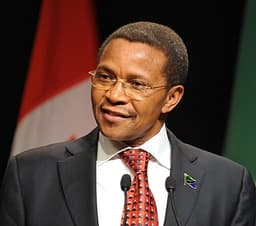
Jakaya Kikwete
Politician · Modern
50.6Total

Moncef Marzouki
Politician · Modern
48.8Total
Basic Information
Born
1950
1945
Died
—
—
Era
Modern
Modern
Nationality
Tanzania
Tunisia
Occupation
Politician
Politician
Civilization
Other
Middle Eastern
Score Comparison
Military (10%)
40.0
40.4
Political (20%)
53.8
68.0
Influence (20%)
54.1
54.1
Legacy (20%)
41.7
43.3
Leadership (15%)
72.0
40.0
Strategy (15%)
38.3
42.4
TOTAL
50.6
48.8
Jakaya Kikwete — Complete Timeline
2005 AD
Became President of TanzaniaPolitical Action◆ Major
Jakaya Kikwete was elected President of Tanzania, succeeding Benjamin Mkapa. He won with over 80% of the vote, continuing the dominance of the Chama Cha Mapinduzi (CCM) party. His presidency focused on economic growth, infrastructure, and social services.
PresidencyElectionCCM
Impact: nationalconstructive
2009 AD
Launched Kilimo Kwanza (Agriculture First) InitiativeReform◆ Major
Kikwete launched the Kilimo Kwanza initiative to modernize agriculture, increase productivity, and ensure food security. The program aimed to transform Tanzania into a regional food exporter by providing subsidies, irrigation, and access to credit for farmers.
AgricultureKilimo KwanzaFood Security
Impact: nationalconstructive
2010 AD
Oversaw Economic Growth and Gas DiscoveriesOther◆ Major
Under Kikwete, Tanzania experienced sustained economic growth averaging 6-7% annually, driven by mining, tourism, and construction. Major natural gas discoveries off the coast of Mtwara raised hopes for energy exports, but development was slow due to regulatory and investment challenges.
Economic GrowthNatural GasEnergy
Impact: nationalconstructive
2015 AD
Faced Zanzibar Political CrisisPolitical Action
Kikwete's government faced a political crisis in Zanzibar after disputed elections in 2015, which were annulled by the Zanzibar Electoral Commission. The opposition Civic United Front (CUF) boycotted the rerun, leading to a one-party government in Zanzibar and increased tensions.
ZanzibarElection DisputePolitical Crisis
Impact: regionaldestructive
Stepped Down After Two TermsPolitical Action◆ Major
Kikwete stepped down after completing his two-term limit, handing power to his successor, John Magufuli. His peaceful transfer of power reinforced Tanzania's reputation for political stability in a region often marked by coups and extended presidencies.
Term LimitsSuccessionDemocracy
Impact: nationalconstructive
Moncef Marzouki — Complete Timeline
2001 AD
Founding of the Congress for the Republic partyPolitical Action
Marzouki founded the Congress for the Republic (CPR) party as a secular, left-leaning opposition movement. The party was banned under President Zine El Abidine Ben Ali, forcing Marzouki into exile in France.
Political PartyOpposition
Impact: nationalconstructive
2011 AD
Election as President of TunisiaPolitical Action◆ Major
Following the Tunisian Revolution, the Constituent Assembly elected Moncef Marzouki as President of Tunisia. He became the first democratically elected president in the country's history, serving from 2011 to 2014.
DemocracyArab SpringElection
Impact: nationalprogressive
2014 AD
Tunisian Constitution of 2014Reform◆ Major
Marzouki oversaw the adoption of a new constitution, which established a mixed presidential-parliamentary system, guaranteed human rights, and enshrined gender equality. The constitution was widely praised as a model for the Arab world.
ConstitutionReformDemocracy
Impact: nationalconstructive
Defeat in 2014 presidential electionPolitical Action◆ Major
Marzouki lost the presidential runoff to Beji Caid Essebsi, receiving 44.3% of the vote. This marked the first peaceful democratic transfer of power in Tunisia's history.
ElectionDemocracy
Impact: national
Expert Analysis
Origins
Jakaya Kikwete was born on October 7, 1950, in Msoga, Tanzania, to a farming family. He studied economics at the University of Dar es Salaam, graduating in 1975. Kikwete joined the ruling Chama Cha Mapinduzi (CCM) party and served in various government roles, including Minister of Foreign Affairs and Minister of Finance.
Moncef Marzouki was born on July 7, 1945, in Grombalia, Tunisia, to a family of landowners. He studied medicine at the University of Tunis and later specialized in neurology in France. Marzouki was a human rights activist and founder of the National Council for Freedoms in Tunisia, opposing the regime of Zine El Abidine Ben Ali.
Rise to Power
Kikwete rose through the ranks of CCM, serving as Minister of Foreign Affairs from 1995 to 2005, where he gained international recognition for his role in African peace processes. In 2005, he won the presidential election with over 80% of the vote, succeeding Benjamin Mkapa.
Marzouki was a long-time opposition figure. After the Tunisian Revolution in 2011, his party, the Congress for the Republic (CPR), gained seats in the Constituent Assembly. On December 12, 2011, the assembly elected him as interim president. He served until 2014, overseeing the drafting of a new constitution.
Leadership & Governance
Kikwete's leadership focused on economic growth and infrastructure. He launched the Kilimo Kwanza (Agriculture First) initiative in 2009 to modernize agriculture. Under his tenure, Tanzania's GDP grew at 6-7% annually, driven by mining, tourism, and construction. Major natural gas discoveries in 2010 boosted prospects. However, critics note limited progress in reducing poverty and corruption.
Marzouki's main achievement was overseeing Tunisia's democratic transition. He championed the 2014 constitution, which established a mixed presidential-parliamentary system and guaranteed civil liberties. His leadership style was inclusive but often clashed with Prime Minister Ali Larayedh and the dominant Ennahda party. Marzouki scored 40.0 in leadership, reflecting his constrained authority as president.
Triumph & Tragedy
Kikwete's triumphs include sustained economic growth, the peaceful transfer of power in 2015, and maintaining stability in a volatile region. His failures include the Zanzibar political crisis after disputed elections in 2015, which damaged his reputation for democratic governance. Also, his anticorruption efforts were seen as inadequate.
Marzouki's triumph was guiding Tunisia through a successful democratic transition, adopting a progressive constitution in 2014. His failure was his defeat in the 2014 presidential election, receiving only 44.3% of the vote, and his subsequent exile. He was criticized for being divisive and ineffective in managing the economy, with Tunisia facing terrorist attacks and economic stagnation.
Character & Destiny
Kikwete was known as a conciliatory and diplomatic figure, preferring consensus. His character led to stability but also indecisiveness on corruption. His decision to step down after two terms reinforced democratic norms, but his handling of Zanzibar showed a reluctance to confront allies.
Marzouki was a principled activist, often confrontational. His character drove the democratic transition but also created conflicts with other political actors. His inability to form a broad coalition led to his electoral defeat. Historians note his idealism sometimes outpaced political reality.
Legacy
Kikwete's legacy includes Tanzania's economic growth, the discovery of natural gas, and a peaceful transfer of power. However, his impact on poverty reduction and corruption is limited. He scored 41.7 in legacy.
Marzouki's legacy is tied to Tunisia's democratic transition. The 2014 constitution is a landmark for human rights in the Arab world. But his personal political legacy is overshadowed by the success of the transition itself. He scored 43.3 in legacy.
Conclusion
Comparing their overall impact, Kikwete's total score of 50.6 edges Marzouki's 48.8. Kikwete had stronger economic outcomes and maintained stability, while Marzouki oversaw a historic political transformation. However, Marzouki's role in establishing democracy in a region where it remains fragile may have longer-lasting significance. The data supports that Kikwete's governance was more effective in terms of growth and stability, but Marzouki's contribution to democratic norms is unique. Therefore, Kikwete had greater immediate impact, but Marzouki's legacy may prove more transformative in the long run.
Rankings
🥇
Jakaya KikweteLeader
Mil: 40.0Pol: 53.8Inf: 54.1
50.6
🥈
Moncef Marzouki
Mil: 40.4Pol: 68.0Inf: 54.1
48.8
+1.8 behind
How This Comparison Works
Algorithm
Each figure is scored on 6 dimensions (0—100 scale) based on structured historical data: Military (10%), Political (20%), Influence (20%), Legacy (20%), Leadership (15%), Strategy (15%). The weighted total produces the final ranking.
Data Sources
Scores are computed from structured sub-indicators in the database. Scale factors adjust for era (Ancient ×0.85, Modern ×1.0) and civilization size (Eastern ×1.05, Other ×0.80) to account for differences in population and military scale.
Maximum 3 Figures
Comparisons are limited to 2—3 figures to ensure readability and statistical meaningfulness.
Error Margins
±5 points per dimension — Sub-scores are derived from historical records with inherent uncertainty. Two figures within 5 points on a dimension should be considered roughly equivalent in that area.
Total Score Accuracy
±3 points overall — The weighted combination of 6 dimensions produces a total score with approximately ±3 points of uncertainty. Differences of less than 3 points are not statistically significant— the figures are effectively tied.
Known Limitations
- Historical records are incomplete and uneven across civilizations
- Figures from oral-tradition societies may be underrepresented
- Occupation labels can misclassify multi-role figures
- Scores measure capability and impact, not moral character
- Quantitative scoring is a comparison tool, not absolute truth
Capability Radar
Military (10%) — Battles & Warfare
Battles
0
24
Win Rate
0
23
Expansion
0
26
Political (20%) — Governance & Reform
Reform
55
55
Diplomacy
65
50
Economy
55
40
Influence (20%) — Cultural & Global Reach
Cultural
30
30
Global
35
35
Legacy (20%) — Historical Impact
Historical
30
40
Longevity
20
20
Leadership (15%) — Power & Stability
Tenure
60
60
Stability
60
35
Strategy (15%) — Tactics & Innovation
Strategy
0
28
Tactics
0
35
Reform
10
38
Similar Comparisons
Comments & Discussion
No comments yet. Be the first to share your thoughts!