Loading...
Isabella II of Spain vs Joseph Bonaparte
Isabella II of Spain leads by 5.2 pts · 2 figures compared
…
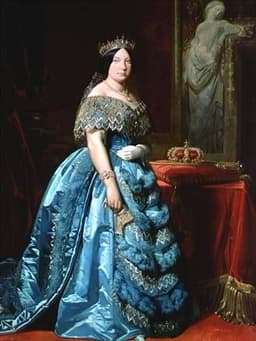
Isabella II of Spain
Emperor · Modern
46.5Total

Joseph Bonaparte
Emperor · Modern
41.3Total
Basic Information
Born
1830
1768
Died
1904
1844
Era
Modern
Modern
Nationality
Spain
Spain
Occupation
Emperor
Emperor
Civilization
Western
Western
Score Comparison
Military (10%)
24.4
14.9
Political (20%)
35.1
33.6
Influence (20%)
51.0
50.2
Legacy (20%)
41.7
38.3
Leadership (15%)
65.7
48.4
Strategy (15%)
57.8
54.3
TOTAL
46.5
41.3
Isabella II of Spain — Complete Timeline
1833 AD
First Carlist WarWar◆ Major
The First Carlist War broke out between the Isabelline forces (liberals) and the Carlists (absolutists). The war lasted until 1840 and ended with the defeat of the Carlists, but left Spain politically divided.
Civil WarCarlist WarsLiberal vs Absolutist
Impact: nationaldestructive
Accession to the thronePolitical Action◆ Major
Isabella II became Queen of Spain at age three after the death of her father Ferdinand VII. Her minority sparked the First Carlist War between supporters of Isabella and those of her uncle Carlos.
SuccessionCarlist WarsRegency
Impact: national
1843 AD
Declaration of majorityPolitical Action◆ Major
Isabella II was declared of age at 13, ending the regency of General Espartero. Her personal rule was marked by instability, with frequent changes of government and military interventions.
RegencyMonarchyPolitical Instability
Impact: national
1868 AD
Revolution of 1868 and exilePolitical Action
The Glorious Revolution (La Gloriosa) overthrew Isabella II, who fled to France. The revolution ended the Bourbon monarchy and led to the Sexenio Democr
RevolutionExileBourbon Restoration
Impact: nationaltragic
Joseph Bonaparte — Complete Timeline
1808 AD
Battle of BailénWar◆ Major
Spanish forces defeated a French army at Bail
Peninsular WarBattleDefeat
Impact: regional
Promulgation of the Bayonne ConstitutionReform◆ Major
Joseph Bonaparte issued the Bayonne Constitution, a liberal charter that introduced reforms such as freedom of the press and abolition of the Inquisition. The constitution was rejected by most Spaniards as imposed by a foreign ruler.
ConstitutionReformNapoleonic Wars
Impact: nationalconstructive
Appointment as King of SpainPolitical Action◆ Major
Napoleon appointed his brother Joseph as King of Spain after the abdication of Charles IV and Ferdinand VII. Joseph's rule was opposed by the Spanish populace and led to the Peninsular War.
Napoleonic WarsMonarchyOccupation
Impact: nationaldestructive
1813 AD
Abdication and exilePolitical Action
After the French defeat at the Battle of Vitoria, Joseph Bonaparte abdicated the Spanish throne and fled to France. He later lived in exile in the United States and Italy, never regaining power.
AbdicationExilePeninsular War
Impact: nationaltragic
Expert Analysis
Origins
Isabella II was born on October 10, 1830, in Madrid, the daughter of King Ferdinand VII and his fourth wife, Maria Christina of Bourbon-Two Sicilies. Her birth was politically significant because Ferdinand had issued the Pragmatic Sanction of 1830, which abolished the Salic Law that barred females from the throne. This act set the stage for the Carlist Wars. Isabella was raised in a sheltered court environment, dominated by her mother's regency and the influence of military figures. Her education was limited, focusing on religious and social graces rather than statecraft, leaving her ill-prepared for the political turmoil ahead.
Joseph Bonaparte was born on January 7, 1768, in Corte, Corsica, to Carlo Buonaparte and Letizia Ramolino. He was the elder brother of Napoleon Bonaparte. Joseph studied law at the University of Pisa and initially pursued a diplomatic and legal career. He served as a diplomat for the French Republic, negotiating treaties and representing French interests. His early life was marked by loyalty to his brother, and he benefited from Napoleon's rise, being appointed to various positions including King of Naples in 1806 before being transferred to Spain in 1808.
Rise to Power
Isabella II became queen at the age of three upon the death of her father Ferdinand VII on September 29, 1833. Her mother, Maria Christina, served as regent. The succession dispute immediately sparked the First Carlist War (1833-1840) between the Isabelline forces (liberals) and the Carlists (absolutists) who supported Ferdinand's brother, Carlos. The war ended with the Convention of Vergara in 1839, but Isabella's rule remained unstable. In 1843, at age 13, she was declared of age, ending the regency of General Espartero. Her personal rule began amid political infighting, with military generals and factions vying for control.
Joseph Bonaparte was appointed King of Spain by his brother Napoleon on June 6, 1808, after the abdications of Charles IV and Ferdinand VII at Bayonne. Joseph had previously been King of Naples, but Napoleon needed a loyal figure in Spain during the Peninsular War. Joseph arrived in Madrid in July 1808, but his rule was immediately contested by Spanish patriots who launched a guerrilla war. The Bayonne Constitution, a liberal charter, was promulgated in July 1808, but it failed to gain support from the Spanish elites or populace.
Leadership & Governance
Isabella II's leadership was characterized by weakness and dependence on military strongmen. She frequently changed governments—over 30 cabinets during her reign—and was accused of favoritism and corruption. Her political score of 35.1 reflects her inability to stabilize the government. She relied on the Moderate Party and generals like Ramón María Narváez, who effectively ruled during her reign. Isabella's involvement in military matters was minimal, reflected in her military score of 24.4. She did not lead troops or formulate strategy.
Joseph Bonaparte attempted to implement liberal reforms through the Bayonne Constitution, which included freedom of the press, abolition of the Inquisition, and land reforms. However, his governance was undermined by the ongoing war and his dependence on French military support. He lacked authority and was seen as a puppet king. His political score of 33.6 is similar to Isabella's, but his leadership score of 48.4 is lower due to his inability to command loyalty. He tried to negotiate with Spanish factions but failed to gain legitimacy.
Triumph & Tragedy
Isabella II's greatest success was surviving the Carlist Wars and maintaining the Bourbon dynasty on the throne. The Convention of Vergara in 1839 secured her position, but the war left deep divisions. Her greatest failure was her inability to provide stable governance, leading to the Glorious Revolution of 1868 that overthrew her. She fled to France, and her exile marked the end of her reign. Her legacy score of 41.7 reflects her mixed impact.
Joseph Bonaparte's triumph was the promulgation of the Bayonne Constitution, which introduced liberal ideas to Spain. However, his greatest failure was his complete rejection by the Spanish people. The Battle of Bailén in 1808 forced him to flee Madrid, and the French defeat at Vitoria in 1813 ended his rule. He abdicated in December 1813 and lived in exile. His military score of 14.9 is the lowest, reflecting his lack of battlefield success.
Character & Destiny
Isabella II was described as capricious and influenced by court favorites. Her personal life was scandalous; she had numerous lovers and was rumored to be illegitimate. Her character contributed to her downfall as she alienated key political factions. Historical assessments note her lack of political acumen. She scored 65.7 in leadership, but this is inflated by her symbolic role as queen.
Joseph Bonaparte was a conciliatory figure, seeking to win over Spaniards through reforms, but he was indecisive and overly reliant on Napoleon. He lacked the ruthlessness needed to suppress opposition. His strategy score of 54.3 suggests some tactical sense, but his overall impact was limited. He died in 1844 in Florence.
Legacy
Isabella II's legacy is one of instability and the weakening of the Spanish monarchy. Her reign saw the rise of military intervention in politics, setting a precedent for future coups. The Carlist Wars she sparked continued intermittently. She is remembered as a symbol of a failed monarchy. Her influence score of 51.0 is moderate.
Joseph Bonaparte's legacy is tied to the Peninsular War and the introduction of liberal reforms. The Bayonne Constitution influenced later Spanish constitutions. However, he is largely viewed as a foreign usurper. His legacy score of 38.3 is lower. His influence score of 50.2 is similar due to his role in spreading Napoleonic ideas.
Conclusion
Isabella II had a greater impact on Spain than Joseph Bonaparte, as her reign shaped the country's political development for decades. Despite her weaknesses, she served as a monarch for 35 years, during which the foundations of modern Spanish liberalism and conservatism were forged. Joseph's rule lasted only five years and was constantly contested. Isabella's total score of 46.5 versus Joseph's 41.3 reflects her higher political and legacy scores. While both were flawed rulers, Isabella's longer tenure and the dynastic conflict she engendered had more lasting consequences for Spain's history.
Rankings
🥇
Isabella II of SpainLeader
Mil: 24.4Pol: 35.1Inf: 51.0
46.5
🥈
Joseph Bonaparte
Mil: 14.9Pol: 33.6Inf: 50.2
41.3
+5.2 behind
How This Comparison Works
Algorithm
Each figure is scored on 6 dimensions (0—100 scale) based on structured historical data: Military (10%), Political (20%), Influence (20%), Legacy (20%), Leadership (15%), Strategy (15%). The weighted total produces the final ranking.
Data Sources
Scores are computed from structured sub-indicators in the database. Scale factors adjust for era (Ancient ×0.85, Modern ×1.0) and civilization size (Eastern ×1.05, Other ×0.80) to account for differences in population and military scale.
Maximum 3 Figures
Comparisons are limited to 2—3 figures to ensure readability and statistical meaningfulness.
Error Margins
±5 points per dimension — Sub-scores are derived from historical records with inherent uncertainty. Two figures within 5 points on a dimension should be considered roughly equivalent in that area.
Total Score Accuracy
±3 points overall — The weighted combination of 6 dimensions produces a total score with approximately ±3 points of uncertainty. Differences of less than 3 points are not statistically significant— the figures are effectively tied.
Known Limitations
- Historical records are incomplete and uneven across civilizations
- Figures from oral-tradition societies may be underrepresented
- Occupation labels can misclassify multi-role figures
- Scores measure capability and impact, not moral character
- Quantitative scoring is a comparison tool, not absolute truth
Capability Radar
Military (10%) — Battles & Warfare
Battles
36
10
Win Rate
37
5
Expansion
42
5
Political (20%) — Governance & Reform
Reform
20
20
Diplomacy
25
20
Economy
15
15
Influence (20%) — Cultural & Global Reach
Cultural
20
15
Global
15
15
Legacy (20%) — Historical Impact
Historical
30
20
Longevity
20
10
Leadership (15%) — Power & Stability
Tenure
60
30
Stability
5
10
Strategy (15%) — Tactics & Innovation
Strategy
45
5
Tactics
51
5
Reform
49
5
Similar Comparisons
Comments & Discussion
No comments yet. Be the first to share your thoughts!