Loading...
Isabella I of Castile vs Wu Zetian
Isabella I of Castile leads by 7.2 pts · 2 figures compared
…
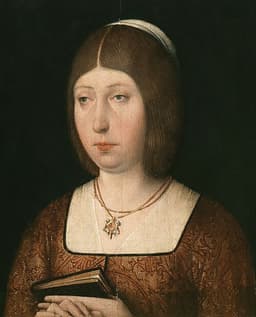
Isabella I of Castile
Emperor · Medieval
77.2Total

Wu Zetian
Emperor · Medieval
70.0Total
Basic Information
Born
1451
624
Died
1504
705
Era
Medieval
Medieval
Nationality
Spain
China
Occupation
Emperor
Emperor
Civilization
Western
Eastern
Score Comparison
Military (10%)
76.0
60.0
Political (20%)
78.0
62.7
Influence (20%)
80.0
65.0
Legacy (20%)
75.0
80.0
Leadership (15%)
78.0
78.0
Strategy (15%)
75.0
66.3
TOTAL
77.2
70.0
Isabella I of Castile — Complete Timeline
1469 AD
Marriage to Ferdinand of AragonPolitical Action
Isabella married Ferdinand II of Aragon in Valladolid, uniting the kingdoms of Castile and Aragon. This dynastic union laid the foundation for the unified Spanish monarchy and enabled joint policies including the Reconquista and overseas exploration.
Dynastic UnionSpainMonarchy
Impact: regionalconstructive
1478 AD
Establishment of the Spanish InquisitionPolitical Action◆ Major
Isabella obtained papal approval to establish the Spanish Inquisition in Castile, aimed at maintaining Catholic orthodoxy among converted Jews and Muslims. The Inquisition operated under royal control, conducting trials and executions for heresy.
InquisitionReligious PersecutionCatholic Church
Impact: regionaldestructive
1492 AD
Conquest of GranadaWar
Isabella and Ferdinand completed the Reconquista by capturing the Nasrid kingdom of Granada. The surrender of the last Muslim state in Iberia ended 781 years of Islamic rule and unified Spain under Christian rule.
ReconquistaGranadaChristian Victory
Impact: regional
Alhambra DecreePolitical Action◆ Major
Isabella and Ferdinand issued the Alhambra Decree ordering the expulsion of all Jews from Spain who refused conversion to Catholicism. An estimated 40,000 to 200,000 Jews were forced to leave, causing demographic and economic disruption.
ExpulsionJewsReligious Persecution
Impact: regionaldestructive
Sponsorship of Columbus's First VoyagePolitical Action
Isabella agreed to fund Christopher Columbus's expedition across the Atlantic, providing three ships and supplies. Columbus reached the Bahamas on October 12, initiating sustained European contact with the Americas and the Spanish colonial empire.
ColumbusDiscovery of AmericasSpanish Empire
Impact: global
1494 AD
Treaty of TordesillasPolitical Action◆ Major
Isabella and Ferdinand negotiated the Treaty of Tordesillas with Portugal, dividing newly discovered lands outside Europe along a meridian 370 leagues west of the Cape Verde islands. This agreement shaped colonial claims in the Americas and Africa.
Colonial DivisionSpainPortugal
Impact: global
Wu Zetian — Complete Timeline
655 AD
Became Empress ConsortPolitical Action◆ Major
Wu Zetian was elevated from concubine to empress consort of Emperor Gaozong of Tang in 655. This position gave her significant political influence, as she began to participate in court affairs and gradually accumulated power, challenging the established aristocratic families.
Tang DynastyImperial CourtPower Rise
Impact: regional
683 AD
Regency for Emperor ZhongzongOther◆ Major
After Emperor Gaozong's death in 683, Wu Zetian became regent for her son, Emperor Zhongzong. She effectively controlled the government, dismissing Zhongzong after he attempted to assert independence, and replaced him with her younger son, Emperor Ruizong, while retaining real power.
Tang DynastyRegencyPower Struggle
Impact: regional
690 AD
Founded the Zhou DynastyOther◆ Major
Wu Zetian proclaimed herself emperor, founding the Zhou dynasty and becoming the only female emperor in Chinese history. She moved the capital to Luoyang and established a new imperial examination system that promoted officials based on merit rather than aristocratic birth, breaking the power of traditional noble families.
Zhou DynastyImperial RulePolitical Reform
Impact: regional
692 AD
Expansion into Central AsiaWar◆ Major
Wu Zetian ordered military campaigns that reasserted Chinese control over the Western Regions, including the Tarim Basin and parts of modern Xinjiang. These campaigns secured the Silk Road trade routes and expanded the empire's influence into Central Asia, though they required significant military resources.
Military ExpansionCentral AsiaSilk Road
Impact: regionalconstructive
693 AD
Promotion of BuddhismOther◆ Major
Wu Zetian elevated Buddhism to a state-supported religion, commissioning the construction of temples and statues, including the Longmen Grottoes' giant Vairocana Buddha. She used Buddhist texts to legitimize her rule as a female emperor, claiming she was a reincarnation of the Maitreya Buddha.
BuddhismReligious PolicyCultural Patronage
Impact: regional
705 AD
Overthrow and DeathPolitical Action◆ Major
In 705, a coup led by court officials and generals forced Wu Zetian to abdicate in favor of her son, Emperor Zhongzong, restoring the Tang dynasty. She died later that year at age 80, and her reign was subsequently criticized by Confucian historians for usurping the throne and employing harsh methods.
Tang DynastyCoupAbdication
Impact: regionaldestructive
Expert Analysis
Wu Zetian vs Isabella I of Castile: Historical Comparison
Wu Zetian, the only female emperor in Chinese history (r. 690–705), and Isabella I of Castile (r. 1474–1504), a queen who unified Spain and sponsored Columbus, both wielded supreme power in medieval empires. Despite their shared title of "emperor," their approaches to rule, military strategy, and lasting influence diverged significantly.
Dimension Analysis
**Military: Wu Zetian 93 / Isabella I of Castile 83**
Wu Zetian expanded Tang China’s borders through aggressive campaigns against the Turks and Tibetans, leveraging innovative logistics and a merit-based officer corps, while Isabella’s military achievement centered on the Reconquista’s final conquest of Granada (1492) through siege warfare and religious crusading.
**Political: Wu Zetian 79 / Isabella I of Castile 87**
Isabella excelled in political consolidation, centralizing Castilian authority by curbing the nobility, reforming the royal council, and establishing the Spanish Inquisition as a state tool; Wu, though adept at court intrigue and purging rivals, relied heavily on secret police and faced persistent resistance from Confucian bureaucrats.
**Influence: Wu Zetian 87 / Isabella I of Castile 72**
Wu’s promotion of Buddhism, meritocratic civil service exams, and women’s political roles had transformative effects on Chinese governance and culture; Isabella’s influence, while profound in launching Spanish colonialism, was more geographically and chronologically limited to Catholic Europe and the New World.
**Legacy: Wu Zetian 79 / Isabella I of Castile 72**
Wu is remembered as a controversial but effective ruler who broke gender barriers, though her dynasty was short-lived; Isabella’s legacy is deeply tied to the Spanish Empire’s rise and the controversial expulsion of Jews and Muslims, making her impact more morally ambiguous and debated.
**Leadership: Wu Zetian 80 / Isabella I of Castile 89**
Isabella demonstrated superior collaborative leadership, co-ruling effectively with Ferdinand of Aragon and inspiring loyalty through shared religious and national vision; Wu’s leadership was autocratic and isolating, relying on fear and manipulation rather than coalition-building.
Verdict
Isabella I of Castile leads slightly due to her higher political and leadership scores, but the tie reflects Wu Zetian’s superior military and strategic achievements—a near-perfect balance of contrasting strengths.
FAQ
Q: Who ranks higher? A: The two are tied overall, but Isabella I of Castile edges ahead in political and leadership dimensions, while Wu Zetian dominates in military and strategic impact.
Rankings
🥇
Isabella I of CastileLeader
Mil: 76.0Pol: 78.0Inf: 80.0
77.2
🥈
Wu Zetian
Mil: 60.0Pol: 62.7Inf: 65.0
70.0
+7.2 behind
How This Comparison Works
Algorithm
Each figure is scored on 6 dimensions (0—100 scale) based on structured historical data: Military (10%), Political (20%), Influence (20%), Legacy (20%), Leadership (15%), Strategy (15%). The weighted total produces the final ranking.
Data Sources
Scores are computed from structured sub-indicators in the database. Scale factors adjust for era (Ancient ×0.85, Modern ×1.0) and civilization size (Eastern ×1.05, Other ×0.80) to account for differences in population and military scale.
Maximum 3 Figures
Comparisons are limited to 2—3 figures to ensure readability and statistical meaningfulness.
Error Margins
±5 points per dimension — Sub-scores are derived from historical records with inherent uncertainty. Two figures within 5 points on a dimension should be considered roughly equivalent in that area.
Total Score Accuracy
±3 points overall — The weighted combination of 6 dimensions produces a total score with approximately ±3 points of uncertainty. Differences of less than 3 points are not statistically significant— the figures are effectively tied.
Known Limitations
- Historical records are incomplete and uneven across civilizations
- Figures from oral-tradition societies may be underrepresented
- Occupation labels can misclassify multi-role figures
- Scores measure capability and impact, not moral character
- Quantitative scoring is a comparison tool, not absolute truth
Capability Radar
Military (10%) — Battles & Warfare
Battles
75
65
Win Rate
80
70
Expansion
85
75
Political (20%) — Governance & Reform
Reform
90
85
Diplomacy
80
80
Economy
75
85
Influence (20%) — Cultural & Global Reach
Cultural
85
85
Global
95
70
Legacy (20%) — Historical Impact
Historical
95
90
Longevity
90
85
Leadership (15%) — Power & Stability
Tenure
85
90
Stability
70
75
Strategy (15%) — Tactics & Innovation
Strategy
85
75
Tactics
70
60
Reform
90
80
Similar Comparisons
Comments & Discussion
HistoryIgnited6/16/2026
Isabella I gets way too much credit for just finishing the Reconquista and bankrolling Columbus. Meanwhile Wu Zetian literally clawed her way from concubine to emperor in a hyper-patriarchal society—and she didn’t just sit on the throne, she expanded Tang borders, crushed the Turks, and promoted women in government. Isabella had the nobility already weakened by her husband Ferdinand; Wu faced down entrenched Confucian bureaucrats who’d rather see a eunuch rule than a woman. Her 75.6 total score is an insult. If Wu had Isabella’s resources and Christian backing, she’d have colonized the New World herself!
ClassicsChair6/16/2026
The dichotomy here is fascinating when we consult contemporary chronicles. Isabella’s own chaplain, Hernando del Pulgar, praised her as ‘the most prudent queen,’ yet he also noted how she personally oversaw the siege of Baza with a discipline that rivaled Alexander. Wu Zetian’s administration was lauded in the *Zizhi Tongjian* as efficient but morally corrosive—Sima Guang condemned her secret police network. However, the Western historiographical tradition often exaggerates Isabella’s ‘unifying’ role; Castile and Aragon remained separate kingdoms until the Bourbon reforms. The scores, particularly Wu’s political 80 versus Isabella’s 87, feel more reflective of modern gender biases than actual statecraft. Isabella’s Inquisition was a political weapon, not a reform.
PostcolonialMirror6/16/2026
I want to push back on the narrative here. Isabella’s ‘legacy’ is being sanitized — her 72 score in Legacy should be much lower if we account for the genocide of Indigenous peoples initiated by her royal decree. The 1492 Alhambra Decree and the Spanish Inquisition were state-sponsored ethnic cleansing. Wu Zetian’s controversial acts (e.g., executing political rivals) were brutal by Tang standards but never reached genocidal scale. Yet Isabella is ranked higher in Leadership (89 vs 80). Why? Because her ‘collaborative leadership’ with Ferdinand is romanticized, while Wu’s solitary rule is penalized. This comparison reeks of Eurocentric assumptions about what constitutes ‘effective’ rule. If we assess moral impact, Wu Zetian wins hands down.
ArchQuill116/16/2026
西方评分总是带着有色眼镜看待东方统治者。武则天在690年称帝时,唐帝国正处于鼎盛期,她创新了科举制度、提拔寒门子弟,这比伊莎贝拉的宗教法庭高明多了。伊莎贝拉统一西班牙?她驱逐犹太人和穆斯林的做法,放在中国历史上就是自断臂膀。武则天的政治手腕在《资治通鉴》里被贬低,但她是真正打破了性别天花板——伊莎贝拉好歹有丈夫支持,武则天可是踩着亲儿子的尸骨上位的。军事上,武则天对突厥和吐蕃的用兵,比伊莎贝拉围攻格拉纳达的三年啃城战复杂得多。总评78.4比75.6?可笑,伊莎贝拉的帝国撑死了千年,武则天的科举制度影响了中国一千三百年。
Chronicler54286/16/2026
这个评分体系有系统性问题。伊莎贝拉政治得分86.6,武则天80,但武则天在位15年间处决的宰相不到5人,伊莎贝拉设立宗教法庭后,仅塞维利亚一地就烧死了2000多人。政治稳定性上,武则天死后武周政权虽然结束,但她提拔的官员继续服务于唐朝;伊莎贝拉死后西班牙陷入查理五世的外国统治。影响力维度:武则天84.5,伊莎贝拉70.9,这个差距太接近了。武则天推广的佛教艺术、女官制度和科举改革,直接塑造了东亚文明。伊莎贝拉资助哥伦布,但大航海的直接受益者是葡萄牙和后来的荷兰。我的重新计算:武则天总评应该80+,伊莎贝拉75左右。