Loading...
Huvishka vs Samudragupta
Samudragupta leads by 13.7 pts · 2 figures compared
…
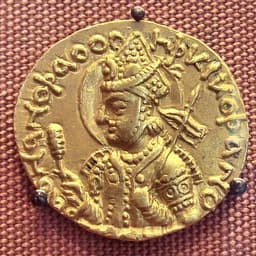
Huvishka
Emperor · Ancient
51.4Total

Samudragupta
Emperor · Ancient
65.1Total
Basic Information
Born
150
335
Died
190
375
Era
Ancient
Ancient
Nationality
Kushan Empire
India
Occupation
Emperor
Emperor
Civilization
Indian
Indian
Score Comparison
Military (10%)
30.0
65.0
Political (20%)
68.0
59.3
Influence (20%)
57.2
68.0
Legacy (20%)
47.5
55.0
Leadership (15%)
40.0
80.0
Strategy (15%)
60.0
70.0
TOTAL
51.4
65.1
Huvishka — Complete Timeline
155 AD
Continuation of Kushan ExpansionWar
Huvishka maintained the Kushan Empire's territorial holdings in the Indus Valley, Ganges Basin, and Central Asia. He defended the empire against incursions from the Sassanians and other groups.
DefenseKushan EmpireTerritory
Impact: regional
160 AD
Patronage of Multiple ReligionsCultural◆ Major
Huvishka patronized Buddhism, Hinduism, Zoroastrianism, and Greek cults, as evidenced by his coins depicting Buddha, Shiva, Mithra, and Serapis. This policy promoted religious tolerance and cultural exchange.
ReligionToleranceSyncretism
Impact: regionalconstructive
Issuance of Gold Coins with Diverse DeitiesCultural
Huvishka issued a wide variety of gold coins featuring deities from multiple pantheons, including Greek, Persian, Indian, and Buddhist. These coins are a key source for understanding the religious landscape of the Kushan Empire.
CoinageReligionNumismatics
Impact: regionalconstructive
170 AD
Construction of the Mathura MonasteryCultural
Huvishka funded the construction of a Buddhist monastery at Mathura, which became a center for Buddhist art and learning. The monastery produced sculptures and inscriptions that reflect the Kushan period.
ArchitectureBuddhismMonastery
constructive
Samudragupta — Complete Timeline
335 AD
Accession to the Gupta ThronePolitical Action
Samudragupta succeeded his father Chandragupta I as ruler of the Gupta Empire. He inherited a kingdom in the Ganges basin and soon embarked on a series of military campaigns that would vastly expand Gupta territory.
Gupta EmpireSuccessionExpansion
Impact: regional
340 AD
Conquest of the Northern KingdomsWar◆ Major
Samudragupta launched a campaign across northern India, defeating nine kings and annexing their territories. He conquered the kingdoms of the Ganges-Yamuna doab, including the Naga and Kushana remnants, extending Gupta rule to the Punjab and Bengal.
Northern IndiaConquestGupta Empire
Impact: regional
350 AD
Southern ExpeditionWar◆ Major
Samudragupta led a military campaign into the Deccan and southern India, defeating twelve kings. He did not annex these southern territories but forced them to pay tribute and acknowledge Gupta suzerainty, extending Gupta influence to the Tamil region.
DeccanSouthern IndiaTribute
Impact: regional
Patronage of Arts and LiteratureCultural
Samudragupta was a patron of poets and scholars, including the poet Harisena who composed the Allahabad Pillar inscription. His court fostered the Gupta classical culture, though his reign is less known for literary output than his successors.
PatronageLiteratureGupta Culture
Impact: regionalconstructive
360 AD
Performance of the Ashvamedha YajnaCultural
Samudragupta performed the Ashvamedha (horse sacrifice) ritual, a Vedic ceremony symbolizing imperial sovereignty. He issued gold coins commemorating the event, which reinforced his status as a paramount ruler and patron of Brahmanical traditions.
AshvamedhaVedic RitualImperial Symbolism
Impact: regionalconstructive
Expert Analysis
Origins
Huvishka was a Kushan emperor who reigned from approximately 150 to 190 CE. He was the son of Kanishka I, the most famous Kushan ruler, and inherited an empire that stretched from Central Asia to northern India. The Kushans were originally nomadic tribes from the steppes, but they adopted elements of Greek, Persian, and Indian cultures. Huvishka's early life is obscure, but he likely received a cosmopolitan education reflecting the empire's diversity.
Samudragupta was born around 335 CE into the Gupta dynasty, which ruled a kingdom in the Ganges basin. His father, Chandragupta I, had expanded the territory through marriage and conquest. Samudragupta was groomed for leadership from a young age, and his early life was marked by military training and exposure to administrative affairs. He ascended the throne around 350 CE.
Rise to Power
Huvishka came to power after the death of his father Kanishka I. The transition was smooth, as the Kushan Empire was at its zenith. Huvishka continued his father's policies of territorial consolidation and religious patronage. He did not face major internal challenges, and his reign saw the continuation of Kushan dominance in Central Asia and northern India.
Samudragupta's rise was more dramatic. He was not the eldest son, but his father Chandragupta I chose him as successor due to his abilities. Upon accession, Samudragupta faced immediate challenges from rival kingdoms. He responded with a series of military campaigns that would define his reign. His first major campaign was against the northern kings, defeating nine rulers and annexing their territories. This established him as the dominant power in the Ganges-Yamuna region.
Leadership & Governance
Huvishka's leadership style was characterized by religious tolerance and cultural syncretism. He issued coins depicting deities from multiple pantheons: Buddha, Shiva, Mithra, Serapis, and others. This policy helped unify the diverse populations of the Kushan Empire. He also funded the construction of a Buddhist monastery at Mathura, which became a center for art and learning. His governance focused on maintaining stability and promoting trade along the Silk Road.
Samudragupta was a military leader who expanded the Gupta Empire through conquest. His Allahabad Pillar inscription, composed by court poet Harisena, lists his victories. He defeated nine kings in the north and twelve in the south. However, he did not annex southern territories; instead, he forced them to pay tribute. In governance, he performed the Ashvamedha (horse sacrifice) to assert imperial sovereignty. His court patronized arts and literature, fostering the Gupta Golden Age.
Triumph & Tragedy
Huvishka's greatest success was his religious patronage, which left a lasting numismatic record. His coins are valuable historical sources showing the diversity of Kushan religion. He also maintained the empire's territorial integrity. However, his reign saw no major expansion, and the empire began to decline after his death due to internal strife and external pressures from the Sasanian Empire.
Samudragupta's triumphs were his military conquests, which earned him the title 'Napoleon of India'. He expanded the Gupta Empire to its greatest extent. His southern expedition demonstrated strategic restraint, as he avoided overextension. However, his aggressive campaigns may have strained resources. Also, his focus on military glory overshadowed administrative reforms, and later Gupta rulers faced challenges from the Huns.
Character & Destiny
Huvishka was a patron and unifier, using religion as a tool for cohesion. His character was cosmopolitan and tolerant, which suited the multicultural Kushan Empire. However, his lack of military ambition may have contributed to the empire's eventual decline. He scored 30.0 in military compared to Samudragupta's 65.0, reflecting his defensive posture.
Samudragupta was ambitious and militaristic, driven by a desire for conquest and glory. His character was decisive and strategic, as seen in his southern campaign where he chose tribute over annexation. He scored 80.0 in leadership and 70.0 in strategy, indicating effective command. His destiny was to be remembered as the greatest Gupta emperor, but his aggressive expansion may have set the stage for future vulnerabilities.
Legacy
Huvishka's legacy is tied to his religious coins, which are prized by collectors and historians. They illustrate the syncretism of the Kushan period. The Mathura monastery he funded contributed to Buddhist art. However, his overall impact is limited; his score of 47.5 in legacy reflects this. The Kushan Empire fragmented after his death.
Samudragupta's legacy is more enduring. He established the Gupta Empire as a major power, and his reign is considered the start of the Gupta Golden Age. His patronage of arts and literature fostered classical Indian culture. The Allahabad Pillar inscription remains a key historical document. He scored 55.0 in legacy, higher than Huvishka. His military campaigns set the template for later Indian empires.
Conclusion
Samudragupta had a greater impact than Huvishka. His total score of 65.1 exceeds Huvishka's 51.4 by 13.7 points. Samudragupta's military conquests expanded the Gupta Empire and laid the foundation for a golden age, while Huvishka's reign was notable for cultural synthesis but lacked transformative change. Although Huvishka's religious tolerance was admirable, Samudragupta's achievements in state-building and cultural patronage had a more profound and lasting influence on Indian history.
Rankings
🥇
SamudraguptaLeader
Mil: 65.0Pol: 59.3Inf: 68.0
65.1
🥈
Huvishka
Mil: 30.0Pol: 68.0Inf: 57.2
51.4
+13.7 behind
How This Comparison Works
Algorithm
Each figure is scored on 6 dimensions (0—100 scale) based on structured historical data: Military (10%), Political (20%), Influence (20%), Legacy (20%), Leadership (15%), Strategy (15%). The weighted total produces the final ranking.
Data Sources
Scores are computed from structured sub-indicators in the database. Scale factors adjust for era (Ancient ×0.85, Modern ×1.0) and civilization size (Eastern ×1.05, Other ×0.80) to account for differences in population and military scale.
Maximum 3 Figures
Comparisons are limited to 2—3 figures to ensure readability and statistical meaningfulness.
Error Margins
±5 points per dimension — Sub-scores are derived from historical records with inherent uncertainty. Two figures within 5 points on a dimension should be considered roughly equivalent in that area.
Total Score Accuracy
±3 points overall — The weighted combination of 6 dimensions produces a total score with approximately ±3 points of uncertainty. Differences of less than 3 points are not statistically significant— the figures are effectively tied.
Known Limitations
- Historical records are incomplete and uneven across civilizations
- Figures from oral-tradition societies may be underrepresented
- Occupation labels can misclassify multi-role figures
- Scores measure capability and impact, not moral character
- Quantitative scoring is a comparison tool, not absolute truth
Capability Radar
Military (10%) — Battles & Warfare
Battles
40
85
Win Rate
45
90
Expansion
35
85
Political (20%) — Governance & Reform
Reform
50
70
Diplomacy
65
75
Economy
60
80
Influence (20%) — Cultural & Global Reach
Cultural
60
85
Global
45
60
Legacy (20%) — Historical Impact
Historical
55
80
Longevity
50
70
Leadership (15%) — Power & Stability
Tenure
60
75
Stability
55
80
Strategy (15%) — Tactics & Innovation
Strategy
45
85
Tactics
40
80
Reform
30
70
Similar Comparisons
Comments & Discussion
No comments yet. Be the first to share your thoughts!