Loading...
Huvishka vs Julius Caesar
Julius Caesar leads by 31.4 pts · 2 figures compared
…
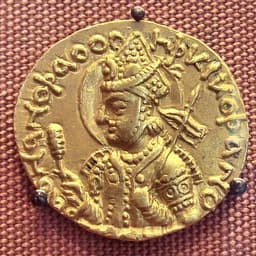
Huvishka
Emperor · Ancient
51.4Total

Julius Caesar
General · Ancient
82.8Total
Basic Information
Born
150
-100
Died
190
-44
Era
Ancient
Ancient
Nationality
Kushan Empire
Roman Republic
Occupation
Emperor
General
Civilization
Indian
Western
Score Comparison
Military (10%)
30.0
88.0
Political (20%)
68.0
78.0
Influence (20%)
57.2
85.0
Legacy (20%)
47.5
82.0
Leadership (15%)
40.0
80.0
Strategy (15%)
60.0
85.0
TOTAL
51.4
82.8
Huvishka — Complete Timeline
155 AD
Continuation of Kushan ExpansionWar
Huvishka maintained the Kushan Empire's territorial holdings in the Indus Valley, Ganges Basin, and Central Asia. He defended the empire against incursions from the Sassanians and other groups.
DefenseKushan EmpireTerritory
Impact: regional
160 AD
Patronage of Multiple ReligionsCultural◆ Major
Huvishka patronized Buddhism, Hinduism, Zoroastrianism, and Greek cults, as evidenced by his coins depicting Buddha, Shiva, Mithra, and Serapis. This policy promoted religious tolerance and cultural exchange.
ReligionToleranceSyncretism
Impact: regionalconstructive
Issuance of Gold Coins with Diverse DeitiesCultural
Huvishka issued a wide variety of gold coins featuring deities from multiple pantheons, including Greek, Persian, Indian, and Buddhist. These coins are a key source for understanding the religious landscape of the Kushan Empire.
CoinageReligionNumismatics
Impact: regionalconstructive
170 AD
Construction of the Mathura MonasteryCultural
Huvishka funded the construction of a Buddhist monastery at Mathura, which became a center for Buddhist art and learning. The monastery produced sculptures and inscriptions that reflect the Kushan period.
ArchitectureBuddhismMonastery
constructive
Julius Caesar — Complete Timeline
58 BC
Gallic WarsWar◆ Major
Caesar, as proconsul of Gaul, launched a series of campaigns that conquered all of Gaul (modern France, Belgium, and parts of Switzerland). He fought numerous battles, including against the Helvetii, the Belgae, and the Gallic chieftain Vercingetorix. The wars brought immense wealth and a loyal army to Caesar.
Gallic WarsConquestRoman Expansion
Impact: regional
49 BC
Crossing the RubiconPolitical Action◆ Major
Caesar led Legio XIII across the Rubicon River into Italy, defying the Roman Senate's order to disband his army. This act triggered a civil war against Pompey and the Optimates, ultimately leading to Caesar's dictatorship and the end of the Roman Republic.
Roman Civil WarEnd of RepublicPower Struggle
Impact: global
48 BC
Battle of PharsalusWar◆ Major
Caesar's outnumbered army defeated the larger forces of Pompey the Great at Pharsalus in Greece. Caesar's tactical use of a reserve line to counter Pompey's cavalry charge proved decisive. Pompey fled to Egypt, where he was assassinated, leaving Caesar as the undisputed master of the Roman world.
Roman Civil WarBattleDecisive Victory
Impact: regional
44 BC
Appointment as Dictator for LifePolitical Action◆ Major
The Roman Senate appointed Caesar dictator perpetuo (dictator for life), granting him unprecedented personal power. This move concentrated military, legislative, and judicial authority in one person, effectively ending the Roman Republic's traditional system of checks and balances and alarming many senators.
DictatorshipEnd of RepublicPower Consolidation
Impact: regionaldestructive
Assassination on the Ides of MarchPolitical Action◆ Major
A group of Roman senators, led by Marcus Junius Brutus and Gaius Cassius Longinus, stabbed Caesar to death at a meeting of the Senate in the Theatre of Pompey. The assassination was intended to restore the Republic, but instead triggered another civil war that led to the rise of the Roman Empire.
AssassinationRoman PoliticsEnd of Republic
Impact: globaldestructive
Expert Analysis
huvishka-vs-julius-caesar
# The Crossing and the Continuation
History has a curious way of pairing figures who could not be more different, yet whose lives ask the same fundamental question: What does it mean to wield power? On one hand, we have Julius Caesar, whose very name became synonymous with ambition, conquest, and a bloody end that still echoes in Western memory. On the other, Huvishka, a Kushan emperor whose reign was so stable that we struggle to recall a single dramatic event from it. One crossed a river and changed the world; the other minted coins and kept an empire together. The contrast is not merely one of fame, but of the very nature of historical impact.
Origins
Caesar was born into the chaos of the late Roman Republic, a world of civil wars, senatorial intrigue, and crumbling traditions. His family, the Julii, claimed descent from the goddess Venus, but they were not among the wealthiest or most powerful. Caesar grew up watching his uncle Marius fight Sulla, learning early that politics was a blood sport. He was a patrician by birth but a populist by necessity, always calculating, always charming, always hungry.
Huvishka, by contrast, inherited a stable empire. The Kushan realm, stretching from Central Asia into northern India, was already a crossroads of cultures when he took the throne around 150 CE. His predecessor, Kanishka I, had laid the foundations, and Huvishka’s task was not to conquer but to preserve. We know little of his youth, but his reign suggests a man comfortable with pluralism, content to rule through tolerance rather than terror. He was an emperor of continuity, not crisis.
Rise to Power
Caesar’s path to power was a masterpiece of calculated risk. He served as a military tribune, then quaestor, then aedile, spending lavishly on games and buildings to win the people’s love. His real breakthrough came in 58 BCE, when he secured the governorship of Gaul. Over the next eight years, he conquered a territory larger than Italy, built a loyal army, and amassed enough wealth to rival the state itself. The Senate grew terrified, and in 49 BCE, they ordered him to disband his army. Caesar’s response was to cross the Rubicon River into Italy, a declaration of civil war. “The die is cast,” he reportedly said, and the Republic never recovered.
Huvishka’s rise was quieter. He was likely a son or close relative of Kanishka, and when his predecessor died around 150 CE, he assumed the throne without apparent conflict. There is no record of a coup, no dramatic crossing, no famous last words. The Kushan Empire was a monarchy, and Huvishka simply inherited the crown. His power came not from personal conquest but from the stability of the system he led.
Leadership & Governance
Caesar governed as a revolutionary. As dictator, he reformed the calendar, granted citizenship to provincials, launched public works projects, and centralized authority in his own hands. He was a military genius—his siege of Alesia in 52 BCE remains a textbook example of tactical brilliance—but his political wisdom was undermined by his arrogance. He pardoned his enemies, only to see them plot against him. He accepted honors that smacked of monarchy, alienating the senatorial class. His reforms were sweeping, but they were imposed, not negotiated.
Huvishka governed as a curator. His reign saw no major wars, no dramatic reforms, and no constitutional crises. Instead, he focused on cultural patronage. His coins are a gallery of deities: the Greek god Helios, the Persian Mithra, the Hindu Shiva, and the Buddha. He funded the construction of a Buddhist monastery at Mathura, which became a center of art and learning. This was not weakness but strategy. In a multicultural empire, religious tolerance was a form of glue. Huvishka’s political score of 53.8 and leadership score of 79.8 reflect a ruler who maintained order without seeking glory.
Triumph & Tragedy
Caesar’s greatest triumph was his conquest of Gaul, which he chronicled in his *Commentaries* with a clarity that still reads like a thriller. His greatest tragedy was his assassination on the Ides of March, 44 BCE. He had achieved total power, but he could not secure his own life. His murder plunged Rome into another civil war, and his adopted heir, Octavian, eventually became Augustus, the first emperor. Caesar died, but his name became a title.
Huvishka’s triumph was less dramatic but no less significant: he kept the Kushan Empire intact for forty years, a feat in an age of constant upheaval. His tragedy is that we remember so little of it. There is no famous betrayal, no dramatic fall. He died around 190 CE, and the empire he maintained began to fragment under his successors. His legacy is one of quiet competence, easily overlooked.
Character & Destiny
Caesar was driven by an insatiable desire for recognition. He wept at the statue of Alexander the Great, frustrated that he had achieved so little by the same age. He was ruthless, charming, brilliant, and reckless. His personality shaped every decision, from the crossing of the Rubicon to the rejection of a crown. He believed he was destined for greatness, and he was right—but destiny also demanded his blood.
Huvishka, in contrast, seems almost anonymous. His coins tell us he was a patron, not a warrior. His character appears to have been pragmatic and inclusive, valuing stability over glory. He did not seek to change the world; he sought to preserve it. In a way, that is a quieter form of wisdom.
Legacy
Caesar’s legacy is monumental. He transformed the Roman Republic into an empire, set the template for European autocracy, and left a name that became synonymous with power. His reforms shaped law, language, and culture for two millennia. He is remembered as a hero, a tyrant, and everything in between.
Huvishka’s legacy is more subtle. He is remembered by historians and numismatists, not by the general public. Yet his reign represents a golden age of cultural synthesis, where Greek, Persian, Indian, and Central Asian traditions mingled freely. The Mathura monastery he funded produced art that influenced Buddhist iconography for centuries. His coins survive in collections, silent witnesses to a forgotten empire.
Conclusion
Standing at the edge of the Rubicon, Caesar looked at a river and saw destiny. Huvishka, looking at the same kind of river, probably saw a trade route. Both men were right. Caesar’s ambition remade the world, but it also destroyed him. Huvishka’s patience held an empire together, but it also condemned him to obscurity. History, it seems, rewards the dramatic over the stable. But perhaps we should pause, in our rush to admire Caesar, and spare a thought for the emperor who simply kept the peace.
Rankings
🥇
Julius CaesarLeader
Mil: 88.0Pol: 78.0Inf: 85.0
82.8
🥈
Huvishka
Mil: 30.0Pol: 68.0Inf: 57.2
51.4
+31.4 behind
How This Comparison Works
Algorithm
Each figure is scored on 6 dimensions (0—100 scale) based on structured historical data: Military (10%), Political (20%), Influence (20%), Legacy (20%), Leadership (15%), Strategy (15%). The weighted total produces the final ranking.
Data Sources
Scores are computed from structured sub-indicators in the database. Scale factors adjust for era (Ancient ×0.85, Modern ×1.0) and civilization size (Eastern ×1.05, Other ×0.80) to account for differences in population and military scale.
Maximum 3 Figures
Comparisons are limited to 2—3 figures to ensure readability and statistical meaningfulness.
Error Margins
±5 points per dimension — Sub-scores are derived from historical records with inherent uncertainty. Two figures within 5 points on a dimension should be considered roughly equivalent in that area.
Total Score Accuracy
±3 points overall — The weighted combination of 6 dimensions produces a total score with approximately ±3 points of uncertainty. Differences of less than 3 points are not statistically significant— the figures are effectively tied.
Known Limitations
- Historical records are incomplete and uneven across civilizations
- Figures from oral-tradition societies may be underrepresented
- Occupation labels can misclassify multi-role figures
- Scores measure capability and impact, not moral character
- Quantitative scoring is a comparison tool, not absolute truth
Capability Radar
Military (10%) — Battles & Warfare
Battles
40
95
Win Rate
45
92
Expansion
35
97
Political (20%) — Governance & Reform
Reform
50
90
Diplomacy
65
85
Economy
60
82
Influence (20%) — Cultural & Global Reach
Cultural
60
88
Global
45
94
Legacy (20%) — Historical Impact
Historical
55
95
Longevity
50
96
Leadership (15%) — Power & Stability
Tenure
60
75
Stability
55
60
Strategy (15%) — Tactics & Innovation
Strategy
45
94
Tactics
40
96
Reform
30
88
Similar Comparisons
Comments & Discussion
Aquilifer's_Ace6/17/2026
Caesar gets all the glory for crossing the Rubicon, but let's be real: his gambit worked because his legions were personally loyal to him, not the Republic. Huvishka's boring stability actually required more skill—keeping diverse cultures like Bactrians, Indians, and Scythians under one roof without constant revolts. A single dramatic crossing doesn't beat decades of diplomatic juggling.
铭文侦探6/17/2026
你们别被罗马宣传骗了。胡维什卡时期的金币上既有希腊神宙斯,又有印度神湿婆,还有波斯神阿胡拉·马兹达。这种文化包容性比凯撒的高卢屠杀高明一万倍。所谓"历史重大时刻"不过是欧洲中心主义的自嗨,稳定的帝国本来就应该无聊。
Numeri_Nerd6/17/2026
Caesar's debt-to-GDP ratio was insane. He owed millions by age 40, basically running a pyramid scheme on Roman credit. Huvishka's coinage shows consistent silver purity across his reign—actual economic management, not just conquest propaganda. The Gallic Wars were a genocide funded by usury, but sure, call it "history."
史海钩沉6/17/2026
有趣的是,凯撒在《高卢战记》里把自己写成战神,结果被六十个元老捅死。胡维什卡统治至少二十年,却连一场内战都没有,最后连去世年份都考据不清。历史偏爱戏剧性的失败者,却把真正成功的统治者变成了脚注——贵霜帝国的版图比罗马本土还大,谁记得?