Loading...
Huseyn Shaheed Suhrawardy vs Vincent Auriol
Vincent Auriol leads by 2.9 pts · 2 figures compared
…

Huseyn Shaheed Suhrawardy
Politician · Modern
52.9Total
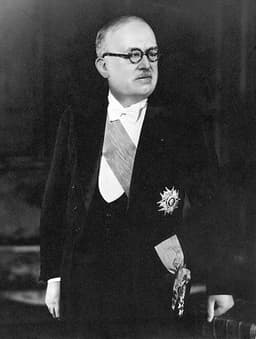
Vincent Auriol
Politician · Modern
55.8Total
Basic Information
Born
1892
1884
Died
1963
1966
Era
Modern
Modern
Nationality
Pakistan
France
Occupation
Politician
Politician
Civilization
Indian
Western
Score Comparison
Military (10%)
36.4
49.6
Political (20%)
61.3
60.0
Influence (20%)
56.4
55.7
Legacy (20%)
46.7
46.7
Leadership (15%)
55.3
79.8
Strategy (15%)
60.0
43.0
TOTAL
52.9
55.8
Huseyn Shaheed Suhrawardy — Complete Timeline
1956 AD
Became Prime Minister of PakistanPolitical Action◆ Major
Huseyn Shaheed Suhrawardy became Prime Minister after Chaudhry Muhammad Ali's resignation. He was the first prime minister from East Pakistan. His tenure focused on regional autonomy and economic development for the eastern wing.
Prime MinisterEast Pakistan
Impact: national
Signed the 1956 Constitution into EffectPolitical Action◆ Major
As Prime Minister, Suhrawardy oversaw the implementation of the 1956 constitution, which established Pakistan as an Islamic republic. He advocated for a federal system with greater autonomy for provinces. The constitution was short-lived due to the 1958 coup.
ConstitutionFederalism
Impact: nationalconstructive
1957 AD
Resigned Under Pressure from President Iskander MirzaPolitical Action
Suhrawardy resigned after losing the confidence of President Iskander Mirza and facing opposition from the military establishment. His resignation highlighted the dominance of the presidency over the prime minister. He returned to opposition politics.
ResignationPolitical Conflict
Impact: national
Vincent Auriol — Complete Timeline
1936 AD
Served as Minister of FinancePolitical Action
Auriol served as Minister of Finance in the Popular Front government of L
Popular FrontLabor Reforms
Impact: nationalprogressive
1947 AD
Elected President of FrancePolitical Action◆ Major
Vincent Auriol was elected the first President of the Fourth French Republic, serving from 1947 to 1954. His presidency oversaw post-war reconstruction, the beginning of the Cold War, and the early stages of decolonization.
PresidencyFourth Republic
Impact: nationalconstructive
1951 AD
Presided over the Creation of the European Coal and Steel CommunityPolitical Action◆ Major
As president, Auriol supported the Schuman Plan and the Treaty of Paris (1951), which established the European Coal and Steel Community, a key step toward European integration.
European Integration
Impact: regionalconstructive
Expert Analysis
Origins
Huseyn Shaheed Suhrawardy was born on September 8, 1892, in Midnapore, Bengal Presidency, British India. His father, Sir Zahid Suhrawardy, was a judge and a member of the Bengal Legislative Council. Suhrawardy studied at Calcutta Madrasah College and later at St. Xavier's College, Calcutta, before earning a law degree from Oxford University. He was called to the bar at Gray's Inn in 1918. His early career involved law and politics in Bengal, where he became involved with the Indian National Congress before moving to the All-India Muslim League.
Vincent Auriol was born on August 27, 1884, in Revel, Haute-Garonne, France, to a family of bakers. He studied law at the University of Toulouse and became a lawyer. He joined the French Section of the Workers' International (SFIO) and was elected to the Chamber of Deputies in 1914. His early career focused on labor law and social issues, and he served as Minister of Finance in the Popular Front government in 1936.
Rise to Power
Suhrawardy rose to prominence in Bengal politics. He was a member of the Bengal Legislative Assembly from 1937 and served as Minister of Labour and later Minister of Civil Supplies in the Bengal government. In 1946, he became the Chief Minister of Bengal, leading a coalition government during the tumultuous period of partition. His handling of the Great Calcutta Killings in August 1946 drew criticism. After partition, he moved to East Pakistan and became a key figure in the Awami League. He became Prime Minister of Pakistan on September 12, 1956, after Chaudhry Muhammad Ali resigned.
Auriol's rise was through the French socialist movement. He served as Minister of Finance in 1936-1937 under Léon Blum, implementing the Matignon Agreements. During World War II, he was arrested by the Vichy government but later escaped to London and joined the Free French. After the war, he was elected to the Constituent Assembly and then as President of the National Assembly. On January 16, 1947, he was elected the first President of the Fourth French Republic, serving until 1954.
Leadership & Governance
Suhrawardy's leadership was marked by his efforts to unite East and West Pakistan. As Prime Minister, he signed the 1956 Constitution, establishing Pakistan as an Islamic republic and introducing a parliamentary system. He advocated for provincial autonomy and the rights of East Pakistan. However, he faced opposition from the military and bureaucracy, and his coalition government was unstable. He scored 61.3 in political acumen but only 36.4 in military influence, reflecting his civilian focus.
Auriol presided over the reconstruction of France after World War II. He supported the Marshall Plan and the creation of the European Coal and Steel Community (ECSC) through the Schuman Plan in 1951. His leadership style was consensual and constitutional, scoring 79.8 in leadership. He worked to stabilize the Fourth Republic's parliamentary system, though he faced challenges from the Cold War and colonial conflicts in Indochina and Algeria.
Triumph & Tragedy
Suhrawardy's greatest success was overseeing the 1956 Constitution, which provided a framework for democracy. He also strengthened the position of East Pakistan within the federation. However, his failure to manage the 1956 Constitution's implementation and his resignation under pressure from President Iskander Mirza in October 1957 marked his downfall. He was later arrested under martial law in 1958 and died in 1963.
Auriol's triumphs include his role in launching the ECSC, a foundation of European integration, and his leadership during post-war reconstruction. He also served as Minister of Finance during the Popular Front's social reforms. However, his presidency was marred by the French defeat at Dien Bien Phu in 1954 and the onset of the Algerian War. He left office with a legacy of institutional stability but limited direct power.
Character & Destiny
Suhrawardy was a charismatic and eloquent statesman, known for his oratory and political maneuvering. His decision to align with the military's opponents led to his isolation. He scored 55.3 in leadership and 60.0 in strategy, but his inability to secure lasting alliances cost him power. His destiny was tied to the fragile unity of Pakistan.
Auriol was a pragmatic socialist, known for his integrity and dedication to republican institutions. His character as a consensus-builder helped France transition from war to peace. He scored 79.8 in leadership, the highest among his scores, reflecting his ability to guide the nation through crisis. His destiny was to be a transitional figure, bridging the Fourth Republic and its challenges.
Legacy
Suhrawardy's legacy is mixed. He is remembered as a champion of East Pakistani rights and a symbol of Bengali nationalism. His influence persists in Bangladesh, where he is revered as a founding figure. However, his failure to secure a stable Pakistan contributed to the eventual separation of East Pakistan. He scored 46.7 in legacy.
Auriol's legacy is tied to the early European integration and the stability of the Fourth Republic. The ECSC evolved into the European Union, a lasting achievement. He also helped establish the presidency as a constitutional office. His legacy score is also 46.7, reflecting his role as a foundational but not transformative figure.
Conclusion
Vincent Auriol had a greater impact than Huseyn Shaheed Suhrawardy. Auriol's support for the Schuman Plan created a supranational framework that reshaped Europe, while Suhrawardy's achievements were limited by Pakistan's internal divisions. Auriol's total score of 55.8 exceeds Suhrawardy's 52.9, and his leadership score of 79.8 dwarfs Suhrawardy's 55.3. Auriol's legacy in European integration is more enduring and influential globally.
Rankings
🥇
Vincent AuriolLeader
Mil: 49.6Pol: 60.0Inf: 55.7
55.8
🥈
Huseyn Shaheed Suhrawardy
Mil: 36.4Pol: 61.3Inf: 56.4
52.9
+2.9 behind
How This Comparison Works
Algorithm
Each figure is scored on 6 dimensions (0—100 scale) based on structured historical data: Military (10%), Political (20%), Influence (20%), Legacy (20%), Leadership (15%), Strategy (15%). The weighted total produces the final ranking.
Data Sources
Scores are computed from structured sub-indicators in the database. Scale factors adjust for era (Ancient ×0.85, Modern ×1.0) and civilization size (Eastern ×1.05, Other ×0.80) to account for differences in population and military scale.
Maximum 3 Figures
Comparisons are limited to 2—3 figures to ensure readability and statistical meaningfulness.
Error Margins
±5 points per dimension — Sub-scores are derived from historical records with inherent uncertainty. Two figures within 5 points on a dimension should be considered roughly equivalent in that area.
Total Score Accuracy
±3 points overall — The weighted combination of 6 dimensions produces a total score with approximately ±3 points of uncertainty. Differences of less than 3 points are not statistically significant— the figures are effectively tied.
Known Limitations
- Historical records are incomplete and uneven across civilizations
- Figures from oral-tradition societies may be underrepresented
- Occupation labels can misclassify multi-role figures
- Scores measure capability and impact, not moral character
- Quantitative scoring is a comparison tool, not absolute truth
Capability Radar
Military (10%) — Battles & Warfare
Battles
46
29
Win Rate
45
31
Expansion
50
36
Political (20%) — Governance & Reform
Reform
40
55
Diplomacy
60
60
Economy
30
50
Influence (20%) — Cultural & Global Reach
Cultural
40
30
Global
40
35
Legacy (20%) — Historical Impact
Historical
50
40
Longevity
30
30
Leadership (15%) — Power & Stability
Tenure
30
65
Stability
20
45
Strategy (15%) — Tactics & Innovation
Strategy
54
36
Tactics
53
41
Reform
57
47
Similar Comparisons
Comments & Discussion
No comments yet. Be the first to share your thoughts!