Loading...
Hermann Hoth vs Julius Caesar
Julius Caesar leads by 34.4 pts · 2 figures compared
…
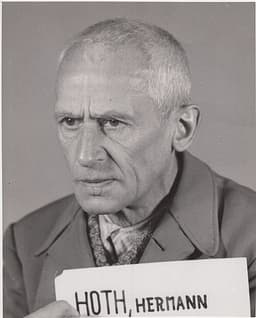
Hermann Hoth
General · Modern
48.4Total

Julius Caesar
General · Ancient
82.8Total
Basic Information
Born
1885
-100
Died
1971
-44
Era
Modern
Ancient
Nationality
Germany
Roman Republic
Occupation
General
General
Civilization
Western
Western
Score Comparison
Military (10%)
67.3
88.0
Political (20%)
27.9
78.0
Influence (20%)
56.4
85.0
Legacy (20%)
48.3
82.0
Leadership (15%)
36.9
80.0
Strategy (15%)
58.0
85.0
TOTAL
48.4
82.8
Hermann Hoth — Complete Timeline
1941 AD
Command of Panzer Group 3 in Operation BarbarossaWar◆ Major
Hoth commanded Panzer Group 3 during the invasion of the Soviet Union. His forces advanced on Minsk and Vitebsk, encircling large Soviet forces in the early stages of the campaign.
World War IIEastern FrontOperation Barbarossa
Impact: regional
1943 AD
Command of 4th Panzer Army at KurskWar◆ Major
Hoth led the 4th Panzer Army in the southern sector of the Battle of Kursk. His forces achieved initial penetrations but were halted at Prokhorovka, contributing to the German failure.
World War IIEastern FrontKursk
Impact: regional
1948 AD
Imprisonment for War CrimesPolitical Action◆ Major
Hoth was tried at the Subsequent Nuremberg Trials in the High Command Trial. He was found guilty of war crimes and crimes against humanity and sentenced to 15 years imprisonment.
War Crimes TrialPost-War Justice
Impact: national
Julius Caesar — Complete Timeline
58 BC
Gallic WarsWar◆ Major
Caesar, as proconsul of Gaul, launched a series of campaigns that conquered all of Gaul (modern France, Belgium, and parts of Switzerland). He fought numerous battles, including against the Helvetii, the Belgae, and the Gallic chieftain Vercingetorix. The wars brought immense wealth and a loyal army to Caesar.
Gallic WarsConquestRoman Expansion
Impact: regional
49 BC
Crossing the RubiconPolitical Action◆ Major
Caesar led Legio XIII across the Rubicon River into Italy, defying the Roman Senate's order to disband his army. This act triggered a civil war against Pompey and the Optimates, ultimately leading to Caesar's dictatorship and the end of the Roman Republic.
Roman Civil WarEnd of RepublicPower Struggle
Impact: global
48 BC
Battle of PharsalusWar◆ Major
Caesar's outnumbered army defeated the larger forces of Pompey the Great at Pharsalus in Greece. Caesar's tactical use of a reserve line to counter Pompey's cavalry charge proved decisive. Pompey fled to Egypt, where he was assassinated, leaving Caesar as the undisputed master of the Roman world.
Roman Civil WarBattleDecisive Victory
Impact: regional
44 BC
Appointment as Dictator for LifePolitical Action◆ Major
The Roman Senate appointed Caesar dictator perpetuo (dictator for life), granting him unprecedented personal power. This move concentrated military, legislative, and judicial authority in one person, effectively ending the Roman Republic's traditional system of checks and balances and alarming many senators.
DictatorshipEnd of RepublicPower Consolidation
Impact: regionaldestructive
Assassination on the Ides of MarchPolitical Action◆ Major
A group of Roman senators, led by Marcus Junius Brutus and Gaius Cassius Longinus, stabbed Caesar to death at a meeting of the Senate in the Theatre of Pompey. The assassination was intended to restore the Republic, but instead triggered another civil war that led to the rise of the Roman Empire.
AssassinationRoman PoliticsEnd of Republic
Impact: globaldestructive
Expert Analysis
hermann-hoth-vs-julius-caesar
# The General and the Dictator: Two Paths to Power and Ruin
On a spring morning in 44 BCE, Julius Caesar walked into the Senate chamber in Rome, ignoring a warning handed to him moments before. Sixty senators surrounded him, their daggers hidden beneath togas. Within minutes, the most powerful man in the Mediterranean lay bleeding at the foot of Pompey’s statue, stabbed twenty-three times. Eighteen centuries later, on a frigid July morning in 1943, General Hermann Hoth sat in his command vehicle on the steppes of southern Russia, watching his panzers churn through mud and dust toward the Soviet stronghold at Prokhorovka. He believed he was commanding the decisive battle of the war. Instead, he was witnessing the beginning of the end for Nazi Germany. One man built an empire that would echo through millennia; the other served a regime that collapsed within a decade. What separates a figure who reshapes history from one who merely passes through it? The answer lies not in talent alone, but in the currents of their times and the choices they made when history demanded them.
Origins
Caesar was born into the twilight of the Roman Republic, a world of fierce aristocratic competition, civil wars, and crumbling institutions. His family, the Julii, claimed descent from the goddess Venus, but they were politically marginal. Young Caesar watched his uncle Gaius Marius fight a brutal civil war against Sulla, learning early that power was won by audacity, not birthright. He fled Sulla’s proscriptions, served as a soldier in Asia Minor, and was captured by pirates—whom he later crucified, as promised. These experiences forged a man who understood that the Republic’s old rules no longer worked.
Hoth was born in 1885 in Neuruppin, Germany, into a world of Prussian military tradition, rigid hierarchy, and imperial ambition. The German Empire was young, unified only fourteen years earlier, and its officer corps worshipped discipline, order, and obedience. Hoth served in World War I, then in the Reichswehr, and later in the Wehrmacht. He was a technician of war, not a revolutionary. His world was one of staff maps, logistics tables, and the cold calculus of armored thrusts. Where Caesar learned to manipulate crowds and senators, Hoth learned to read terrain and supply lines.
Rise to Power
Caesar’s ascent was a masterclass in political maneuvering. He formed the First Triumvirate with Pompey and Crassus, borrowed enormous sums to bribe his way to the consulship, and then secured a five-year command in Gaul. There, over eight years, he conquered a territory larger than Italy, built a loyal army, and amassed staggering wealth. When the Senate ordered him to disband his legions, he crossed the Rubicon River in 49 BCE—an act of war against the Republic. His gamble paid off: his veterans followed him, and within four years he had defeated Pompey, pacified the provinces, and made himself dictator for life.
Hoth’s rise was quieter but no less significant. He commanded Panzer Group 3 during Operation Barbarossa in 1941, driving deep into Soviet territory, encircling Minsk and Vitebsk. His success earned him command of the 4th Panzer Army, one of the most powerful armored formations in history. By 1943, he was the spearpoint of Hitler’s last major offensive in the East. But Hoth never chose his own path. He followed orders, served a Führer he did not challenge, and rose within a system that rewarded technical competence, not political vision. Caesar created his own opportunities; Hoth seized those given to him.
Leadership & Governance
Caesar governed with a blend of clemency and calculation. He pardoned former enemies, reformed the calendar, granted citizenship to provincials, and launched massive public works. His military genius lay in speed, deception, and the personal loyalty of his troops—he fought alongside them, shared their hardships, and rewarded them generously. At Alesia, he besieged a Gallic army while simultaneously defending against a relief force, a feat of logistics and nerve that still stuns military historians. Yet his governance was autocratic: he centralized power, packed the Senate with his supporters, and accepted the title “dictator for life.” He believed the Republic was beyond saving, and he may have been right.
Hoth was a competent operational commander, but he operated within a framework he did not control. At Kursk, his 4th Panzer Army achieved the deepest penetration of any German unit, advancing thirty miles in five days against fierce Soviet resistance. But Hitler’s strategic indecision, the vast Soviet reserves, and the sheer scale of the Eastern Front overwhelmed tactical brilliance. Hoth never reformed anything; he executed orders. His political judgment was absent—he later claimed ignorance of the Holocaust while commanding troops near mass murder sites. The High Command Trial in 1948 found him guilty of war crimes, and he served six years in prison.
Triumph & Tragedy
Caesar’s greatest moment was his triumph over Gaul and his defeat of Pompey—he had conquered the known world for Rome and for himself. His tragedy was that he could not stop the cycle of violence he had unleashed. The Ides of March was not just his death; it was the Republic’s death. His assassins thought they were saving liberty; they merely opened the door for Augustus and the Empire.
Hoth’s triumph was the rapid advance of Panzer Group 3 in 1941, capturing 300,000 Soviet prisoners near Minsk. His tragedy was Kursk—the largest tank battle in history, where his forces bled white against the Soviet defensive lines. After the war, he lived quietly in West Germany, a convicted war criminal who never publicly expressed remorse. His greatest failure was not on the battlefield, but in his moral blindness.
Character & Destiny
Caesar was restless, brilliant, and utterly convinced of his own destiny. He took risks that would have destroyed lesser men—crossing the Rubicon, pardoning enemies, alienating the Senate—because he believed his star would hold. His arrogance killed him: he dismissed the omens, ignored the warnings, and walked into the Senate unarmed. Yet that same audacity built his legend.
Hoth was diligent, competent, and obedient. He never questioned the regime he served, even as it descended into genocide and self-destruction. His tragedy was that of the professional soldier in a criminal state: he performed his duty so well that he enabled atrocity. Where Caesar shaped his era, Hoth was shaped by his—and crushed by it.
Legacy
Caesar’s legacy is immeasurable. The Julian calendar, the title “kaiser” and “tsar,” the very concept of a dictator who transforms a republic into an empire—all trace back to him. Shakespeare’s play, the Rubicon crossing, the Ides of March: he is a permanent fixture in Western consciousness. His military campaigns are still studied at Sandhurst and West Point.
Hoth’s legacy is narrow. Military historians debate his decisions at Kursk; war crimes scholars examine his trial. To the general public, he is unknown. His score of 70.1—competent but unremarkable—reflects a life of professional achievement within a catastrophic moral framework. Caesar’s 83.3 captures a man who changed the world, for better and worse.
Conclusion
The difference between Caesar and Hoth is not merely one of talent, but of horizon. Caesar saw a world in crisis and decided to remake it, whatever the cost. Hoth saw a world at war and decided to fight it, without asking who started it or why. One created an empire; the other served one. Their stories remind us that history does not judge by competence alone. It judges by what we choose to do with our power, and whether we have the courage—or the folly—to use it for something greater than ourselves.
Rankings
🥇
Julius CaesarLeader
Mil: 88.0Pol: 78.0Inf: 85.0
82.8
🥈
Hermann Hoth
Mil: 67.3Pol: 27.9Inf: 56.4
48.4
+34.4 behind
How This Comparison Works
Algorithm
Each figure is scored on 6 dimensions (0—100 scale) based on structured historical data: Military (10%), Political (20%), Influence (20%), Legacy (20%), Leadership (15%), Strategy (15%). The weighted total produces the final ranking.
Data Sources
Scores are computed from structured sub-indicators in the database. Scale factors adjust for era (Ancient ×0.85, Modern ×1.0) and civilization size (Eastern ×1.05, Other ×0.80) to account for differences in population and military scale.
Maximum 3 Figures
Comparisons are limited to 2—3 figures to ensure readability and statistical meaningfulness.
Error Margins
±5 points per dimension — Sub-scores are derived from historical records with inherent uncertainty. Two figures within 5 points on a dimension should be considered roughly equivalent in that area.
Total Score Accuracy
±3 points overall — The weighted combination of 6 dimensions produces a total score with approximately ±3 points of uncertainty. Differences of less than 3 points are not statistically significant— the figures are effectively tied.
Known Limitations
- Historical records are incomplete and uneven across civilizations
- Figures from oral-tradition societies may be underrepresented
- Occupation labels can misclassify multi-role figures
- Scores measure capability and impact, not moral character
- Quantitative scoring is a comparison tool, not absolute truth
Capability Radar
Military (10%) — Battles & Warfare
Battles
75
95
Win Rate
70
92
Expansion
60
97
Political (20%) — Governance & Reform
Reform
10
90
Diplomacy
15
85
Economy
10
82
Influence (20%) — Cultural & Global Reach
Cultural
30
88
Global
40
94
Legacy (20%) — Historical Impact
Historical
50
95
Longevity
30
96
Leadership (15%) — Power & Stability
Tenure
20
75
Stability
10
60
Strategy (15%) — Tactics & Innovation
Strategy
75
94
Tactics
80
96
Reform
40
88
Similar Comparisons
Comments & Discussion
No comments yet. Be the first to share your thoughts!