Loading...
Herbert Hoover vs Kaysone Phomvihane
Kaysone Phomvihane leads by 0.5 pts · 2 figures compared
…
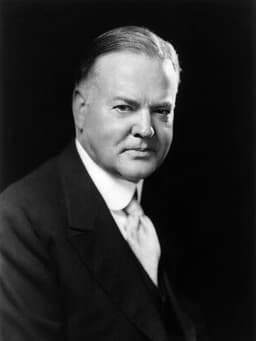
Herbert Hoover
Politician · Modern
53.8Total

Kaysone Phomvihane
Politician · Modern
54.3Total
Basic Information
Born
1874
1920
Died
1964
—
Era
Modern
Modern
Nationality
United States
Laos
Occupation
Politician
Politician
Civilization
Western
Eastern
Score Comparison
Military (10%)
49.1
31.5
Political (20%)
54.7
68.0
Influence (20%)
58.0
53.3
Legacy (20%)
49.2
45.8
Leadership (15%)
65.0
72.0
Strategy (15%)
41.8
53.5
TOTAL
53.8
54.3
Herbert Hoover — Complete Timeline
1928 AD
Election as President of the United StatesPolitical Action◆ Major
Hoover, a Republican, won the 1928 presidential election in a landslide against Democrat Al Smith. Hoover's reputation as a successful businessman and humanitarian, particularly for his relief work in Europe during and after World War I, contributed to his victory.
Presidential ElectionRepublican Party
Impact: national
1929 AD
Stock Market Crash of 1929Other
The Wall Street Crash of 1929 occurred in October, marking the beginning of the Great Depression. Hoover's response, including calls for voluntary cooperation and limited federal intervention, was widely criticized as inadequate, and the depression deepened.
Great DepressionEconomic Crisis
Impact: globaltragic
1930 AD
Signing of the Smoot-Hawley TariffPolitical Action◆ Major
Hoover signed the Smoot-Hawley Tariff, which raised tariffs on thousands of imported goods to record levels. The tariff sparked retaliatory measures from other countries, contributing to a collapse in international trade and worsening the Great Depression.
Tariff PolicyGreat Depression
Impact: globaldestructive
Kaysone Phomvihane — Complete Timeline
1955 AD
Founding of the Lao People's Revolutionary PartyPolitical Action◆ Major
Kaysone Phomvihane was a founding member of the Lao People's Revolutionary Party (LPRP), the communist party that later led Laos. He became its first general secretary, a position he held until his death.
LPRPCommunist partyFounding
Impact: nationalconstructive
1960 AD
Leadership of Pathet LaoPolitical Action◆ Major
Kaysone Phomvihane became the de facto leader of the Pathet Lao, the communist insurgency in Laos. He directed military operations against the Royal Lao Government during the Laotian Civil War.
Pathet LaoInsurgencyCivil war
Impact: national
1975 AD
Proclamation of the Lao People's Democratic RepublicPolitical Action◆ Major
Kaysone Phomvihane proclaimed the establishment of the Lao People's Democratic Republic, ending the monarchy. He became the first prime minister of the new communist state, implementing socialist policies.
Lao PDRCommunist stateMonarchy abolished
Impact: nationalconstructive
1986 AD
Economic reforms (Chintanakan Mai)Reform◆ Major
Kaysone Phomvihane introduced the New Economic Mechanism (Chintanakan Mai), shifting Laos from a centrally planned economy to a market-oriented one. The reforms allowed private enterprise and foreign investment.
Economic reformMarket economyChintanakan Mai
Impact: nationalprogressive
Expert Analysis
Origins
Herbert Hoover was born on August 10, 1874, in West Branch, Iowa, to a Quaker family. Orphaned at age nine, he was raised by relatives and worked his way through Stanford University, graduating in 1895 with a degree in geology. His early career as a mining engineer took him around the world, making him a millionaire by age 40. This background shaped his belief in individualism and voluntary cooperation.
Kaysone Phomvihane was born on December 13, 1920, in Savannakhet Province, Laos, to a Vietnamese father and a Lao mother. He studied law at Hanoi University but left to join the communist movement. Influenced by Ho Chi Minh and the Viet Minh, he became a founding member of the Lao People's Revolutionary Party (LPRP) in 1955. His mixed heritage and education in Vietnam connected him deeply to the Indochinese communist network.
Rise to Power
Hoover rose to prominence as a humanitarian during World War I, organizing relief for occupied Belgium and later for famine-stricken Russia. His reputation as a skilled administrator led to his appointment as U.S. Secretary of Commerce under Presidents Harding and Coolidge (1921-1928). In 1928, he won the presidency in a landslide, with 58.2% of the popular vote, against Democrat Al Smith.
Kaysone rose through the ranks of the Pathet Lao, the communist insurgency backed by North Vietnam. He became its de facto leader in the 1960s, directing military campaigns against the Royal Lao Government and U.S.-backed forces. After years of civil war, the Pathet Lao seized power in 1975, and on December 2, Kaysone proclaimed the Lao People's Democratic Republic, becoming its first prime minister (1975-1991) and later president (1991-1992).
Leadership & Governance
Hoover's leadership style was technocratic and individualistic. He believed in limited government intervention and voluntary cooperation between business and labor. During the Great Depression, he implemented measures like the Reconstruction Finance Corporation (1932) to support banks and businesses, but resisted direct federal relief. His signing of the Smoot-Hawley Tariff in 1930, which raised tariffs to record levels (average 40%), worsened the global economic downturn. His political score of 54.7 reflects his inability to adapt to the crisis.
Kaysone ruled Laos with an iron fist through the LPRP, maintaining a one-party state. He initially pursued radical collectivization and purges of former regime officials. However, facing economic stagnation, he introduced the New Economic Mechanism (Chintanakan Mai) in 1986, shifting from central planning to a market-oriented economy while keeping political control. His leadership score of 72.0 reflects his pragmatic adaptation, though his political score of 68.0 indicates authoritarian governance.
Triumph & Tragedy
Hoover's greatest triumph was his humanitarian work: he saved millions from starvation during and after WWI through the Commission for Relief in Belgium and the American Relief Administration. His greatest tragedy was the Great Depression. Despite his efforts, unemployment rose to 25% by 1933, and his reputation was shattered. He scored 49.1 in military (none) and 41.8 in strategy, reflecting his failure to address the economic collapse.
Kaysone's greatest triumph was unifying Laos under communist rule and ending the civil war. His economic reforms in the 1980s stabilized the economy and attracted foreign investment. His greatest tragedy was the human cost of his early policies: forced collectivization led to famine and a failed harvest in 1977-78, and political repression resulted in thousands fleeing as refugees. He scored 31.5 in military (limited direct command) and 53.5 in strategy.
Character & Destiny
Hoover was intelligent, efficient, and deeply principled, but his rigid individualism and distrust of government intervention made him ill-suited for the crisis. Historian Richard Hofstadter described him as "the last of the laissez-faire presidents." His character led to his political downfall and a legacy tarnished by the Depression.
Kaysone was pragmatic, secretive, and ruthless. He maintained a cult of personality while quietly shifting economic policies. His ability to adapt kept him in power for 17 years, but his authoritarian methods left a mixed legacy. He died in 1992 while still in office.
Legacy
Hoover's legacy is overwhelmingly negative in popular memory, but historians note his humanitarian achievements and the lasting impact of his public works projects (e.g., Hoover Dam). His score of 49.2 in legacy reflects the damage to his reputation. The New Deal, which succeeded his presidency, defined U.S. policy for decades.
Kaysone's legacy is foundational to modern Laos. He established the LPRP's dominance, which continues today, and his economic reforms set Laos on a path of growth (GDP per capita rose from $200 in 1985 to $1,500 by 2010). However, political repression and single-party rule remain. His legacy score of 45.8 reflects Laos' ongoing challenges.
Conclusion
While Hoover's global impact through humanitarian work was significant, his failure during the Great Depression overshadows his achievements. Kaysone Phomvihane, with a higher total score (54.3 vs 53.8), had a more enduring impact on his nation's political and economic structure. Hoover's presidency was a turning point for U.S. policy, but Kaysone's long rule shaped Laos from monarchy to communist state and through market reforms. In terms of lasting influence on a nation's trajectory, Kaysone Phomvihane edges out Herbert Hoover.
Rankings
🥇
Kaysone PhomvihaneLeader
Mil: 31.5Pol: 68.0Inf: 53.3
54.3
🥈
Herbert Hoover
Mil: 49.1Pol: 54.7Inf: 58.0
53.8
+0.5 behind
How This Comparison Works
Algorithm
Each figure is scored on 6 dimensions (0—100 scale) based on structured historical data: Military (10%), Political (20%), Influence (20%), Legacy (20%), Leadership (15%), Strategy (15%). The weighted total produces the final ranking.
Data Sources
Scores are computed from structured sub-indicators in the database. Scale factors adjust for era (Ancient ×0.85, Modern ×1.0) and civilization size (Eastern ×1.05, Other ×0.80) to account for differences in population and military scale.
Maximum 3 Figures
Comparisons are limited to 2—3 figures to ensure readability and statistical meaningfulness.
Error Margins
±5 points per dimension — Sub-scores are derived from historical records with inherent uncertainty. Two figures within 5 points on a dimension should be considered roughly equivalent in that area.
Total Score Accuracy
±3 points overall — The weighted combination of 6 dimensions produces a total score with approximately ±3 points of uncertainty. Differences of less than 3 points are not statistically significant— the figures are effectively tied.
Known Limitations
- Historical records are incomplete and uneven across civilizations
- Figures from oral-tradition societies may be underrepresented
- Occupation labels can misclassify multi-role figures
- Scores measure capability and impact, not moral character
- Quantitative scoring is a comparison tool, not absolute truth
Capability Radar
Military (10%) — Battles & Warfare
Battles
30
5
Win Rate
29
5
Expansion
38
10
Political (20%) — Governance & Reform
Reform
30
60
Diplomacy
55
55
Economy
40
40
Influence (20%) — Cultural & Global Reach
Cultural
30
30
Global
50
30
Legacy (20%) — Historical Impact
Historical
55
40
Longevity
40
35
Leadership (15%) — Power & Stability
Tenure
60
70
Stability
20
50
Strategy (15%) — Tactics & Innovation
Strategy
36
10
Tactics
40
5
Reform
44
15
Similar Comparisons
Comments & Discussion
No comments yet. Be the first to share your thoughts!