Loading...
Henry the Young King vs John II of Castile
Henry the Young King leads by 4.5 pts · 2 figures compared
…
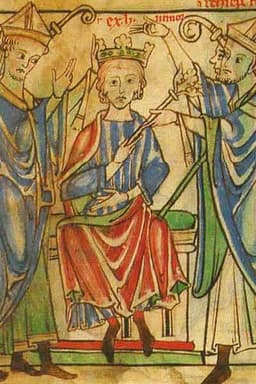
Henry the Young King
Emperor · Medieval
40.8Total

John II of Castile
Emperor · Medieval
36.3Total
Basic Information
Born
1155
1405
Died
1183
1454
Era
Medieval
Medieval
Nationality
England
Castile
Occupation
Emperor
Emperor
Civilization
Western
Western
Score Comparison
Military (10%)
14.9
10.2
Political (20%)
40.8
30.7
Influence (20%)
47.1
46.3
Legacy (20%)
35.8
37.5
Leadership (15%)
49.9
34.6
Strategy (15%)
50.0
45.0
TOTAL
40.8
36.3
Henry the Young King — Complete Timeline
1170 AD
Coronation as Junior KingPolitical Action◆ Major
Henry the Young King was crowned as junior king of England by his father Henry II, a practice to secure succession. This coronation gave him nominal authority but no real power, leading to future conflict.
CoronationSuccession
Impact: national
1172 AD
Second CoronationPolitical Action
To assert his status, Henry the Young King was crowned again at Winchester by the Archbishop of York, after his first coronation was performed by the Archbishop of Canterbury, causing a dispute.
CoronationChurch Dispute
Impact: national
1173 AD
Rebellion of 1173-1174War◆ Major
Henry the Young King led a major rebellion against his father Henry II, joined by his brothers Richard and Geoffrey, and supported by King Louis VII of France. The revolt failed after 18 months, and Henry was forced to submit.
RebellionCivil WarFamily Conflict
Impact: regionaldestructive
1183 AD
Death from DysenteryOther◆ Major
Henry the Young King died of dysentery at Martel in Quercy, France, at age 28. His death ended his rivalry with his father and brothers, and he was buried in Rouen Cathedral.
DeathDisease
Impact: regionaltragic
John II of Castile — Complete Timeline
1423 AD
Appointed Álvaro de Luna as ConstablePolitical Action◆ Major
John II appointed
Castilian PoliticsRoyal FavoritismÁlvaro de Luna
Impact: national
1445 AD
Battle of OlmedoWar◆ Major
John II and
Castilian Civil WarBattleNoble Rebellion
Impact: national
1453 AD
Execution of Álvaro de LunaPolitical Action
Under pressure from the nobility and his second wife, Isabella of Portugal, John II ordered the execution of his longtime favorite
Castilian PoliticsRoyal FavoritismExecution
Impact: nationaltragic
Expert Analysis
Origins
Henry the Young King was born on 28 February 1155, the second son of King Henry II of England and Eleanor of Aquitaine. He was raised in his father's court, groomed for kingship but never given real power. His early life was marked by privilege and expectation, yet he remained overshadowed by his formidable father. John II of Castile was born on 6 March 1405, the son of Henry III of Castile and Catherine of Lancaster. He inherited the throne at age one, leading to a regency dominated by his mother and later by his uncle, Ferdinand of Aragon. John's early years were shaped by factional struggles, leaving him ill-prepared for independent rule.
Rise to Power
Henry the Young King was crowned junior king on 14 June 1170 at Westminster Abbey, a ceremony intended to secure the succession. However, Henry II refused to delegate any real authority, which fueled resentment. In 1173, Henry the Young King fled to the court of King Louis VII of France and launched a rebellion, joined by his brothers Richard and Geoffrey. The revolt lasted 18 months but ultimately failed when Louis VII made peace with Henry II. John II became king at age one in 1406, but effective power lay with his mother and then his uncle. In 1419, at age 14, John II was declared of age, but he was soon dominated by Álvaro de Luna, who became his constable and chief advisor. John's rise was passive; he was a figurehead rather than a leader.
Leadership & Governance
Henry the Young King's leadership was characterized by a desire for power without the capacity to wield it. He spent most of his reign in conflict with his father, leading a coalition of nobles and foreign kings. His governance was nonexistent; he never ruled independently. John II of Castile ceded authority to Álvaro de Luna, who centralized power and curbed the nobility. While John was weak, Luna's governance brought stability and royal authority, as seen in the Battle of Olmedo (1445), where royal forces defeated the League of Nobles. However, John's indecisiveness led to Luna's execution in 1453, undermining all gains.
Triumph & Tragedy
Henry the Young King's greatest triumph was his coronation as junior king, which gave him nominal status. However, his rebellion of 1173-1174 was a failure, and he died in 1183 at age 28 from dysentery, having never achieved real power. His tragedy was being a king without a kingdom. John II's triumph was the victory at Olmedo, which temporarily strengthened royal authority. His greatest tragedy was ordering the execution of Luna, his most capable servant, under pressure from his wife Isabella of Portugal. After Luna's death, John II's reign collapsed into factionalism, and he died in 1454, leaving a weak monarchy.
Character & Destiny
Henry the Young King was ambitious but petulant, unable to compromise or wait for power. His character led him into rebellion, but he lacked the patience and political acumen to succeed. Historians note that his early death prevented any chance of redemption. John II was passive and easily influenced, dominated by favorites. His indecisiveness led to Luna's execution, which doomed his reign. Both men were shaped by their environments: Henry by an overbearing father, John by a long regency. Neither developed the skills needed to rule effectively.
Legacy
Henry the Young King's legacy is minimal; he is remembered as a rebel prince who failed to secure power. His story illustrates the dangers of shared kingship in medieval England. John II's legacy is mixed: his reign saw the rise of Luna and a brief strengthening of the crown, but his weakness led to noble resurgence. The execution of Luna weakened the monarchy, contributing to the later conflicts under Henry IV. John's total score of 36.3 reflects his limited impact.
Conclusion
Henry the Young King scored 40.8 overall, higher than John II's 36.3, but neither achieved lasting impact. Henry's rebellion was a footnote in the Angevin dynasty, while John's reign had slightly more consequence through Luna's reforms. However, John's failure to maintain those reforms leaves him with a lower score. Henry had more potential but died young. Between a failed rebel and a passive king, Henry's brief attempt at power gives him a marginal edge, but both are among history's least effective monarchs. Henry the Young King had greater impact by virtue of his more active, if misguided, efforts.
Rankings
🥇
Henry the Young KingLeader
Mil: 14.9Pol: 40.8Inf: 47.1
40.8
🥈
John II of Castile
Mil: 10.2Pol: 30.7Inf: 46.3
36.3
+4.5 behind
How This Comparison Works
Algorithm
Each figure is scored on 6 dimensions (0—100 scale) based on structured historical data: Military (10%), Political (20%), Influence (20%), Legacy (20%), Leadership (15%), Strategy (15%). The weighted total produces the final ranking.
Data Sources
Scores are computed from structured sub-indicators in the database. Scale factors adjust for era (Ancient ×0.85, Modern ×1.0) and civilization size (Eastern ×1.05, Other ×0.80) to account for differences in population and military scale.
Maximum 3 Figures
Comparisons are limited to 2—3 figures to ensure readability and statistical meaningfulness.
Error Margins
±5 points per dimension — Sub-scores are derived from historical records with inherent uncertainty. Two figures within 5 points on a dimension should be considered roughly equivalent in that area.
Total Score Accuracy
±3 points overall — The weighted combination of 6 dimensions produces a total score with approximately ±3 points of uncertainty. Differences of less than 3 points are not statistically significant— the figures are effectively tied.
Known Limitations
- Historical records are incomplete and uneven across civilizations
- Figures from oral-tradition societies may be underrepresented
- Occupation labels can misclassify multi-role figures
- Scores measure capability and impact, not moral character
- Quantitative scoring is a comparison tool, not absolute truth
Capability Radar
Military (10%) — Battles & Warfare
Battles
10
10
Win Rate
5
10
Expansion
5
5
Political (20%) — Governance & Reform
Reform
0
10
Diplomacy
10
15
Economy
0
10
Influence (20%) — Cultural & Global Reach
Cultural
5
10
Global
5
5
Legacy (20%) — Historical Impact
Historical
10
15
Longevity
5
10
Leadership (15%) — Power & Stability
Tenure
10
30
Stability
5
10
Strategy (15%) — Tactics & Innovation
Strategy
10
5
Tactics
10
5
Reform
0
5
Similar Comparisons
Comments & Discussion
No comments yet. Be the first to share your thoughts!