Loading...
Henri of Luxembourg vs Peter II of Russia
Henri of Luxembourg leads by 4.8 pts · 2 figures compared
…
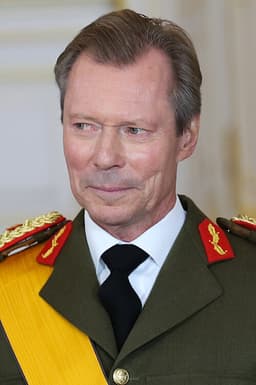
Henri of Luxembourg
Emperor · Modern
45.2Total

Peter II of Russia
Emperor · Modern
40.4Total
Basic Information
Born
1955
1715
Died
—
1730
Era
Modern
Modern
Nationality
Luxembourg
Russia
Occupation
Emperor
Emperor
Civilization
Western
Western
Score Comparison
Military (10%)
46.2
48.6
Political (20%)
33.6
32.1
Influence (20%)
47.9
45.5
Legacy (20%)
35.0
34.2
Leadership (15%)
61.6
34.6
Strategy (15%)
55.5
56.1
TOTAL
45.2
40.4
Henri of Luxembourg — Complete Timeline
2000 AD
Accession to the thronePolitical Action◆ Major
Henri became Grand Duke of Luxembourg on October 7, 2000, following the abdication of his father, Grand Duke Jean. He inherited a constitutional monarchy with limited powers, serving as head of state and symbol of national unity.
AccessionMonarchyLuxembourg
Impact: national
Representation of Luxembourg internationallyCultural
As Grand Duke, Henri represented Luxembourg in numerous international events, including state visits, EU summits, and cultural exchanges. He promoted Luxembourg's role as a founding member of the EU and its financial center, strengthening diplomatic ties.
DiplomacyEUInternational Relations
Impact: regionalconstructive
2008 AD
Constitutional role in legislative processPolitical Action◆ Major
In 2008, Henri refused to sign a law legalizing euthanasia on moral grounds, leading to a constitutional crisis. The parliament subsequently amended the constitution to remove the Grand Duke's formal role in the legislative process, reducing his powers to a purely ceremonial function.
Constitutional CrisisEuthanasiaMonarchy
Impact: national
Peter II of Russia — Complete Timeline
1727 AD
Accession as Emperor of RussiaPolitical Action◆ Major
Peter II ascended the throne at age 11 after the death of Catherine I, under the regency of the Supreme Privy Council. His accession was orchestrated by the Dolgorukov family, who sought to control the young tsar. He was the last male Romanov to rule.
SuccessionRegencyRomanov
Impact: national
Exile of Alexander MenshikovPolitical Action◆ Major
Peter II, influenced by the Dolgorukovs, ordered the arrest and exile of Alexander Menshikov, the powerful former regent. Menshikov was stripped of his titles and sent to Siberia, ending his dominance. This event marked the rise of the Dolgorukov family at court.
ExilePower StruggleDolgorukov
Impact: nationaldestructive
1728 AD
Move of the Court to MoscowPolitical Action◆ Major
Peter II moved the imperial court from Saint Petersburg back to Moscow, reversing Peter the Great's Westernizing policy. This relocation reflected the influence of conservative nobles and weakened the new capital's status. The court remained in Moscow until his death.
Court RelocationMoscowConservatism
Impact: national
1730 AD
Death from SmallpoxOther◆ Major
Peter II died of smallpox at age 14 on the day of his planned wedding to Ekaterina Dolgorukova. His death ended the male line of the Romanov dynasty and triggered a succession crisis, leading to the accession of Anna of Russia. The event was sudden and unexpected.
DeathSmallpoxSuccession Crisis
Impact: nationaltragic
Expert Analysis
Origins
Henri of Luxembourg was born on April 16, 1955, in Betzdorf Castle, Luxembourg, as the eldest son of Grand Duke Jean and Princess Joséphine-Charlotte of Belgium. He was educated in Luxembourg, France, and the United Kingdom, studying at the Royal Military Academy Sandhurst and later at the University of Geneva, where he earned a degree in political science. His upbringing prepared him for a constitutional role.
Peter II of Russia was born on October 23, 1715, in Saint Petersburg, the only son of Tsarevich Alexei Petrovich and Princess Charlotte of Brunswick-Wolfenbüttel. His father was executed by Peter the Great in 1718, leaving young Peter in a precarious position. He was raised under the shadow of his grandfather's reforms and the court intrigues that followed.
Rise to Power
Henri became Grand Duke on October 7, 2000, when his father abdicated in his favor. This peaceful transition was the result of decades of preparation; Henri had already served as Lieutenant-Representative since 1998. His rise was constitutional and uneventful, reflecting the stability of Luxembourg's monarchy.
Peter II ascended the throne on May 18, 1727, at age 11, after the death of Empress Catherine I. His accession was orchestrated by the Supreme Privy Council, dominated by the powerful Prince Alexander Menshikov. Menshikov initially acted as regent, but Peter II quickly fell under the influence of the Dolgorukov family, who engineered Menshikov's exile in September 1727.
Leadership & Governance
Henri operates within a constitutional framework. His role is largely ceremonial and representative. In 2008, he refused to sign a euthanasia law on moral grounds, triggering a constitutional crisis. Parliament amended the constitution to remove the monarch's veto power, limiting his influence. Henri scored 61.6 in leadership, reflecting his adherence to constitutional norms despite personal convictions.
Peter II ruled with absolute authority, but his youth meant the government was run by favorites. He reversed Peter the Great's Westernizing policies, moving the court from Saint Petersburg to Moscow in 1728. This shift weakened the central government and strengthened the old nobility. His political score of 32.1 reflects his short, ineffective reign.
Triumph & Tragedy
Henri's greatest success is maintaining the monarchy's relevance in a modern democracy. His constitutional crisis and subsequent amendment resolved without destabilizing the state. However, his influence is limited; his total score of 45.2 reflects a modest impact.
Peter II's exile of Menshikov freed him from a domineering regent, but his reliance on the Dolgorukovs led to poor governance. His greatest tragedy was his death from smallpox at age 14 on January 30, 1730, the day of his planned wedding. This ended the male line of the Romanov dynasty, leading to a succession crisis. His military score of 48.6 is nominal, given he never commanded armies.
Character & Destiny
Henri is seen as dutiful and reserved, prioritizing stability over personal power. His refusal to sign the euthanasia law showed moral conviction, but he ultimately accepted constitutional limits. His legacy score of 35.0 reflects his non-controversial, low-key rule.
Peter II was influenced by court factions, lacking the will or experience to rule independently. His character was shaped by the isolation and pressure of being a teenage emperor. His early death cut short any potential for development, sealing his fate as a footnote in history.
Legacy
Henri's legacy is as a modern constitutional monarch who upheld the traditions of Luxembourg while adapting to democratic norms. His role in the euthanasia crisis set a precedent for limiting royal power. Luxembourg remains a stable, prosperous nation.
Peter II's legacy is minimal: his reign saw the temporary reversal of Peter the Great's reforms and the end of the Romanov male line. The court's return to Moscow was reversed by his successor, Anna Ioannovna. His influence score of 45.5 is inflated by his position, not his actions.
Conclusion
Henri of Luxembourg, with a total score of 45.2 compared to Peter II's 40.4, had a greater impact. While Henri's power is limited, his reign has been stable and constitutionally significant. Peter II's rule was brief and reactionary, contributing little to Russia's development. Henri's influence, though modest, is more substantive than Peter's, whose legacy is defined by his untimely death. Thus, Henri emerges as the more effective and lasting figure.
Rankings
🥇
Henri of LuxembourgLeader
Mil: 46.2Pol: 33.6Inf: 47.9
45.2
🥈
Peter II of Russia
Mil: 48.6Pol: 32.1Inf: 45.5
40.4
+4.8 behind
How This Comparison Works
Algorithm
Each figure is scored on 6 dimensions (0—100 scale) based on structured historical data: Military (10%), Political (20%), Influence (20%), Legacy (20%), Leadership (15%), Strategy (15%). The weighted total produces the final ranking.
Data Sources
Scores are computed from structured sub-indicators in the database. Scale factors adjust for era (Ancient ×0.85, Modern ×1.0) and civilization size (Eastern ×1.05, Other ×0.80) to account for differences in population and military scale.
Maximum 3 Figures
Comparisons are limited to 2—3 figures to ensure readability and statistical meaningfulness.
Error Margins
±5 points per dimension — Sub-scores are derived from historical records with inherent uncertainty. Two figures within 5 points on a dimension should be considered roughly equivalent in that area.
Total Score Accuracy
±3 points overall — The weighted combination of 6 dimensions produces a total score with approximately ±3 points of uncertainty. Differences of less than 3 points are not statistically significant— the figures are effectively tied.
Known Limitations
- Historical records are incomplete and uneven across civilizations
- Figures from oral-tradition societies may be underrepresented
- Occupation labels can misclassify multi-role figures
- Scores measure capability and impact, not moral character
- Quantitative scoring is a comparison tool, not absolute truth
Capability Radar
Military (10%) — Battles & Warfare
Battles
26
21
Win Rate
28
28
Expansion
28
29
Political (20%) — Governance & Reform
Reform
15
5
Diplomacy
30
5
Economy
25
5
Influence (20%) — Cultural & Global Reach
Cultural
15
5
Global
10
5
Legacy (20%) — Historical Impact
Historical
10
10
Longevity
10
5
Leadership (15%) — Power & Stability
Tenure
24
10
Stability
35
10
Strategy (15%) — Tactics & Innovation
Strategy
35
33
Tactics
38
35
Reform
38
40
Similar Comparisons
Comments & Discussion
No comments yet. Be the first to share your thoughts!