Loading...
Henri of Luxembourg vs Napoleon Bonaparte
Napoleon Bonaparte leads by 25.7 pts · 2 figures compared
…
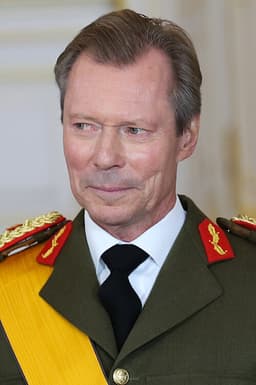
Henri of Luxembourg
Emperor · Modern
45.2Total

Napoleon Bonaparte
General · Modern
70.9Total
Basic Information
Born
1955
1769
Died
—
1821
Era
Modern
Modern
Nationality
Luxembourg
France
Occupation
Emperor
General
Civilization
Western
Western
Score Comparison
Military (10%)
46.2
94.0
Political (20%)
33.6
72.0
Influence (20%)
47.9
40.0
Legacy (20%)
35.0
80.0
Leadership (15%)
61.6
78.0
Strategy (15%)
55.5
90.0
TOTAL
45.2
70.9
Henri of Luxembourg — Complete Timeline
2000 AD
Accession to the thronePolitical Action◆ Major
Henri became Grand Duke of Luxembourg on October 7, 2000, following the abdication of his father, Grand Duke Jean. He inherited a constitutional monarchy with limited powers, serving as head of state and symbol of national unity.
AccessionMonarchyLuxembourg
Impact: national
Representation of Luxembourg internationallyCultural
As Grand Duke, Henri represented Luxembourg in numerous international events, including state visits, EU summits, and cultural exchanges. He promoted Luxembourg's role as a founding member of the EU and its financial center, strengthening diplomatic ties.
DiplomacyEUInternational Relations
Impact: regionalconstructive
2008 AD
Constitutional role in legislative processPolitical Action◆ Major
In 2008, Henri refused to sign a law legalizing euthanasia on moral grounds, leading to a constitutional crisis. The parliament subsequently amended the constitution to remove the Grand Duke's formal role in the legislative process, reducing his powers to a purely ceremonial function.
Constitutional CrisisEuthanasiaMonarchy
Impact: national
Napoleon Bonaparte — Complete Timeline
1799 AD
Coup of 18 BrumaireOther◆ Major
Napoleon Bonaparte, with support from his brother Lucien and key political figures, overthrew the Directory in a bloodless coup. He established the Consulate with himself as First Consul, effectively becoming the ruler of France. This event ended the French Revolution's most unstable period.
French RevolutionCoupRise to Power
Impact: regional
1804 AD
Promulgation of the Napoleonic CodeOther◆ Major
Napoleon enacted the Civil Code of the French, known as the Napoleonic Code, a comprehensive set of laws that replaced the fragmented feudal legal systems. The code established legal equality, protected property rights, and secularized law. It became the basis for legal systems in many European and world countries.
Legal ReformNapoleonic CodeCivil Law
Impact: globalconstructive
1805 AD
Battle of AusterlitzWar◆ Major
Napoleon's Grande Arm
Napoleonic WarsBattleDecisive Victory
Impact: global
1812 AD
Invasion of RussiaWar◆ Major
Napoleon led the Grande Arm
Napoleonic WarsInvasionDisaster
Impact: globaldestructive
1815 AD
Battle of WaterlooWar◆ Major
Napoleon's French army was defeated by the combined forces of the Duke of Wellington's Anglo-Allied army and Gebhard Leberecht von Bl
Napoleonic WarsBattleFinal Defeat
Impact: globaldestructive
Expert Analysis
henri-of-luxembourg-vs-napoleon-bonaparte
# The Emperor and the Grand Duke: Two Faces of Modern Power
On a June morning in 1815, Napoleon Bonaparte stood on a muddy field near Waterloo, watching his Imperial Guard march into cannon fire. Less than two centuries later, on an October day in 2000, Henri of Luxembourg stepped into a palace in a small European capital, inheriting a throne that had long ceased to command armies. Both were rulers. Both bore titles that evoked centuries of tradition. But between them lay an abyss not merely of time, but of what it meant to lead.
Origins
Napoleon was born in 1769 on the island of Corsica, a place only recently annexed by France, into a minor noble family of Italian origin. His childhood was marked by the fierce independence of his homeland and the humiliations of poverty. He spoke French with an accent, was mocked by schoolmates, and burned with an ambition that seemed almost absurd for a boy from the backwater of Ajaccio. The old order of Europe, with its kings and aristocrats, was a system designed to keep men like him in their place.
Henri, born in 1955, came into the world as the eldest son of Grand Duke Jean of Luxembourg. His cradle was a palace, his future mapped out before he could speak. The grand duchy was a constitutional monarchy, a tiny state wedged between France and Germany, its survival dependent not on conquest but on diplomacy. Henri’s education was a preparation for a role that was ceremonial, not commanding. Where Napoleon learned mathematics and artillery, Henri studied political science and international law.
Rise to Power
Napoleon’s ascent was a revolution in itself. The French Revolution shattered the old hierarchies, and he seized the opportunity with both hands. At 24, he drove the British out of Toulon. At 26, he saved the revolutionary government from a royalist uprising. By 30, he had conquered Italy and Egypt. In 1799, at just 30, he staged a coup and made himself First Consul. Five years later, he crowned himself Emperor in Notre Dame, taking the crown from the Pope’s hands and placing it on his own head.
Henri’s rise was the opposite of dramatic. He studied at the Royal Military Academy Sandhurst, served in the Luxembourg army, and took part in ceremonial duties. When his father abdicated on October 7, 2000, Henri simply stepped into the role. There was no battle, no coup, no moment of destiny. The throne came to him as quietly as the morning.
Leadership & Governance
Napoleon governed as he conquered: with energy, genius, and an iron will. He rewrote French law with the Napoleonic Code, a system that still influences legal thinking across Europe and beyond. He centralized the state, reformed education, and built roads and canals. But his greatest talent was war. His campaigns are still studied in military academies: the lightning marches, the crushing victories at Austerlitz and Jena, the ability to turn a continent into a chessboard.
His political wisdom, however, was flawed. He could not stop. He placed his brothers on thrones, created a new aristocracy, and treated Europe as his personal estate. The Continental System, designed to strangle Britain, instead strangled his own empire. His invasion of Russia in 1812 was a catastrophe that cost half a million men.
Henri governs as a constitutional monarch. He signs laws, receives ambassadors, and represents Luxembourg at EU summits. In 2008, he refused to sign a law legalizing euthanasia, citing moral objections. The parliament simply amended the constitution to remove the need for royal assent. It was a crisis, but a quiet one, resolved without bloodshed. His power is symbolic, his influence moral rather than military. His score of 32.5 in military capability is not a failure; it is a reflection of a world where generals no longer rule.
Triumph & Tragedy
Napoleon’s greatest moment came on December 2, 1805, at Austerlitz, where he destroyed the combined armies of Russia and Austria. It was a masterpiece of strategy, a battle so perfect that it became a legend. His worst came at Waterloo, where his old magic failed, his generals hesitated, and the Prussian arrival sealed his fate. He died in exile on Saint Helena in 1821, a prisoner of the British, his empire reduced to memory.
Henri’s triumphs are quieter. He has presided over Luxembourg’s transformation into one of the wealthiest nations on earth, a center of finance and European cooperation. His tragedy, if it can be called that, is the irrelevance of his role. He is a king without a sword, a ruler who cannot command a single soldier into battle. His legacy score of 47.7 reflects not personal failure but the diminished nature of monarchy itself.
Character & Destiny
Napoleon was driven by an insatiable hunger. “I live only for posterity,” he once said, and he meant it. He was brilliant, ruthless, and incapable of moderation. His personality shaped his destiny: his ambition built an empire, and his ambition destroyed it. He could not stop because he did not know how.
Henri is a man of duty, not ambition. He accepted a role he did not choose and performs it with grace. His character is that of a caretaker, not a conqueror. Where Napoleon’s decisions changed the map of Europe, Henri’s decisions change almost nothing. That is not a judgment; it is the reality of modern monarchy.
Legacy
Napoleon’s legacy is everywhere. The Napoleonic Code governs France, Italy, and much of Latin America. His military tactics are taught in every war college. He is remembered as a genius and a tyrant, a liberator and a conqueror. His score of 82.4 on the composite index places him among the most significant figures in history.
Henri’s legacy is Luxembourg itself. He has kept a tiny nation stable, prosperous, and respected. He will be remembered as a good man who did his duty. That is not a small thing, but it is a small thing compared to Napoleon.
Conclusion
The comparison between Napoleon and Henri is not really a comparison at all. It is a meditation on the transformation of power. Napoleon embodied the age of empire, when one man could bend the world to his will. Henri embodies the age of institutions, when power is diffused, constrained, and ceremonial. One conquered Europe with cannon; the other represents a country that no one needs to conquer. Between them lies the whole story of modern history: the rise and fall of absolute power, and the quiet triumph of the ordinary.
Rankings
🥇
Napoleon BonaparteLeader
Mil: 94.0Pol: 72.0Inf: 40.0
70.9
🥈
Henri of Luxembourg
Mil: 46.2Pol: 33.6Inf: 47.9
45.2
+25.7 behind
How This Comparison Works
Algorithm
Each figure is scored on 6 dimensions (0—100 scale) based on structured historical data: Military (10%), Political (20%), Influence (20%), Legacy (20%), Leadership (15%), Strategy (15%). The weighted total produces the final ranking.
Data Sources
Scores are computed from structured sub-indicators in the database. Scale factors adjust for era (Ancient ×0.85, Modern ×1.0) and civilization size (Eastern ×1.05, Other ×0.80) to account for differences in population and military scale.
Maximum 3 Figures
Comparisons are limited to 2—3 figures to ensure readability and statistical meaningfulness.
Error Margins
±5 points per dimension — Sub-scores are derived from historical records with inherent uncertainty. Two figures within 5 points on a dimension should be considered roughly equivalent in that area.
Total Score Accuracy
±3 points overall — The weighted combination of 6 dimensions produces a total score with approximately ±3 points of uncertainty. Differences of less than 3 points are not statistically significant— the figures are effectively tied.
Known Limitations
- Historical records are incomplete and uneven across civilizations
- Figures from oral-tradition societies may be underrepresented
- Occupation labels can misclassify multi-role figures
- Scores measure capability and impact, not moral character
- Quantitative scoring is a comparison tool, not absolute truth
Capability Radar
Military (10%) — Battles & Warfare
Battles
26
95
Win Rate
28
90
Expansion
28
95
Political (20%) — Governance & Reform
Reform
15
95
Diplomacy
30
80
Economy
25
85
Influence (20%) — Cultural & Global Reach
Cultural
15
85
Global
10
90
Legacy (20%) — Historical Impact
Historical
10
95
Longevity
10
90
Leadership (15%) — Power & Stability
Tenure
24
85
Stability
35
70
Strategy (15%) — Tactics & Innovation
Strategy
35
95
Tactics
38
98
Reform
38
92
Similar Comparisons
Comments & Discussion
LION OF AJACCIO6/17/2026
Napoleon's rise from Corsican obscurity to master of Europe is a story of sheer will against a system designed to exclude him. Henri inherited a gilded cage; Napoleon seized an empire. Waterloo wasn't a failure of ambition but of arithmetic—the Coalition simply had more men. Henri's Luxembourg is a tax haven, not a battlefield. One man conquered continents with bayonets, the other inherited a bank vault. Give me the hungry corsair over the pampered prince any day.
沙场铁算盘6/17/2026
数据上两人根本不在一个维度。拿破仑1805年动员近20万大军在三皇会战粉碎俄奥联军,而亨利大公的军队总共不到一千人,连维持阅兵式都够呛。拿破仑在位期间法国人口从2800万增长到近3000万,战争损耗远低于拿破仑本人的宣传数字。这种君主对比简直是拿铁砧和羽毛秤较量。
CLASSICS COLLECTOR6/17/2026
The fundamental difference is legitimacy. Napoleon manufactured his through plebiscites and battlefield glory, crowning himself in Notre Dame to hijack imperial Rome's legacy. Henri's authority flows from centuries of dynastic continuity, his title pre-dating Napoleon's upstart empire by 400 years. One conquered La Grande Armée; the other conquered Luxembourg's constitutional law. Napoleon's ambition made him an emperor of men; Henri's restraint makes him an emperor of handkerchiefs.
纸上谈兵客6/17/2026
军事史爱好者必须指出这不公平。拿破仑在1807年弗里德兰战役后控制了整个欧陆,连普鲁士女王都来求饶。亨利大公别说打赢一场战役,连一个团的步兵都指挥不了。拿破仑把革命的火种变成征服的铁蹄,亨利只是拿着家族勋章在议会里签签字。一个是铁血大帝,一个是镀金摆设。
REVISIONIST'S QUARRY6/17/2026
Let's not canonize Napoleon as some romantic underdog. He re-established slavery, sold Louisiana to fund wars, and left France smaller than he found it. Henri never conquered anyone, but he didn't need to. He presides over the world's second-richest GDP per capita, a banking stability Napoleon could never achieve. The Corsican burned Europe for glory; the Grand Duke kept his tiny nation wealthy, peaceful, and free. Which legacy truly serves humanity?