Loading...
He Long vs Julius Caesar
Julius Caesar leads by 22.8 pts · 2 figures compared
…
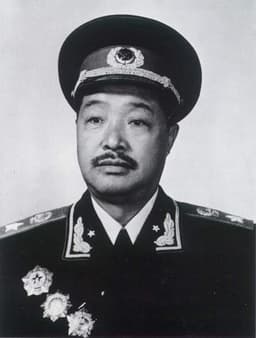
He Long
General · Modern
60.0Total

Julius Caesar
General · Ancient
82.8Total
Basic Information
Born
1896
-100
Died
1969
-44
Era
Modern
Ancient
Nationality
China
Roman Republic
Occupation
General
General
Civilization
Eastern
Western
Score Comparison
Military (10%)
67.5
88.0
Political (20%)
68.0
78.0
Influence (20%)
57.2
85.0
Legacy (20%)
52.0
82.0
Leadership (15%)
72.0
80.0
Strategy (15%)
50.0
85.0
TOTAL
60.0
82.8
He Long — Complete Timeline
1927 AD
Led the Nanchang UprisingWar
He Long led the Nanchang Uprising, the first major armed conflict between the Chinese Communist Party and the Nationalists. Although the uprising failed, it is celebrated as the founding moment of the People's Liberation Army.
Chinese Civil WarUprisingPLA Founding
Impact: nationaldestructive
1937 AD
Commander of the 120th Division in the Second Sino-Japanese WarWar◆ Major
He Long commanded the 120th Division of the Eighth Route Army, operating in the Shanxi-Chahar-Hebei border region. He led guerrilla campaigns against Japanese forces and expanded Communist-controlled territory.
Second Sino-Japanese WarGuerrilla Warfare
Impact: regional
1955 AD
Appointed Marshal of the People's Liberation ArmyPolitical Action◆ Major
He Long was appointed as one of the ten marshals of the People's Liberation Army. This honor recognized his contributions to the Communist victory and his role in the Nanchang Uprising.
Military HonorPLA
Impact: nationalconstructive
1969 AD
Purged and Died in Prison during the Cultural RevolutionPolitical Action◆ Major
He Long was purged by Mao Zedong during the Cultural Revolution, accused of being a 'counter-revolutionary.' He was imprisoned and died in custody in 1969, later being posthumously rehabilitated in 1982.
Cultural RevolutionPolitical PurgeDeath
Impact: nationaltragic
Julius Caesar — Complete Timeline
58 BC
Gallic WarsWar◆ Major
Caesar, as proconsul of Gaul, launched a series of campaigns that conquered all of Gaul (modern France, Belgium, and parts of Switzerland). He fought numerous battles, including against the Helvetii, the Belgae, and the Gallic chieftain Vercingetorix. The wars brought immense wealth and a loyal army to Caesar.
Gallic WarsConquestRoman Expansion
Impact: regional
49 BC
Crossing the RubiconPolitical Action◆ Major
Caesar led Legio XIII across the Rubicon River into Italy, defying the Roman Senate's order to disband his army. This act triggered a civil war against Pompey and the Optimates, ultimately leading to Caesar's dictatorship and the end of the Roman Republic.
Roman Civil WarEnd of RepublicPower Struggle
Impact: global
48 BC
Battle of PharsalusWar◆ Major
Caesar's outnumbered army defeated the larger forces of Pompey the Great at Pharsalus in Greece. Caesar's tactical use of a reserve line to counter Pompey's cavalry charge proved decisive. Pompey fled to Egypt, where he was assassinated, leaving Caesar as the undisputed master of the Roman world.
Roman Civil WarBattleDecisive Victory
Impact: regional
44 BC
Appointment as Dictator for LifePolitical Action◆ Major
The Roman Senate appointed Caesar dictator perpetuo (dictator for life), granting him unprecedented personal power. This move concentrated military, legislative, and judicial authority in one person, effectively ending the Roman Republic's traditional system of checks and balances and alarming many senators.
DictatorshipEnd of RepublicPower Consolidation
Impact: regionaldestructive
Assassination on the Ides of MarchPolitical Action◆ Major
A group of Roman senators, led by Marcus Junius Brutus and Gaius Cassius Longinus, stabbed Caesar to death at a meeting of the Senate in the Theatre of Pompey. The assassination was intended to restore the Republic, but instead triggered another civil war that led to the rise of the Roman Empire.
AssassinationRoman PoliticsEnd of Republic
Impact: globaldestructive
Expert Analysis
he-long-vs-julius-caesar
# The General and the Revolutionary: Two Paths of Power
On a March morning in 44 BCE, Julius Caesar fell beneath twenty-three dagger blows in the Senate chamber of Rome, his blood pooling on the marble floor where he had once stood as master of the known world. Nearly two thousand years later, in a Beijing prison cell in 1969, He Long died alone, broken by the very revolution he had helped to ignite. Both men were generals who reshaped their worlds; both met violent ends at the hands of those they trusted. Yet the arcs of their lives could not have been more different—one a conqueror who became a god, the other a revolutionary who became a ghost.
Origins
Julius Caesar was born into the twilight of the Roman Republic, a world of senatorial rivalries, slave armies, and a political system straining under the weight of empire. His family, the Julii, claimed descent from the goddess Venus, but they were not among the ruling elite. Caesar’s father died when he was sixteen, leaving him to navigate a treacherous world of debt, patronage, and civil war. The Rome of his youth was a place where a man could rise by military glory, political cunning, or sheer audacity—and Caesar would master all three.
He Long emerged from a very different soil. Born in 1896 in Sangzhi County, Hunan, he grew up in a China crumbling under the weight of the Qing Dynasty’s collapse, foreign exploitation, and warlord chaos. His family were peasants, not patricians; his father was a poor farmer who died when He Long was young. Where Caesar learned rhetoric in the forums of Rome, He Long learned to wield a knife in the gang fights of Hunan’s countryside. His first act of rebellion, at age fourteen, was to kill a corrupt official—a deed that set him on a path of violence that would never truly end.
Rise to Power
Caesar’s ascent was a masterpiece of calculated risk. He borrowed fortunes to buy popularity, served as a military tribune in Spain, and returned to Rome to forge the First Triumvirate with Pompey and Crassus. But his true springboard was Gaul. Between 58 and 50 BCE, he conquered a territory larger than Italy itself, amassing a loyal army and an immense personal fortune. When the Senate ordered him to disband his forces, he crossed the Rubicon River in 49 BCE, igniting a civil war that would make him master of Rome. His military score of 88 reflects not merely battlefield brilliance but the strategic genius to turn conquest into political capital.
He Long’s rise was less a single stroke than a series of desperate gambles. In 1927, he co-led the Nanchang Uprising, the first armed clash between the Chinese Communist Party and the Nationalists. It failed militarily—his forces were crushed—but it succeeded politically: it marked the birth of the Red Army. He Long fled to the mountains, where he built guerrilla forces from peasants and bandits, his leadership score of 84.8 reflecting an ability to inspire loyalty in men who had nothing to lose. By 1937, he commanded the 120th Division of the Eighth Route Army, fighting the Japanese in the Shanxi-Chahar-Hebei border region. His path was not one of conquest but of survival—a slow, grinding war of attrition that demanded political endurance as much as military skill.
Leadership & Governance
Caesar governed as he conquered: with speed, brilliance, and a touch of mercy that disarmed his enemies. As dictator, he reformed the calendar, granted citizenship to provincials, and launched public works that employed the poor. His political score of 78 understates his genius: he understood that power in Rome came from spectacle and generosity, not just legions. Yet his reforms were never completed. He ruled for only a year as dictator for life, and his assassination revealed the fatal flaw in his approach—he centralized power without building institutions to sustain it.
He Long governed in a world where politics was war by other means. After the Communist victory in 1949, he was appointed one of ten marshals of the People’s Liberation Army in 1955, a ceremonial honor that masked a deeper struggle. His political score of 85.9 reflects his ability to navigate the treacherous currents of Mao Zedong’s China. He was not a strategist—his strategy score of 58.6 is the lowest among the ten marshals—but he was a survivor, a man who understood that in revolutionary China, loyalty mattered more than tactics. He helped suppress banditry in the southwest, built infrastructure, and kept his head down while others rose and fell.
Triumph & Tragedy
Caesar’s greatest triumph was Gaul—a decade of conquest that made him a legend and gave him the army that would carry him to power. His greatest tragedy was his own success. By destroying the Republic, he made himself a target. The Ides of March was not a failure of arms but of political imagination: he could not conceive of a system that did not revolve around himself.
He Long’s triumph was the Nanchang Uprising, a defeat that became a founding myth. His tragedy was the Cultural Revolution. In 1969, Mao turned on the very marshals who had built his army. He Long was arrested, accused of being a “counter-revolutionary,” and died in prison—starved, beaten, forgotten. His death was not a dramatic assassination but a slow erasure, a bureaucratic murder that mirrored the cold efficiency of the state he had helped create.
Character & Destiny
Caesar was a gambler who believed in his own star. He wrote his own history, both in the Commentaries on the Gallic War and in the coins that bore his image. His personality—arrogant, generous, calculating—drove him to take risks that would have destroyed lesser men. He died because he could not imagine a world where he was not in control.
He Long was a survivor who believed in the cause. He was a man of action, not words—he left no memoirs, no philosophical treatises. His personality—rough, loyal, pragmatic—allowed him to endure decades of war and political turmoil. He died because the revolution he served became a monster that consumed its own children.
Legacy
Caesar’s legacy is the Roman Empire. His name became a title—Kaiser, Tsar—and his reforms shaped Western civilization for two millennia. He is remembered as a genius, a tyrant, and a martyr, a figure who embodies both the glory and the danger of absolute power.
He Long’s legacy is more ambiguous. After his death, he was rehabilitated in 1978, his ashes placed in the Babaoshan Revolutionary Cemetery. But he remains a footnote in Western histories, a name known mainly to scholars. In China, he is honored as a founding marshal, yet his story is a cautionary tale: the revolutionary who lived long enough to be destroyed by his own creation.
Conclusion
Two generals, two centuries, two worlds. Caesar crossed a river and changed history; He Long crossed a battlefield and was erased by it. One built an empire that lasted a thousand years; the other helped build a state that would outlive him by decades. Their fates remind us that power is never safe, that the sword cuts both ways, and that the men who shape history are often shaped by forces they cannot control. In the end, both died violently—but Caesar’s death became a legend, while He Long’s became a silence. That difference is the measure of their worlds.
Rankings
🥇
Julius CaesarLeader
Mil: 88.0Pol: 78.0Inf: 85.0
82.8
🥈
He Long
Mil: 67.5Pol: 68.0Inf: 57.2
60.0
+22.8 behind
How This Comparison Works
Algorithm
Each figure is scored on 6 dimensions (0—100 scale) based on structured historical data: Military (10%), Political (20%), Influence (20%), Legacy (20%), Leadership (15%), Strategy (15%). The weighted total produces the final ranking.
Data Sources
Scores are computed from structured sub-indicators in the database. Scale factors adjust for era (Ancient ×0.85, Modern ×1.0) and civilization size (Eastern ×1.05, Other ×0.80) to account for differences in population and military scale.
Maximum 3 Figures
Comparisons are limited to 2—3 figures to ensure readability and statistical meaningfulness.
Error Margins
±5 points per dimension — Sub-scores are derived from historical records with inherent uncertainty. Two figures within 5 points on a dimension should be considered roughly equivalent in that area.
Total Score Accuracy
±3 points overall — The weighted combination of 6 dimensions produces a total score with approximately ±3 points of uncertainty. Differences of less than 3 points are not statistically significant— the figures are effectively tied.
Known Limitations
- Historical records are incomplete and uneven across civilizations
- Figures from oral-tradition societies may be underrepresented
- Occupation labels can misclassify multi-role figures
- Scores measure capability and impact, not moral character
- Quantitative scoring is a comparison tool, not absolute truth
Capability Radar
Military (10%) — Battles & Warfare
Battles
65
95
Win Rate
60
92
Expansion
55
97
Political (20%) — Governance & Reform
Reform
45
90
Diplomacy
50
85
Economy
40
82
Influence (20%) — Cultural & Global Reach
Cultural
40
88
Global
35
94
Legacy (20%) — Historical Impact
Historical
55
95
Longevity
45
96
Leadership (15%) — Power & Stability
Tenure
55
75
Stability
45
60
Strategy (15%) — Tactics & Innovation
Strategy
60
94
Tactics
55
96
Reform
50
88
Similar Comparisons
Comments & Discussion
No comments yet. Be the first to share your thoughts!