Loading...
This comparison has not been analyzed yet.
One-time AI generation (~1 minute). Scores and timeline are already available below.
Hatshepsut vs Shulgi
Shulgi leads by 7.7 pts · 2 figures compared
…
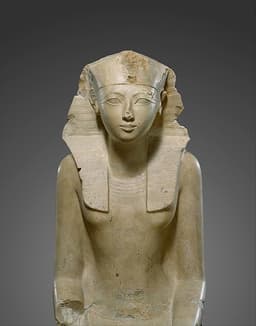
Hatshepsut
Emperor · Ancient
54.9Total

Shulgi
Emperor · Ancient
62.6Total
Basic Information
Born
-1507
-2094
Died
-1458
-2047
Era
Ancient
Ancient
Nationality
Egypt
Sumer
Occupation
Emperor
Emperor
Civilization
Middle Eastern
Middle Eastern
Score Comparison
Military (10%)
50.0
70.0
Political (20%)
59.3
59.3
Influence (20%)
61.0
61.0
Legacy (20%)
50.0
58.0
Leadership (15%)
72.0
80.0
Strategy (15%)
25.0
50.0
TOTAL
54.9
62.6
Hatshepsut — Complete Timeline
1479 BC
Coronation as PharaohPolitical Action
Hatshepsut assumed the throne as pharaoh after the death of her husband Thutmose II, initially as regent for her stepson Thutmose III. She later declared herself king, adopting full royal titulary and male iconography to legitimize her rule.
SuccessionFemale PharaohLegitimacy
Impact: national
1470 BC
Expedition to the Land of PuntCultural◆ Major
Hatshepsut dispatched a trading expedition to the Land of Punt, likely located in the Horn of Africa. The mission returned with myrrh trees, gold, ivory, and exotic animals, which were depicted in reliefs at her mortuary temple at Deir el-Bahri.
TradePuntDeir el-Bahri
Impact: regionalconstructive
1460 BC
Construction of Mortuary Temple at Deir el-BahriCultural◆ Major
Hatshepsut commissioned a terraced mortuary temple at Deir el-Bahri, designed by her architect Senenmut. The temple featured colonnades, reliefs of her divine birth and the Punt expedition, and became a masterpiece of Egyptian architecture.
ArchitectureSenenmutMortuary Temple
Impact: nationalconstructive
1458 BC
Damnation of Hatshepsut's MemoryPolitical Action◆ Major
After Hatshepsut's death, Thutmose III ordered the systematic erasure of her name and images from monuments and temples. Her cartouches were chiseled out, and her statues were smashed, likely to consolidate his own legitimacy and remove her from official records.
Damnatio MemoriaeThutmose IIIIconoclasm
Impact: nationaldestructive
1457 BC
Obelisk Erection at KarnakCultural
Hatshepsut erected two massive obelisks at the Karnak temple, one of which still stands. The obelisks were carved from single blocks of granite and inscribed with texts proclaiming her devotion to the god Amun and her right to rule.
MonumentObeliskAmun
Impact: nationalconstructive
Shulgi — Complete Timeline
2090 BC
Deified himself as a godCultural◆ Major
Shulgi declared himself a god during his reign, establishing a cult of personality. He was worshipped as a divine king in temples across Sumer, with hymns and prayers composed in his honor, setting a precedent for later Mesopotamian rulers.
DeificationReligionSumer
Impact: regional
2085 BC
Reformed the administrative and legal systemReform◆ Major
Shulgi implemented administrative reforms including standardization of weights and measures, creation of a centralized bureaucracy, and codification of laws. These reforms improved tax collection, trade, and governance across the Ur III empire.
AdministrationLawReform
Impact: regionalconstructive
2080 BC
Expanded the Ur III empire through military campaignsWar◆ Major
Shulgi led military campaigns that expanded Ur's territory into regions such as Elam, Assyria, and the Zagros mountains. He established a network of fortresses and roads to control conquered areas, securing trade routes and tribute.
ConquestEmpireMilitary
Impact: regional
Built the Great Ziggurat of UrCultural◆ Major
Shulgi completed the construction of the Great Ziggurat of Ur, a massive stepped temple dedicated to the moon god Nanna. The structure, built of mud-brick, became a symbol of Ur's power and religious centrality in Mesopotamia.
ArchitectureZigguratReligion
Impact: regionalconstructive
2075 BC
Established a system of royal roads and waystationsReform
Shulgi built a network of roads with waystations and couriers to facilitate communication and trade across his empire. This system improved military logistics and administrative control, influencing later Persian and Roman road networks.
InfrastructureRoadsCommunication
Impact: regionalconstructive
This comparison has not been analyzed yet.
One-time AI generation (~1 minute). Scores and timeline are already available below.
Rankings
🥇
ShulgiLeader
Mil: 70.0Pol: 59.3Inf: 61.0
62.6
🥈
Hatshepsut
Mil: 50.0Pol: 59.3Inf: 61.0
54.9
+7.7 behind
How This Comparison Works
Algorithm
Each figure is scored on 6 dimensions (0—100 scale) based on structured historical data: Military (10%), Political (20%), Influence (20%), Legacy (20%), Leadership (15%), Strategy (15%). The weighted total produces the final ranking.
Data Sources
Scores are computed from structured sub-indicators in the database. Scale factors adjust for era (Ancient ×0.85, Modern ×1.0) and civilization size (Eastern ×1.05, Other ×0.80) to account for differences in population and military scale.
Maximum 3 Figures
Comparisons are limited to 2—3 figures to ensure readability and statistical meaningfulness.
Error Margins
±5 points per dimension — Sub-scores are derived from historical records with inherent uncertainty. Two figures within 5 points on a dimension should be considered roughly equivalent in that area.
Total Score Accuracy
±3 points overall — The weighted combination of 6 dimensions produces a total score with approximately ±3 points of uncertainty. Differences of less than 3 points are not statistically significant— the figures are effectively tied.
Known Limitations
- Historical records are incomplete and uneven across civilizations
- Figures from oral-tradition societies may be underrepresented
- Occupation labels can misclassify multi-role figures
- Scores measure capability and impact, not moral character
- Quantitative scoring is a comparison tool, not absolute truth
Capability Radar
Military (10%) — Battles & Warfare
Battles
10
55
Win Rate
10
60
Expansion
20
50
Political (20%) — Governance & Reform
Reform
75
75
Diplomacy
70
70
Economy
80
80
Influence (20%) — Cultural & Global Reach
Cultural
70
70
Global
55
55
Legacy (20%) — Historical Impact
Historical
65
70
Longevity
60
65
Leadership (15%) — Power & Stability
Tenure
70
80
Stability
75
75
Strategy (15%) — Tactics & Innovation
Strategy
15
55
Tactics
10
50
Reform
10
60
Similar Comparisons
Comments & Discussion
No comments yet. Be the first to share your thoughts!