Loading...
Hatshepsut vs Tai Geng of Shang
Hatshepsut leads by 14.7 pts · 2 figures compared
…
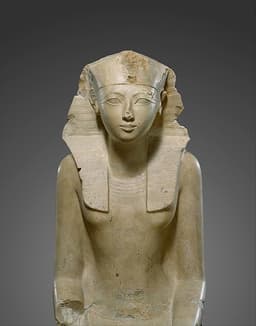
Hatshepsut
Emperor · Ancient
54.9Total

Tai Geng of Shang
Emperor · Ancient
40.2Total
Basic Information
Born
-1507
-1550
Died
-1458
-1520
Era
Ancient
Ancient
Nationality
Egypt
Shang China
Occupation
Emperor
Emperor
Civilization
Middle Eastern
Eastern
Score Comparison
Military (10%)
50.0
28.6
Political (20%)
59.3
26.4
Influence (20%)
61.0
43.2
Legacy (20%)
50.0
33.3
Leadership (15%)
72.0
55.3
Strategy (15%)
25.0
60.0
TOTAL
54.9
40.2
Hatshepsut — Complete Timeline
1479 BC
Coronation as PharaohPolitical Action
Hatshepsut assumed the throne as pharaoh after the death of her husband Thutmose II, initially as regent for her stepson Thutmose III. She later declared herself king, adopting full royal titulary and male iconography to legitimize her rule.
SuccessionFemale PharaohLegitimacy
Impact: national
1470 BC
Expedition to the Land of PuntCultural◆ Major
Hatshepsut dispatched a trading expedition to the Land of Punt, likely located in the Horn of Africa. The mission returned with myrrh trees, gold, ivory, and exotic animals, which were depicted in reliefs at her mortuary temple at Deir el-Bahri.
TradePuntDeir el-Bahri
Impact: regionalconstructive
1460 BC
Construction of Mortuary Temple at Deir el-BahriCultural◆ Major
Hatshepsut commissioned a terraced mortuary temple at Deir el-Bahri, designed by her architect Senenmut. The temple featured colonnades, reliefs of her divine birth and the Punt expedition, and became a masterpiece of Egyptian architecture.
ArchitectureSenenmutMortuary Temple
Impact: nationalconstructive
1458 BC
Damnation of Hatshepsut's MemoryPolitical Action◆ Major
After Hatshepsut's death, Thutmose III ordered the systematic erasure of her name and images from monuments and temples. Her cartouches were chiseled out, and her statues were smashed, likely to consolidate his own legitimacy and remove her from official records.
Damnatio MemoriaeThutmose IIIIconoclasm
Impact: nationaldestructive
1457 BC
Obelisk Erection at KarnakCultural
Hatshepsut erected two massive obelisks at the Karnak temple, one of which still stands. The obelisks were carved from single blocks of granite and inscribed with texts proclaiming her devotion to the god Amun and her right to rule.
MonumentObeliskAmun
Impact: nationalconstructive
Tai Geng of Shang — Complete Timeline
1550 BC
Peaceful Succession as Sixth Shang KingPolitical Action
Tai Geng succeeded his brother Wo Ding without recorded conflict, continuing the Shang tradition of fraternal succession. His reign was characterized by stability and the maintenance of existing policies, with no major wars or reforms recorded.
SuccessionStability
Expert Analysis
Origins
Hatshepsut was born around 1507 BCE to Pharaoh Thutmose I and his Great Royal Wife Ahmose. As a royal princess, she received education in religion, administration, and possibly military tactics. She married her half-brother Thutmose II, a common practice to secure the dynasty. Upon his death, she served as regent for his young son Thutmose III, but within a few years, she assumed full pharaonic power, adopting male regalia and titles. Tai Geng of Shang, by contrast, was born into the Shang dynasty in China, likely in the 14th century BCE. His exact birth year is uncertain due to limited records. He was the son of King Tai Wu and succeeded his brother Wo Ding without conflict, continuing the Shang tradition of fraternal succession. His early life is poorly documented, but he would have been trained in court rituals, governance, and the oracle bone divination that characterized Shang rule.
Rise to Power
Hatshepsut's rise was unconventional. After Thutmose II's death in 1479 BCE, she became regent for Thutmose III, who was about two years old. She gradually consolidated power, and by Year 7 of the regency, she had herself crowned pharaoh, claiming divine birth through the god Amun. She depicted herself as a male king with a beard and kilt to legitimize her rule. Her supporters included high officials like Senenmut and the priesthood of Amun. Tai Geng's rise was peaceful. He inherited the throne after his brother Wo Ding's death, likely around 1320 BCE. The Shang dynasty practiced fraternal succession, so his accession was routine. He faced no known rivals or rebellions, and his reign is noted for its stability, though specific details are scarce.
Leadership & Governance
Hatshepsut focused on trade and monumental building rather than military expansion. Her expedition to Punt in Year 9 brought back myrrh, incense, gold, and exotic animals, boosting Egypt's economy and prestige. She also commissioned the mortuary temple at Deir el-Bahri, a terraced structure that blended with the cliffs. Her obelisks at Karnak were the tallest of their time. She ruled for about 22 years, maintaining internal peace through effective administration. Tai Geng's governance is less documented but appears to have continued the Shang system of feudalism and ritual. The Shang king was both political and religious leader, performing divinations using oracle bones. Tai Geng's reign saw no major wars or internal strife, suggesting competent but uneventful rule. His leadership score of 55.3 reflects stability, while Hatshepsut's 72.0 indicates more active governance.
Triumph & Tragedy
Hatshepsut's greatest triumph was her successful reign as a female pharaoh, achieving economic prosperity and architectural wonders. The Punt expedition was a landmark in Egyptian trade. Her temple at Deir el-Bahri remains a masterpiece. However, her legacy was marred by Thutmose III's damnatio memoriae: after her death, he ordered her images and cartouches erased from monuments, although the extent is debated. This attempt to remove her from history partly failed as many reliefs survived. Tai Geng's triumph was maintaining peace in a dynasty that often saw violent successions. His tragedy is obscurity: few records survive, and his reign left little mark compared to later Shang kings like Wu Ding. He scored 33.3 in legacy, reflecting his limited historical footprint.
Character & Destiny
Hatshepsut demonstrated ambition and political acumen, likely aware that her gender required extra legitimacy. She used propaganda, such as claiming divine birth, and surrounded herself with loyal advisors. Her decision to rule as a king rather than regent showed calculated risk-taking. Her fate—partial erasure—was a consequence of her stepson's desire to restore traditional male rule. Tai Geng appears as a passive figure, content to follow established norms. His peaceful succession suggests he was a consensus builder, but his lack of ambition led to historical invisibility. His character suited the Shang system, which valued ritual continuity over individual achievement.
Legacy
Hatshepsut's legacy is complex: she was rediscovered in the 19th century as Egyptology emerged. Today, she is celebrated as a pioneering female ruler, with her temple a UNESCO World Heritage site. Her obelisks still stand, and her reign is studied as a model of female leadership in antiquity. Tai Geng's legacy is minimal. He is listed in the Shang king genealogy but has no notable monuments or inscriptions. The Shang dynasty itself left a legacy of bronze casting and oracle bone script, but Tai Geng contributed little to it. His influence score of 43.2 reflects his role as a placeholder in a lineage.
Conclusion
Hatshepsut had greater impact. Her total score of 54.9 vs. Tai Geng's 40.2 reflects her active reforms and enduring monuments. While Tai Geng maintained peace, he did not advance his civilization. Hatshepsut expanded trade, built iconic structures, and challenged gender norms, leaving a legacy that resurfaces centuries later. Her leadership and political scores (72.0 and 59.3) far exceed his (55.3 and 26.4). Tai Geng's reign was a footnote; Hatshepsut's was a chapter. In the balance of history, the female pharaoh who ruled as king outweighs the Shang king who merely reigned.
Rankings
🥇
HatshepsutLeader
Mil: 50.0Pol: 59.3Inf: 61.0
54.9
🥈
Tai Geng of Shang
Mil: 28.6Pol: 26.4Inf: 43.2
40.2
+14.7 behind
How This Comparison Works
Algorithm
Each figure is scored on 6 dimensions (0—100 scale) based on structured historical data: Military (10%), Political (20%), Influence (20%), Legacy (20%), Leadership (15%), Strategy (15%). The weighted total produces the final ranking.
Data Sources
Scores are computed from structured sub-indicators in the database. Scale factors adjust for era (Ancient ×0.85, Modern ×1.0) and civilization size (Eastern ×1.05, Other ×0.80) to account for differences in population and military scale.
Maximum 3 Figures
Comparisons are limited to 2—3 figures to ensure readability and statistical meaningfulness.
Error Margins
±5 points per dimension — Sub-scores are derived from historical records with inherent uncertainty. Two figures within 5 points on a dimension should be considered roughly equivalent in that area.
Total Score Accuracy
±3 points overall — The weighted combination of 6 dimensions produces a total score with approximately ±3 points of uncertainty. Differences of less than 3 points are not statistically significant— the figures are effectively tied.
Known Limitations
- Historical records are incomplete and uneven across civilizations
- Figures from oral-tradition societies may be underrepresented
- Occupation labels can misclassify multi-role figures
- Scores measure capability and impact, not moral character
- Quantitative scoring is a comparison tool, not absolute truth
Capability Radar
Military (10%) — Battles & Warfare
Battles
10
30
Win Rate
10
36
Expansion
20
38
Political (20%) — Governance & Reform
Reform
75
20
Diplomacy
70
20
Economy
80
20
Influence (20%) — Cultural & Global Reach
Cultural
70
10
Global
55
5
Legacy (20%) — Historical Impact
Historical
65
10
Longevity
60
10
Leadership (15%) — Power & Stability
Tenure
70
30
Stability
75
40
Strategy (15%) — Tactics & Innovation
Strategy
15
39
Tactics
10
42
Reform
10
48
Similar Comparisons
Comments & Discussion
No comments yet. Be the first to share your thoughts!