Loading...
Hassan Rouhani vs Vojislav Kostunica
Vojislav Kostunica leads by 4.4 pts · 2 figures compared
…
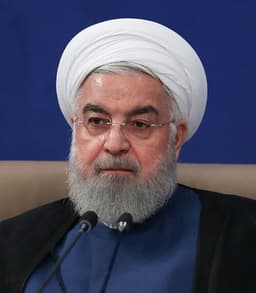
Hassan Rouhani
Politician · Modern
50.1Total

Vojislav Kostunica
Politician · Modern
54.5Total
Basic Information
Born
1948
1944
Died
—
—
Era
Modern
Modern
Nationality
Iran
Serbia
Occupation
Politician
Politician
Civilization
Middle Eastern
Western
Score Comparison
Military (10%)
34.1
50.0
Political (20%)
45.0
72.0
Influence (20%)
60.0
54.9
Legacy (20%)
50.0
43.3
Leadership (15%)
53.2
66.0
Strategy (15%)
44.4
42.4
TOTAL
50.1
54.5
Hassan Rouhani — Complete Timeline
2013 AD
Elected President of IranPolitical Action◆ Major
Rouhani won the presidential election with a landslide, promising to improve relations with the West and revive the economy. His victory was seen as a mandate for moderation and reform after the hardline presidency of Mahmoud Ahmadinejad.
ElectionReformIran
Impact: nationalconstructive
2015 AD
Joint Comprehensive Plan of Action (JCPOA)Political Action
Rouhani's government negotiated the JCPOA with the P5+1 (US, UK, France, Russia, China, Germany). The deal limited Iran's nuclear program in exchange for sanctions relief, marking a major diplomatic achievement.
Nuclear DealDiplomacySanctions
Impact: globalconstructive
2018 AD
US withdrawal from JCPOAPolitical Action◆ Major
President Trump withdrew the US from the JCPOA and reimposed sanctions. Rouhani's government struggled to maintain the deal with European partners, but the economic pressure led to protests and a currency crisis in Iran.
Nuclear DealSanctionsUS-Iran
Impact: globaldestructive
2019 AD
2019-2020 Iranian protestsPolitical Action◆ Major
Rouhani's government faced nationwide protests over fuel price hikes and economic mismanagement. The protests were violently suppressed, with hundreds killed according to human rights groups, damaging Rouhani's reformist image.
ProtestsSuppressionEconomy
Impact: nationaldestructive
Vojislav Kostunica — Complete Timeline
2000 AD
Election as President of YugoslaviaPolitical Action
Kostunica was elected President of the Federal Republic of Yugoslavia after defeating Slobodan Milosevic in the presidential election. His victory marked the end of Milosevic's rule and the beginning of democratic transition.
DemocratizationElectionPost-Milosevic
Impact: regionalprogressive
Admission of Yugoslavia to the United NationsPolitical Action◆ Major
Kostunica oversaw the readmission of the Federal Republic of Yugoslavia to the United Nations. The country had been suspended from the UN during the Milosevic era due to the wars in the former Yugoslavia.
United NationsDiplomacyReintegration
Impact: globalconstructive
2008 AD
Opposition to the Independence of KosovoPolitical Action◆ Major
Kostunica, as Prime Minister of Serbia, strongly opposed the unilateral declaration of independence by Kosovo. He pursued diplomatic and legal measures to prevent international recognition of Kosovo's independence.
KosovoIndependenceNationalism
Impact: regionaldestructive
Expert Analysis
Origins
Hassan Rouhani was born on November 12, 1948, in Sorkheh, Iran. He studied at Qom Seminary and later earned a law degree from the University of Tehran. His early involvement in the Islamic Revolution and subsequent diplomatic roles shaped his pragmatic approach. Vojislav Kostunica was born on September 24, 1944, in Belgrade, Yugoslavia. He studied law at the University of Belgrade and earned a PhD in constitutional law. His academic background and opposition to Slobodan Milosevic's regime defined his political identity.
Rise to Power
Rouhani rose through Iran's political system, serving as a member of parliament, secretary of the Supreme National Security Council, and chief nuclear negotiator under President Khatami. His key turning point was the 2013 presidential election, where he won 50.7% of the vote on a platform of moderation and economic revival. Kostunica's rise came through his leadership of the Democratic Party of Serbia. He defeated Milosevic in the September 2000 presidential election with 50.2% of the vote, triggering the Bulldozer Revolution and ending Milosevic's rule.
Leadership & Governance
Rouhani's leadership was characterized by a pragmatic, reformist approach. He prioritized diplomatic engagement, resulting in the Joint Comprehensive Plan of Action (JCPOA) in 2015, which limited Iran's nuclear program. However, his governance faced severe constraints from hardliners, limiting domestic reforms. Kostunica, as Yugoslav president (2000-2003) and later Serbian prime minister (2004-2008), focused on democratic consolidation and Euro-Atlantic integration. He oversaw Yugoslavia's readmission to the United Nations in 2000 but struggled with economic reforms and corruption.
Triumph & Tragedy
Rouhani's greatest triumph was the JCPOA, which temporarily eased sanctions and boosted Iran's economy. However, the US withdrawal in 2018 and reimposition of sanctions devastated the economy, leading to protests in 2019-2020 that were violently suppressed. His political score of 45.0 reflects mixed outcomes. Kostunica's triumph was overseeing a peaceful transition from Milosevic's authoritarianism to democracy. Yet his failure to secure Kosovo's status within Serbia and his nationalist stance on the issue limited his legacy. His leadership score of 66.0 indicates stronger domestic management.
Character & Destiny
Rouhani was a cautious, moderate cleric who sought incremental change. His diplomatic skills scored 44.4 in strategy, but his inability to shield Iran from US pressure revealed political weakness. Kostunica, a constitutional lawyer, was principled and stubborn, often prioritizing legalism over pragmatism. His military score of 50.0 reflects his non-interventionist stance, but his handling of Kosovo showed inflexibility. Both leaders' characters shaped their fates: Rouhani's moderation brought both the nuclear deal and its collapse; Kostunica's integrity brought democratic transition but stalled progress.
Legacy
Rouhani's legacy is tied to the JCPOA, which remains a template for future nuclear diplomacy despite its failure. His influence score of 60.0 reflects Iran's continued global relevance. Kostunica's legacy is as the man who ended Milosevic's rule and restored Yugoslavia's international standing. However, his tenure saw the loss of Kosovo and limited economic transformation. His legacy score of 43.3 is lower due to these unresolved issues.
Conclusion
Vojislav Kostunica had greater impact, scoring 54.5 total versus Rouhani's 50.1. While Rouhani's nuclear deal was historic, its reversal and subsequent economic collapse undercut his achievements. Kostunica's role in dismantling an authoritarian regime and establishing democratic institutions in Serbia was more durable. Despite his failures on Kosovo, his leadership score of 66.0 and political score of 72.0 demonstrate stronger governance. Rouhani's legacy is more fragile, dependent on international factors beyond his control.
Rankings
🥇
Vojislav KostunicaLeader
Mil: 50.0Pol: 72.0Inf: 54.9
54.5
🥈
Hassan Rouhani
Mil: 34.1Pol: 45.0Inf: 60.0
50.1
+4.4 behind
How This Comparison Works
Algorithm
Each figure is scored on 6 dimensions (0—100 scale) based on structured historical data: Military (10%), Political (20%), Influence (20%), Legacy (20%), Leadership (15%), Strategy (15%). The weighted total produces the final ranking.
Data Sources
Scores are computed from structured sub-indicators in the database. Scale factors adjust for era (Ancient ×0.85, Modern ×1.0) and civilization size (Eastern ×1.05, Other ×0.80) to account for differences in population and military scale.
Maximum 3 Figures
Comparisons are limited to 2—3 figures to ensure readability and statistical meaningfulness.
Error Margins
±5 points per dimension — Sub-scores are derived from historical records with inherent uncertainty. Two figures within 5 points on a dimension should be considered roughly equivalent in that area.
Total Score Accuracy
±3 points overall — The weighted combination of 6 dimensions produces a total score with approximately ±3 points of uncertainty. Differences of less than 3 points are not statistically significant— the figures are effectively tied.
Known Limitations
- Historical records are incomplete and uneven across civilizations
- Figures from oral-tradition societies may be underrepresented
- Occupation labels can misclassify multi-role figures
- Scores measure capability and impact, not moral character
- Quantitative scoring is a comparison tool, not absolute truth
Capability Radar
Military (10%) — Battles & Warfare
Battles
19
28
Win Rate
26
34
Expansion
26
33
Political (20%) — Governance & Reform
Reform
55
55
Diplomacy
75
60
Economy
50
40
Influence (20%) — Cultural & Global Reach
Cultural
30
30
Global
60
30
Legacy (20%) — Historical Impact
Historical
55
40
Longevity
40
20
Leadership (15%) — Power & Stability
Tenure
60
60
Stability
40
35
Strategy (15%) — Tactics & Innovation
Strategy
30
40
Tactics
32
40
Reform
37
42
Similar Comparisons
Comments & Discussion
No comments yet. Be the first to share your thoughts!