Loading...
Hassan Ibrahim vs Ibrahim Babangida
Ibrahim Babangida leads by 2.0 pts · 2 figures compared
…
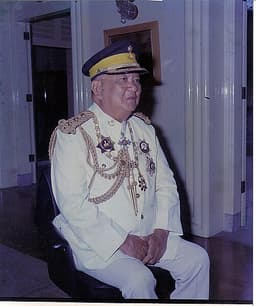
Hassan Ibrahim
General · Modern
44.4Total

Ibrahim Babangida
General · Modern
46.4Total
Basic Information
Born
1917
1941
Died
1996
—
Era
Modern
Modern
Nationality
Egypt
Nigeria
Occupation
General
General
Civilization
Middle Eastern
Other
Score Comparison
Military (10%)
10.2
25.9
Political (20%)
40.8
43.7
Influence (20%)
51.8
51.8
Legacy (20%)
39.2
42.5
Leadership (15%)
67.0
64.0
Strategy (15%)
45.0
41.0
TOTAL
44.4
46.4
Hassan Ibrahim — Complete Timeline
1952 AD
Participated in the 1952 Egyptian RevolutionPolitical Action◆ Major
Hassan Ibrahim was a member of the Free Officers movement that overthrew King Farouk. He was part of the inner circle that planned the July 23 coup.
Egyptian RevolutionFree OfficersCoup
Impact: national
1961 AD
Served as Vice President of EgyptPolitical Action◆ Major
Ibrahim served as Vice President of Egypt under Nasser from 1961 to 1964. He was involved in the administration of the United Arab Republic and domestic policy.
Vice PresidentUnited Arab RepublicNasser Era
Impact: national
1964 AD
Resigned from GovernmentPolitical Action
Ibrahim resigned from his vice presidency due to disagreements with Nasser's policies. He later retired from public life, distancing himself from the regime.
ResignationPolitical DisagreementNasser Era
Impact: national
Ibrahim Babangida — Complete Timeline
1985 AD
1985 Nigerian coup d'étatPolitical Action
Ibrahim Babangida led a palace coup that overthrew Muhammadu Buhari. Babangida became the military president, promising to restore democracy and address economic issues.
CoupMilitary RuleBabangida
Impact: national
1986 AD
Structural Adjustment Program (SAP)Reform◆ Major
Babangida implemented a Structural Adjustment Program (SAP) under the guidance of the IMF and World Bank. The program included currency devaluation and privatization, leading to economic hardship and social unrest.
Economic ReformSAPIMF
Impact: nationaldestructive
1993 AD
Annulment of the 1993 presidential electionPolitical Action
Babangida annulled the June 12, 1993 presidential election, widely believed to have been won by Moshood Abiola. The annulment triggered a political crisis, protests, and the eventual end of Babangida's regime.
ElectionAnnulmentCrisis
Impact: nationaldestructive
Resignation and handover to interim governmentPolitical Action◆ Major
Under intense pressure, Babangida resigned as military president and handed over power to an interim national government led by Ernest Shonekan. This move was intended to defuse the crisis but failed to restore stability.
ResignationInterim GovernmentTransition
Impact: national
Expert Analysis
Origins
Hassan Ibrahim was born in 1920 in Egypt. He joined the military and became a Free Officer, participating in the 1952 Egyptian Revolution. His early life was shaped by the nationalist movement against British influence and the monarchy. Ibrahim Babangida was born in 1941 in Niger State, Nigeria. He trained as a soldier and rose through the ranks, influenced by the political instability and military interventions in Nigeria's early independence.
Rise to Power
Hassan Ibrahim's rise came through the Free Officers' coup on July 23, 1952. He was part of the inner circle that overthrew King Farouk. He served as Vice President of Egypt from 1961 to 1964 under Gamal Abdel Nasser, playing a role in the United Arab Republic. Ibrahim Babangida rose to power via a palace coup on August 27, 1985, overthrowing Muhammadu Buhari. He promised to restore democracy and address economic issues.
Leadership & Governance
Hassan Ibrahim's leadership was within Nasser's shadow. He was involved in the administration of the United Arab Republic, but his influence was limited. He resigned in 1964 due to disagreements with Nasser's policies, showing a principled stance. Ibrahim Babangida's governance was marked by the Structural Adjustment Program (SAP) from 1986, which devalued the currency and cut subsidies. His political score of 43.7 reflects his ability to navigate Nigeria's complex political landscape, but his annulment of the 1993 election showed a disregard for democratic processes.
Triumph & Tragedy
Hassan Ibrahim's triumph was being a founding member of the Free Officers, contributing to Egypt's independence from British influence. His tragedy was his resignation and retirement, leaving him a minor figure in history. Ibrahim Babangida's triumph was his economic reforms through SAP, which aimed to stabilize Nigeria's economy. His tragedy was the annulment of the 1993 election, widely believed won by Moshood Abiola, triggering a political crisis that led to his resignation in 1993. This act overshadowed his earlier achievements.
Character & Destiny
Hassan Ibrahim was a loyalist who eventually chose principle over power. His decision to resign shows a commitment to his beliefs, but it also limited his impact. Ibrahim Babangida was a shrewd political operator, willing to use force and manipulation. His annulment of the election reveals a prioritization of control over democracy. Historical assessments highlight his role in Nigeria's political instability.
Legacy
Hassan Ibrahim's legacy is as a minor Free Officer. He is remembered for his role in the revolution but not for independent leadership. His legacy score of 39.2 reflects this. Ibrahim Babangida's legacy is controversial: he is blamed for derailing Nigeria's democracy, but his economic policies had lasting effects. His legacy score of 42.5 shows a mixed impact.
Conclusion
Ibrahim Babangida had a greater impact on Nigeria than Hassan Ibrahim had on Egypt. Babangida's actions directly shaped Nigeria's political trajectory, while Ibrahim was a supporting figure. Babangida's score of 46.4 versus Ibrahim's 44.4 reflects this. Babangida's influence score of 51.8 matches Ibrahim's, but his political and military scores are higher. Babangida's decisions led to long-term consequences, making him the more significant figure.
Rankings
🥇
Ibrahim BabangidaLeader
Mil: 25.9Pol: 43.7Inf: 51.8
46.4
🥈
Hassan Ibrahim
Mil: 10.2Pol: 40.8Inf: 51.8
44.4
+2.0 behind
How This Comparison Works
Algorithm
Each figure is scored on 6 dimensions (0—100 scale) based on structured historical data: Military (10%), Political (20%), Influence (20%), Legacy (20%), Leadership (15%), Strategy (15%). The weighted total produces the final ranking.
Data Sources
Scores are computed from structured sub-indicators in the database. Scale factors adjust for era (Ancient ×0.85, Modern ×1.0) and civilization size (Eastern ×1.05, Other ×0.80) to account for differences in population and military scale.
Maximum 3 Figures
Comparisons are limited to 2—3 figures to ensure readability and statistical meaningfulness.
Error Margins
±5 points per dimension — Sub-scores are derived from historical records with inherent uncertainty. Two figures within 5 points on a dimension should be considered roughly equivalent in that area.
Total Score Accuracy
±3 points overall — The weighted combination of 6 dimensions produces a total score with approximately ±3 points of uncertainty. Differences of less than 3 points are not statistically significant— the figures are effectively tied.
Known Limitations
- Historical records are incomplete and uneven across civilizations
- Figures from oral-tradition societies may be underrepresented
- Occupation labels can misclassify multi-role figures
- Scores measure capability and impact, not moral character
- Quantitative scoring is a comparison tool, not absolute truth
Capability Radar
Military (10%) — Battles & Warfare
Battles
5
10
Win Rate
5
10
Expansion
5
10
Political (20%) — Governance & Reform
Reform
30
30
Diplomacy
30
35
Economy
20
25
Influence (20%) — Cultural & Global Reach
Cultural
10
20
Global
10
20
Legacy (20%) — Historical Impact
Historical
15
30
Longevity
10
15
Leadership (15%) — Power & Stability
Tenure
40
60
Stability
30
15
Strategy (15%) — Tactics & Innovation
Strategy
5
15
Tactics
5
15
Reform
5
20
Similar Comparisons
Comments & Discussion
No comments yet. Be the first to share your thoughts!