Loading...
Harold Harefoot vs Vikramaditya I
Vikramaditya I leads by 13.6 pts · 2 figures compared
…
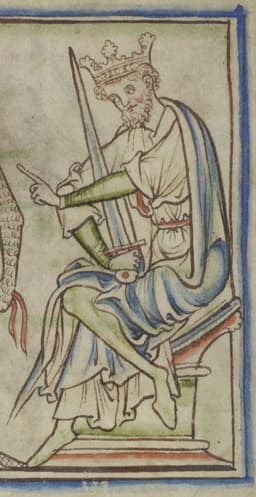
Harold Harefoot
Emperor · Medieval
36.6Total

Vikramaditya I
Emperor · Medieval
50.2Total
Basic Information
Born
1015
655
Died
1040
680
Era
Medieval
Medieval
Nationality
England
India
Occupation
Emperor
Emperor
Civilization
Western
Indian
Score Comparison
Military (10%)
20.0
50.0
Political (20%)
27.9
40.8
Influence (20%)
47.1
51.8
Legacy (20%)
35.8
43.3
Leadership (15%)
39.0
62.2
Strategy (15%)
38.6
60.0
TOTAL
36.6
50.2
Harold Harefoot — Complete Timeline
1035 AD
Regency for HarthacnutPolitical Action◆ Major
After Cnut's death, Harold Harefoot acted as regent for his half-brother Harthacnut, who was in Denmark. Harold controlled much of England, while Harthacnut's mother Emma held Wessex.
RegencySuccessionPower Struggle
Impact: national
1037 AD
Claim to the ThronePolitical Action◆ Major
Harold Harefoot was accepted as king of England by the Witan, the council of nobles. He ruled alone, while Harthacnut remained in Denmark unable to assert his claim.
CoronationSuccessionUsurpation
Impact: national
1040 AD
Death of Harold HarefootPolitical Action◆ Major
Harold died at Oxford on March 17, 1040. His death allowed Harthacnut to claim the English throne without opposition.
DeathSuccessionEnd of Reign
Impact: nationaltragic
Vikramaditya I — Complete Timeline
655 AD
Recapture of Badami from the PallavasWar◆ Major
Vikramaditya I recaptured the Chalukya capital Badami from the Pallava king Narasimhavarman I, who had occupied it after defeating Pulakeshin II. This victory restored Chalukya sovereignty and marked the revival of the dynasty.
Military VictoryBadamiChalukya Revival
Impact: regionalconstructive
660 AD
Restoration of Chalukya powerPolitical Action◆ Major
After recapturing Badami, Vikramaditya I re-established Chalukya authority over their former territories in the Deccan. He issued inscriptions and patronized temples, signaling the dynasty's return to power.
RestorationChalukyaDeccan
Impact: regionalconstructive
Expert Analysis
Origins
Harold Harefoot was born around 1016, the son of Cnut the Great, King of England, Denmark, and Norway, and Ælfgifu of Northampton. His paternity was disputed, but he was raised in England among the Danish nobility. In contrast, Vikramaditya I was born in the early 7th century into the Chalukya dynasty of Vatapi (Badami) in present-day Karnataka, India. He was the son of Pulakeshin II, one of the most powerful Chalukya emperors, and received training in statecraft and warfare from a young age. His early life was marked by the catastrophic defeat of his father by the Pallava king Narasimhavarman I in 642, which led to the fall of Badami and the temporary collapse of Chalukya power.
Rise to Power
Harold's rise was facilitated by the death of his father Cnut in 1035. Initially, he served as regent for his half-brother Harthacnut, who was in Denmark. Harold controlled much of England, and in 1037, he was accepted as king by the Witan, the council of nobles, ruling alone until his death in 1040. His claim was contested by supporters of Harthacnut, but Harold's political maneuvering and control of the royal treasury secured his position. Vikramaditya I rose to power after a period of exile and resistance. Following the Pallava occupation of Badami, the Chalukya family fled. Vikramaditya I, along with his brothers, organized resistance. He allied with the Kadambas and other local rulers, and around 654, he launched a campaign to recapture Badami. After a series of battles, he defeated the Pallava forces and restored Chalukya rule, becoming king in 655. His military score of 50.0 reflects his success in this campaign, while Harold's 20.0 indicates his limited military involvement.
Leadership & Governance
Harold Harefoot's leadership was characterized by consolidation of power through political means rather than military expansion. He maintained control over England by distributing lands and titles to loyal nobles, but his reign was short and marked by internal strife. He did not issue significant legal or administrative reforms. Vikramaditya I, on the other hand, focused on rebuilding the Chalukya state after its near destruction. He restored temples, issued land grants to Brahmins, and re-established administrative structures. His political score of 40.8 reflects his ability to restore order, while Harold's 27.9 indicates less effective governance. Vikramaditya I also patronized arts and literature, with inscriptions recording his donations and victories.
Triumph & Tragedy
Harold's greatest triumph was securing the English throne against his half-brother's claim, ruling effectively from 1037 to 1040. His tragedy was his short reign and early death at age 24, which allowed Harthacnut to take the throne without opposition. His legacy is mixed; he is often seen as a usurper. Vikramaditya I's greatest triumph was the recapture of Badami, restoring Chalukya prestige and territory. He successfully defended against Pallava counterattacks and expanded Chalukya influence. However, his reign was also relatively short (655-680), and after his death, the Chalukya faced renewed threats from the Pallavas. His leadership score of 62.2 is higher than Harold's 39.0, reflecting his greater impact.
Character & Destiny
Harold Harefoot was pragmatic and politically astute, but his character is often viewed as ambitious and ruthless. He was not known for military prowess, and his reliance on political maneuvering limited his long-term influence. Vikramaditya I was a determined and capable military leader, with a strategic mind that allowed him to rebuild a fallen empire. His strategy score of 60.0 compared to Harold's 38.6 highlights his superior planning. Both were shaped by their circumstances: Harold by the complex succession after Cnut, Vikramaditya by the need to avenge his father's defeat.
Legacy
Harold Harefoot's legacy is minimal; he is a footnote in English history, remembered mainly as the son of Cnut who briefly ruled. His influence score of 47.1 is inflated due to his association with Cnut, but his actual impact was limited. Vikramaditya I, with a legacy score of 43.3, is remembered as the restorer of the Chalukya dynasty. He is celebrated in Kannada literature and inscriptions, and his reign marked the beginning of a revival that continued under his successors. The Chalukya dynasty went on to become a major power in the Deccan for centuries.
Conclusion
While both rulers faced challenges, Vikramaditya I had a greater impact. His military and political achievements, scoring 50.0 and 40.8 respectively, directly restored a major dynasty's power, whereas Harold's 20.0 and 27.9 reflect a reign that did little to change England's trajectory. Vikramaditya I's total score of 50.2 is 13.6 points higher than Harold's 36.6, a clear gap. The recapture of Badami was a decisive event that shaped Deccan history, while Harold's reign was a brief interlude. Therefore, Vikramaditya I emerges as the more significant historical figure.
Rankings
🥇
Vikramaditya ILeader
Mil: 50.0Pol: 40.8Inf: 51.8
50.2
🥈
Harold Harefoot
Mil: 20.0Pol: 27.9Inf: 47.1
36.6
+13.6 behind
How This Comparison Works
Algorithm
Each figure is scored on 6 dimensions (0—100 scale) based on structured historical data: Military (10%), Political (20%), Influence (20%), Legacy (20%), Leadership (15%), Strategy (15%). The weighted total produces the final ranking.
Data Sources
Scores are computed from structured sub-indicators in the database. Scale factors adjust for era (Ancient ×0.85, Modern ×1.0) and civilization size (Eastern ×1.05, Other ×0.80) to account for differences in population and military scale.
Maximum 3 Figures
Comparisons are limited to 2—3 figures to ensure readability and statistical meaningfulness.
Error Margins
±5 points per dimension — Sub-scores are derived from historical records with inherent uncertainty. Two figures within 5 points on a dimension should be considered roughly equivalent in that area.
Total Score Accuracy
±3 points overall — The weighted combination of 6 dimensions produces a total score with approximately ±3 points of uncertainty. Differences of less than 3 points are not statistically significant— the figures are effectively tied.
Known Limitations
- Historical records are incomplete and uneven across civilizations
- Figures from oral-tradition societies may be underrepresented
- Occupation labels can misclassify multi-role figures
- Scores measure capability and impact, not moral character
- Quantitative scoring is a comparison tool, not absolute truth
Capability Radar
Military (10%) — Battles & Warfare
Battles
5
55
Win Rate
5
60
Expansion
5
45
Political (20%) — Governance & Reform
Reform
0
30
Diplomacy
10
45
Economy
5
35
Influence (20%) — Cultural & Global Reach
Cultural
5
30
Global
5
20
Legacy (20%) — Historical Impact
Historical
10
35
Longevity
5
25
Leadership (15%) — Power & Stability
Tenure
15
40
Stability
10
40
Strategy (15%) — Tactics & Innovation
Strategy
5
55
Tactics
5
50
Reform
0
30
Similar Comparisons
Comments & Discussion
No comments yet. Be the first to share your thoughts!