Loading...
Harold Harefoot vs Kulun Beg
Kulun Beg leads by 2.8 pts · 2 figures compared
…
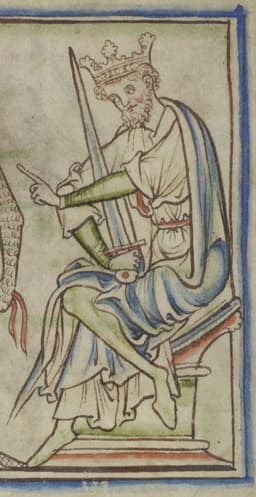
Harold Harefoot
Emperor · Medieval
36.6Total

Kulun Beg
Emperor · Medieval
39.4Total
Basic Information
Born
1015
735
Died
1040
745
Era
Medieval
Medieval
Nationality
England
Second Turkic Khaganate
Occupation
Emperor
Emperor
Civilization
Western
Eastern
Score Comparison
Military (10%)
20.0
20.0
Political (20%)
27.9
35.0
Influence (20%)
47.1
45.5
Legacy (20%)
35.8
35.0
Leadership (15%)
39.0
49.9
Strategy (15%)
38.6
45.0
TOTAL
36.6
39.4
Harold Harefoot — Complete Timeline
1035 AD
Regency for HarthacnutPolitical Action◆ Major
After Cnut's death, Harold Harefoot acted as regent for his half-brother Harthacnut, who was in Denmark. Harold controlled much of England, while Harthacnut's mother Emma held Wessex.
RegencySuccessionPower Struggle
Impact: national
1037 AD
Claim to the ThronePolitical Action◆ Major
Harold Harefoot was accepted as king of England by the Witan, the council of nobles. He ruled alone, while Harthacnut remained in Denmark unable to assert his claim.
CoronationSuccessionUsurpation
Impact: national
1040 AD
Death of Harold HarefootPolitical Action◆ Major
Harold died at Oxford on March 17, 1040. His death allowed Harthacnut to claim the English throne without opposition.
DeathSuccessionEnd of Reign
Impact: nationaltragic
Kulun Beg — Complete Timeline
744 AD
Accession as Kulun BegPolitical Action◆ Major
Kulun Beg became the final khagan of the Second Turkic Khaganate after the death of Ozmysh Khagan. His rule was brief and contested by the rising Uyghur Khaganate.
SuccessionKhaganateDecline
Impact: regional
745 AD
War with the Uyghur KhaganateWar
Kulun Beg fought against the Uyghur Khaganate under Kutlug I Bilge Kagan. The Uyghurs defeated his forces and killed him, ending the Second Turkic Khaganate and establishing Uyghur dominance.
WarDefeatEnd of Khaganate
Impact: regionaltragic
Expert Analysis
Origins
Harold Harefoot, born around 1016, was the son of Cnut the Great, king of England, Denmark, and Norway, and his first wife Ælfgifu of Northampton. His upbringing was shaped by the political maneuverings of the Danish court in England. Little is known of his early education, but he was thrust into Anglo-Scandinavian politics at a young age. His half-brother Harthacnut, born to Cnut and Emma of Normandy, was the designated heir, but Harold's mother Ælfgifu actively promoted his claim.
Kulun Beg, whose name survives only in Chinese records, was a member of the Ashina clan, the ruling dynasty of the Second Turkic Khaganate. He became khagan in 741 after the death of Ozmysh Khagan. His background is obscure, but he likely came from the elite military aristocracy of the Turkic confederation. The khaganate was already in decline, threatened by internal factions and the rising Uyghur Khaganate to the east.
Rise to Power
Harold Harefoot's rise began immediately after Cnut's death on November 12, 1035. Harthacnut, the acknowledged heir, was in Denmark dealing with a Norwegian rebellion. Harold, supported by his mother and many English nobles, claimed the regency. By 1036, he controlled most of England, and the Witan (council of nobles) accepted him as regent. In 1037, with Harthacnut still absent, Harold was formally recognized as king. His political score of 27.9 reflects his ability to secure power through manipulation of the Witan and exploitation of Harthacnut's absence.
Kulun Beg became khagan in 741 after Ozmysh Khagan was killed in battle against the Uyghurs. His accession was contested; the Basmyl and Uyghur tribes were in open revolt. He had to assert authority over a fractured confederation. His political score of 35.0 is slightly higher than Harold's, indicating some ability to claim leadership in a crisis, though his position was precarious.
Leadership & Governance
Harold Harefoot's governance was marked by consolidation. He maintained the administrative systems established by Cnut, relying on the Anglo-Saxon shire system and Danish military support. He faced opposition from the powerful Earl Godwin, who initially supported Harthacnut, but Harold managed to neutralize him. His leadership score of 39.0 reflects a cautious, pragmatic approach. He did not undertake major reforms but kept the kingdom stable during his brief reign.
Kulun Beg's leadership was tested by war. He attempted to rally the Turkic tribes against the Uyghur threat. His leadership score of 49.9 is higher than Harold's, indicating a more active military role. However, his governance was undermined by internal dissent and the superior strategy of the Uyghur khagan, Kutlug I Bilge Kagan. Kulun Beg's reign was entirely consumed by conflict, with no time for administrative or cultural achievements.
Triumph & Tragedy
Harold Harefoot's greatest triumph was securing the English throne against the claims of Harthacnut and Alfred Aetheling (Emma's son from her first marriage). He successfully ruled England for nearly five years, maintaining peace and order. His tragedy was his early death at age 24, possibly from illness, on March 17, 1040. His death allowed Harthacnut to take the throne without opposition, and Harold's reputation was later tarnished by chroniclers favorable to Harthacnut and Emma.
Kulun Beg's triumph was becoming khagan at a time of crisis, holding the khaganate together for a few years. His tragedy was total defeat and death in battle against the Uyghurs around 744. The Second Turkic Khaganate was destroyed, and its people absorbed into the Uyghur Khaganate. His military score of 20.0 reflects his inability to prevent this collapse.
Character & Destiny
Harold Harefoot is often depicted as ambitious and ruthless. He was responsible for the blinding and death of Alfred Aetheling in 1036, a brutal act that secured his position. His character suggests a willingness to eliminate rivals. His destiny was cut short by death, but he achieved his primary goal: ruling England. His total score of 36.6 reflects a brief but effective reign.
Kulun Beg's character is less known, but his actions suggest a determined leader facing impossible odds. He chose to fight rather than submit, leading to his death. His destiny was to be the last of his dynasty, a tragic end to a once-powerful khaganate. His total score of 39.4 is slightly higher than Harold's, indicating a slightly more impactful role in the context of his own state's survival.
Legacy
Harold Harefoot's legacy is minor but specific. He demonstrated that a contested succession could be resolved by the Witan, setting a precedent for English kingship. His reign was a brief interlude in the Danish rule of England. He is remembered as a usurper, but his actions helped stabilize the kingdom after Cnut's death. His influence score of 47.1 is moderate.
Kulun Beg's legacy is as the final khagan of the Second Turkic Khaganate. His defeat marked the end of Turkic dominance in Mongolia and the rise of the Uyghurs. He is a symbol of the khaganate's ultimate failure. His influence score of 45.5 is slightly lower than Harold's, but his historical significance is tied to the collapse of a major steppe empire.
Conclusion
Harold Harefoot had a greater impact on English history than Kulun Beg had on Turkic history. While Kulun Beg's total score (39.4) is slightly higher than Harold's (36.6), the context differs. Harold's reign, though brief, shaped the succession of the English throne and influenced the Norman Conquest indirectly by weakening Anglo-Danish rule. Kulun Beg's defeat was a terminal event for his khaganate, but the Uyghurs would have likely prevailed regardless. Harold's political maneuvering (27.9 vs 35.0) and leadership (39.0 vs 49.9) were lower, but his legacy (35.8 vs 35.0) and influence (47.1 vs 45.5) are comparable. However, Harold's actions had direct consequences for the English monarchy, while Kulun Beg's death was a footnote in the larger story of steppe empires. Therefore, Harold Harefoot's impact was more significant in the long term.
Rankings
🥇
Kulun BegLeader
Mil: 20.0Pol: 35.0Inf: 45.5
39.4
🥈
Harold Harefoot
Mil: 20.0Pol: 27.9Inf: 47.1
36.6
+2.8 behind
How This Comparison Works
Algorithm
Each figure is scored on 6 dimensions (0—100 scale) based on structured historical data: Military (10%), Political (20%), Influence (20%), Legacy (20%), Leadership (15%), Strategy (15%). The weighted total produces the final ranking.
Data Sources
Scores are computed from structured sub-indicators in the database. Scale factors adjust for era (Ancient ×0.85, Modern ×1.0) and civilization size (Eastern ×1.05, Other ×0.80) to account for differences in population and military scale.
Maximum 3 Figures
Comparisons are limited to 2—3 figures to ensure readability and statistical meaningfulness.
Error Margins
±5 points per dimension — Sub-scores are derived from historical records with inherent uncertainty. Two figures within 5 points on a dimension should be considered roughly equivalent in that area.
Total Score Accuracy
±3 points overall — The weighted combination of 6 dimensions produces a total score with approximately ±3 points of uncertainty. Differences of less than 3 points are not statistically significant— the figures are effectively tied.
Known Limitations
- Historical records are incomplete and uneven across civilizations
- Figures from oral-tradition societies may be underrepresented
- Occupation labels can misclassify multi-role figures
- Scores measure capability and impact, not moral character
- Quantitative scoring is a comparison tool, not absolute truth
Capability Radar
Military (10%) — Battles & Warfare
Battles
5
5
Win Rate
5
5
Expansion
5
5
Political (20%) — Governance & Reform
Reform
0
5
Diplomacy
10
5
Economy
5
5
Influence (20%) — Cultural & Global Reach
Cultural
5
5
Global
5
5
Legacy (20%) — Historical Impact
Historical
10
5
Longevity
5
5
Leadership (15%) — Power & Stability
Tenure
15
10
Stability
10
5
Strategy (15%) — Tactics & Innovation
Strategy
5
5
Tactics
5
5
Reform
0
5
Similar Comparisons
Comments & Discussion
No comments yet. Be the first to share your thoughts!