Loading...
Harald Bluetooth vs Yang Guang
Harald Bluetooth leads by 1.8 pts · 2 figures compared
…
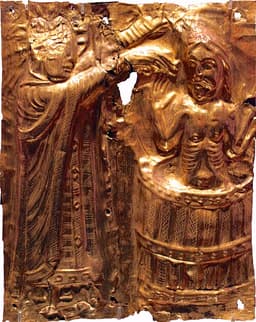
Harald Bluetooth
Emperor · Medieval
59.3Total
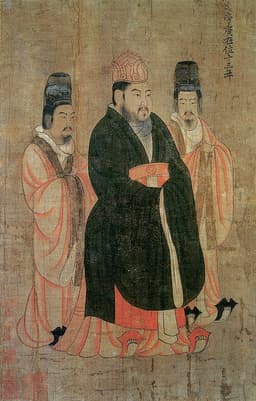
Yang Guang
Emperor · Medieval
57.5Total
Basic Information
Born
911
569
Died
985
618
Era
Medieval
Medieval
Nationality
Denmark
China
Occupation
Emperor
Emperor
Civilization
Western
Eastern
Score Comparison
Military (10%)
40.0
47.5
Political (20%)
72.0
62.7
Influence (20%)
62.0
72.0
Legacy (20%)
56.0
40.0
Leadership (15%)
70.0
62.2
Strategy (15%)
45.0
60.0
TOTAL
59.3
57.5
Harald Bluetooth — Complete Timeline
958 AD
Unified DenmarkPolitical Action◆ Major
Harald Bluetooth unified the Danish tribes into a single kingdom, consolidating power over Jutland, Zealand, and surrounding islands. This unification laid the foundation for the medieval Danish state and established the Gorm dynasty's rule.
UnificationDenmarkMedieval Kingdom
Impact: regionalconstructive
965 AD
Introduced Christianity to DenmarkCultural◆ Major
Harald Bluetooth converted to Christianity and mandated the conversion of Denmark. He erected the larger Jelling rune stone, which proclaims that he 'made the Danes Christian'. This event marked Denmark's entry into Christian Europe and aligned it with Latin Christendom.
ChristianizationReligionJelling Stones
Impact: regionalconstructive
Built the Jelling monumentsCultural◆ Major
Harald Bluetooth commissioned the Jelling rune stones and burial mounds in memory of his parents. The larger stone, often called 'Denmark's birth certificate', features a depiction of Christ and a runic inscription celebrating his unification of Denmark and Norway.
Jelling StonesMonumentsCultural Heritage
Impact: regionalconstructive
970 AD
Conquered NorwayWar◆ Major
Harald Bluetooth conquered Norway after defeating Earl Hakon Sigurdsson, bringing Norway under Danish rule. This expansion created a short-lived North Sea empire and demonstrated Danish military power in Scandinavia.
ConquestNorwayDanish Empire
Impact: regional
985 AD
Rebelled against by his son Sweyn ForkbeardPolitical Action◆ Major
Harald Bluetooth faced a rebellion led by his son Sweyn Forkbeard, who opposed his father's rule and Christianization policies. The rebellion forced Harald into exile, where he died shortly after, ending his reign and leading to Sweyn's ascension.
RebellionDynastic ConflictExile
Impact: regionaldestructive
Yang Guang — Complete Timeline
605 AD
Construction of the Grand CanalReform◆ Major
Emperor Yang Guang ordered the construction of the Grand Canal, linking the Yellow River and Yangtze River. The project mobilized millions of laborers and created a vital waterway for grain transport and trade, but the immense human cost led to widespread resentment and rebellion.
InfrastructureGrand CanalCorvée Labor
Impact: national
612 AD
Three Expeditions against GoguryeoWar◆ Major
Yang Guang launched three massive military campaigns against the Korean kingdom of Goguryeo. The first invasion in 612 ended in catastrophic defeat at the Battle of Salsu, with hundreds of thousands of Chinese soldiers killed. The repeated failures drained the treasury and sparked widespread revolts.
Goguryeo-Sui WarMilitary DisasterOverextension
Impact: regionaldestructive
613 AD
Rebellion of Yang XuanganWar◆ Major
While Yang Guang was campaigning against Goguryeo, the noble Yang Xuangan launched a major rebellion in the rear. The revolt was suppressed, but it exposed the fragility of Sui rule and encouraged further uprisings across the empire.
RebellionSui Dynasty Decline
Impact: nationaldestructive
618 AD
Assassination of Yang GuangPolitical Action
As rebellions engulfed the empire, Yang Guang was strangled to death in Jiangdu by his own guards led by Yuwen Huaji. His death marked the effective end of the Sui dynasty, which collapsed shortly after, leading to the rise of the Tang dynasty.
AssassinationSui CollapseDynastic Transition
Impact: nationaltragic
Expert Analysis
Origins
Harald Bluetooth (c. 935–986) was born into the Danish royal family, son of King Gorm the Old and Thyra Dannebod. Gorm had united Jutland, but Denmark remained fragmented. Harald grew up in a pagan warrior culture, learning the traditions of his Norse ancestors. His mother Thyra was a strong influence, and he inherited a kingdom still divided among chieftains.
Yang Guang (569–618) was born as the second son of Emperor Wen of Sui, who had reunified China after centuries of division. Yang Guang grew up in the imperial court, receiving a Confucian education and military training. He was ambitious and literary, but also ruthless, as seen in his role in the death of his elder brother Yang Yong, whom he displaced as crown prince.
Rise to Power
Harald Bluetooth became king of Denmark around 958 after his father Gorm's death. He quickly consolidated power by subduing rival chieftains and expanding his realm. The turning point came when he converted to Christianity around 965, likely influenced by the Holy Roman Empire's pressure and the need to align with Christian trading partners. He erected the Jelling rune stone, proclaiming he "won all Denmark and Norway and made the Danes Christian." This act unified the kingdom under a single religion and royal authority.
Yang Guang's rise was more calculated and violent. He orchestrated the assassination of his father, Emperor Wen, in 604, according to historical accounts. He then eliminated his brother Yang Liang to secure the throne. As Emperor Yang of Sui, he launched ambitious projects to consolidate and expand the empire. His rise was marked by centralization of power, moving the capital to Luoyang, and suppressing nobility.
Leadership & Governance
Harald Bluetooth ruled through a mix of traditional chieftain politics and new Christian ideology. He built fortifications like the Danevirke, a defensive wall, and constructed bridges and roads to improve communication. His governance score of 72.0 reflects his ability to unite tribes, but his military score of 40.0 indicates limited expansion beyond Scandinavia. He relied on alliances with the Church to legitimize his rule, minting the first Danish coins.
Yang Guang was a centralizer who pushed massive state projects. He rebuilt the Great Wall, expanded the examination system for bureaucrats, and most famously ordered the Grand Canal (1,100 miles) to link north and south. His political score of 62.7 shows effective control, but his leadership score of 62.2 was undermined by overreach. He forced millions of peasants into labor, causing widespread suffering and rebellion. His strategy score of 60.0 reflects his ambitious but poorly executed military campaigns.
Triumph & Tragedy
Harald Bluetooth's greatest triumph was unifying Denmark and introducing Christianity, which integrated his kingdom into European Christendom. The Jelling stones remain a national symbol. His tragedy was the rebellion of his son Sweyn Forkbeard, who opposed his father's Christianization and forced Harald into exile. He died in 986, possibly from wounds, with his legacy secured but his immediate rule ended.
Yang Guang's triumph was the Grand Canal, which became a vital economic artery for centuries, facilitating trade and cultural exchange. His tragedy was the catastrophic failure of his three campaigns against Goguryeo (612–614), with over 300,000 casualties. The resulting rebellions, including the revolt of Yang Xuangan, led to his assassination in 618. His total score of 57.5 is dragged down by a legacy score of 40.0, as the Sui dynasty collapsed soon after his death.
Character & Destiny
Harald Bluetooth was pragmatic and adaptable, willing to embrace Christianity for political unity. His decision to convert was strategic, not purely spiritual. He maintained Norse traditions while adopting new symbols, as seen in the Jelling stone mixing pagan and Christian imagery. His character scored 70.0 in leadership, but his reliance on traditional power structures limited his reach.
Yang Guang was ambitious and visionary but also arrogant and cruel. He ignored the limits of his resources, pushing his people too hard. His literary pretensions and obsession with grandeur (e.g., building a fleet of dragon boats for canal tours) contrasted with his harsh conscription. His character led directly to his downfall, as his policies sparked the rebellions that killed him.
Legacy
Harald Bluetooth's legacy is tangible: he unified Denmark and made it Christian, influencing Scandinavia for centuries. The Bluetooth wireless technology is named after him, symbolizing unification. His total score of 59.3 reflects enduring influence (62.0) and legacy (56.0). Denmark's monarchy traces back to his line, and the Jelling stones are UNESCO World Heritage.
Yang Guang's legacy is mixed. The Grand Canal endured, but his dynasty collapsed. His influence score of 72.0 is high because the canal shaped China's economy, but his legacy score of 40.0 reflects the Sui's short life. Later dynasties like Tang learned from his mistakes, but he is often remembered as a tyrant.
Conclusion
Harald Bluetooth had a greater impact relative to his resources and context. With a total score of 59.3 vs. Yang Guang's 57.5, Harald achieved lasting unification and cultural transformation that outlasted his reign. Yang Guang's projects were monumental but his failures destroyed his dynasty. Harald's legacy persists in Danish identity and European history, while Yang Guang's is overshadowed by the Tang success that followed. Thus, Harald Bluetooth edges out Yang Guang in historical significance.
Rankings
🥇
Harald BluetoothLeader
Mil: 40.0Pol: 72.0Inf: 62.0
59.3
🥈
Yang Guang
Mil: 47.5Pol: 62.7Inf: 72.0
57.5
+1.8 behind
How This Comparison Works
Algorithm
Each figure is scored on 6 dimensions (0—100 scale) based on structured historical data: Military (10%), Political (20%), Influence (20%), Legacy (20%), Leadership (15%), Strategy (15%). The weighted total produces the final ranking.
Data Sources
Scores are computed from structured sub-indicators in the database. Scale factors adjust for era (Ancient ×0.85, Modern ×1.0) and civilization size (Eastern ×1.05, Other ×0.80) to account for differences in population and military scale.
Maximum 3 Figures
Comparisons are limited to 2—3 figures to ensure readability and statistical meaningfulness.
Error Margins
±5 points per dimension — Sub-scores are derived from historical records with inherent uncertainty. Two figures within 5 points on a dimension should be considered roughly equivalent in that area.
Total Score Accuracy
±3 points overall — The weighted combination of 6 dimensions produces a total score with approximately ±3 points of uncertainty. Differences of less than 3 points are not statistically significant— the figures are effectively tied.
Known Limitations
- Historical records are incomplete and uneven across civilizations
- Figures from oral-tradition societies may be underrepresented
- Occupation labels can misclassify multi-role figures
- Scores measure capability and impact, not moral character
- Quantitative scoring is a comparison tool, not absolute truth
Capability Radar
Military (10%) — Battles & Warfare
Battles
30
55
Win Rate
35
40
Expansion
45
60
Political (20%) — Governance & Reform
Reform
70
75
Diplomacy
65
40
Economy
50
70
Influence (20%) — Cultural & Global Reach
Cultural
60
70
Global
50
65
Legacy (20%) — Historical Impact
Historical
65
75
Longevity
55
80
Leadership (15%) — Power & Stability
Tenure
60
60
Stability
55
20
Strategy (15%) — Tactics & Innovation
Strategy
40
50
Tactics
25
45
Reform
20
30
Similar Comparisons
Comments & Discussion
No comments yet. Be the first to share your thoughts!