Loading...
This comparison has not been analyzed yet.
One-time AI generation (~1 minute). Scores and timeline are already available below.
Harald Bluetooth vs Imad-ul-Mulk
Harald Bluetooth leads by 16.0 pts · 2 figures compared
…
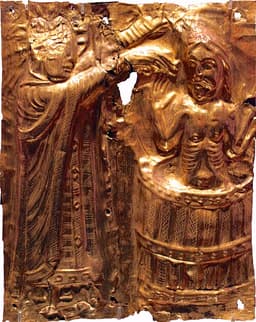
Harald Bluetooth
Emperor · Medieval
59.3Total

Imad-ul-Mulk
Emperor · Medieval
43.3Total
Basic Information
Born
911
1490
Died
985
1546
Era
Medieval
Medieval
Nationality
Denmark
India
Occupation
Emperor
Emperor
Civilization
Western
Indian
Score Comparison
Military (10%)
40.0
50.0
Political (20%)
72.0
32.2
Influence (20%)
62.0
49.4
Legacy (20%)
56.0
39.2
Leadership (15%)
70.0
55.3
Strategy (15%)
45.0
30.3
TOTAL
59.3
43.3
Harald Bluetooth — Complete Timeline
958 AD
Unified DenmarkPolitical Action◆ Major
Harald Bluetooth unified the Danish tribes into a single kingdom, consolidating power over Jutland, Zealand, and surrounding islands. This unification laid the foundation for the medieval Danish state and established the Gorm dynasty's rule.
UnificationDenmarkMedieval Kingdom
Impact: regionalconstructive
965 AD
Introduced Christianity to DenmarkCultural◆ Major
Harald Bluetooth converted to Christianity and mandated the conversion of Denmark. He erected the larger Jelling rune stone, which proclaims that he 'made the Danes Christian'. This event marked Denmark's entry into Christian Europe and aligned it with Latin Christendom.
ChristianizationReligionJelling Stones
Impact: regionalconstructive
Built the Jelling monumentsCultural◆ Major
Harald Bluetooth commissioned the Jelling rune stones and burial mounds in memory of his parents. The larger stone, often called 'Denmark's birth certificate', features a depiction of Christ and a runic inscription celebrating his unification of Denmark and Norway.
Jelling StonesMonumentsCultural Heritage
Impact: regionalconstructive
970 AD
Conquered NorwayWar◆ Major
Harald Bluetooth conquered Norway after defeating Earl Hakon Sigurdsson, bringing Norway under Danish rule. This expansion created a short-lived North Sea empire and demonstrated Danish military power in Scandinavia.
ConquestNorwayDanish Empire
Impact: regional
985 AD
Rebelled against by his son Sweyn ForkbeardPolitical Action◆ Major
Harald Bluetooth faced a rebellion led by his son Sweyn Forkbeard, who opposed his father's rule and Christianization policies. The rebellion forced Harald into exile, where he died shortly after, ending his reign and leading to Sweyn's ascension.
RebellionDynastic ConflictExile
Impact: regionaldestructive
Imad-ul-Mulk — Complete Timeline
1490 AD
Founded Imad Shahi DynastyPolitical Action◆ Major
Imad-ul-Mulk, a Bahmani governor, declared independence from the declining Bahmani Sultanate and established the Imad Shahi dynasty in Berar. This act was part of the fragmentation of the Bahmani kingdom into the Deccan sultanates.
Dynasty FoundingBerar SultanateBahmani Successor
Impact: regionalconstructive
1495 AD
Consolidation of BerarPolitical Action
Imad-ul-Mulk consolidated his control over the Berar region, establishing a stable administration and fortifying key strongholds. He maintained Berar's independence through diplomacy and military preparedness against neighboring sultanates.
ConsolidationBerar SultanateAdministration
Impact: regionalconstructive
1500 AD
Alliance with AhmadnagarPolitical Action
Imad-ul-Mulk formed an alliance with Ahmadnagar's Nizam Shahi dynasty against the Vijayanagara Empire and other Deccan rivals. This alliance helped secure Berar's borders and allowed for coordinated military campaigns.
AllianceDeccan PoliticsDiplomacy
Impact: regionalconstructive
This comparison has not been analyzed yet.
One-time AI generation (~1 minute). Scores and timeline are already available below.
Rankings
🥇
Harald BluetoothLeader
Mil: 40.0Pol: 72.0Inf: 62.0
59.3
🥈
Imad-ul-Mulk
Mil: 50.0Pol: 32.2Inf: 49.4
43.3
+16.0 behind
How This Comparison Works
Algorithm
Each figure is scored on 6 dimensions (0—100 scale) based on structured historical data: Military (10%), Political (20%), Influence (20%), Legacy (20%), Leadership (15%), Strategy (15%). The weighted total produces the final ranking.
Data Sources
Scores are computed from structured sub-indicators in the database. Scale factors adjust for era (Ancient ×0.85, Modern ×1.0) and civilization size (Eastern ×1.05, Other ×0.80) to account for differences in population and military scale.
Maximum 3 Figures
Comparisons are limited to 2—3 figures to ensure readability and statistical meaningfulness.
Error Margins
±5 points per dimension — Sub-scores are derived from historical records with inherent uncertainty. Two figures within 5 points on a dimension should be considered roughly equivalent in that area.
Total Score Accuracy
±3 points overall — The weighted combination of 6 dimensions produces a total score with approximately ±3 points of uncertainty. Differences of less than 3 points are not statistically significant— the figures are effectively tied.
Known Limitations
- Historical records are incomplete and uneven across civilizations
- Figures from oral-tradition societies may be underrepresented
- Occupation labels can misclassify multi-role figures
- Scores measure capability and impact, not moral character
- Quantitative scoring is a comparison tool, not absolute truth
Capability Radar
Military (10%) — Battles & Warfare
Battles
30
25
Win Rate
35
20
Expansion
45
30
Political (20%) — Governance & Reform
Reform
70
20
Diplomacy
65
25
Economy
50
20
Influence (20%) — Cultural & Global Reach
Cultural
60
15
Global
50
10
Legacy (20%) — Historical Impact
Historical
65
20
Longevity
55
15
Leadership (15%) — Power & Stability
Tenure
60
30
Stability
55
20
Strategy (15%) — Tactics & Innovation
Strategy
40
20
Tactics
25
20
Reform
20
15
Similar Comparisons
Comments & Discussion
No comments yet. Be the first to share your thoughts!