Loading...
This comparison has not been analyzed yet.
One-time AI generation (~1 minute). Scores and timeline are already available below.
Haqnazar Khan vs Maximilian I Joseph
Maximilian I Joseph leads by 0.9 pts · 2 figures compared
…
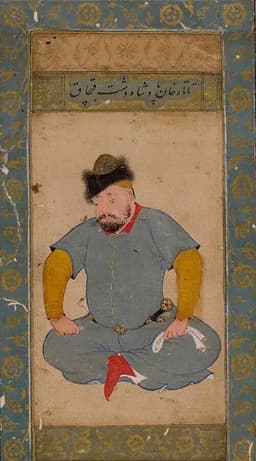
Haqnazar Khan
Emperor · Modern
57.3Total

Maximilian I Joseph
Emperor · Modern
58.2Total
Basic Information
Born
1520
1756
Died
1580
1825
Era
Modern
Modern
Nationality
Kazakh Khanate
Bavaria
Occupation
Emperor
Emperor
Civilization
Eastern
Western
Score Comparison
Military (10%)
55.0
45.0
Political (20%)
68.0
70.3
Influence (20%)
54.9
59.0
Legacy (20%)
47.5
47.5
Leadership (15%)
72.0
80.0
Strategy (15%)
51.7
45.0
TOTAL
57.3
58.2
Haqnazar Khan — Complete Timeline
1560 AD
Reunification of the Three Kazakh HordesPolitical Action◆ Major
Haqnazar Khan successfully reunited the three Kazakh hordes (the Great, Middle, and Little Hordes) under a single khan's authority after a period of fragmentation. This reunification restored the territorial integrity of the Kazakh Khanate and strengthened its military capacity against external threats.
ReunificationKazakh KhanateHordes
Impact: nationalconstructive
1570 AD
Victory over the Shaybanid UzbeksWar◆ Major
Haqnazar Khan led a military campaign against the Shaybanid Uzbeks, defeating them near the Syr Darya River. This victory secured the southern borders of the Kazakh Khanate and regained control over key trade cities such as Turkistan and Sauran.
Military CampaignShaybanidsTerritorial Gain
Impact: regional
1573 AD
Alliance with the Russian TsardomPolitical Action
Haqnazar Khan sent an embassy to Ivan the Terrible, establishing diplomatic relations with the Russian Tsardom. This alliance was aimed at countering the Nogai Horde and the Siberian Khanate, and it opened trade routes between the Kazakh steppe and Russia.
DiplomacyRussiaTrade
Impact: regionalconstructive
1575 AD
Defense against the OiratsWar
Haqnazar Khan repelled an invasion by the Oirat (Dzungar) confederation into the eastern Kazakh steppe. The defense preserved Kazakh territorial integrity and prevented the Oirats from establishing a permanent presence in the region.
DefenseOiratsDzungars
Impact: regional
Maximilian I Joseph — Complete Timeline
1806 AD
Elevation of Bavaria to a kingdomPolitical Action
Maximilian I Joseph, as Elector of Bavaria, allied with Napoleon Bonaparte and was rewarded with the elevation of Bavaria to a kingdom on January 1, 1806. He became the first King of Bavaria, gaining significant territorial expansion and sovereignty.
Kingdom of BavariaNapoleonic EraTerritorial Expansion
Impact: regionalconstructive
Alliance with Napoleon and participation in the Confederation of the RhinePolitical Action◆ Major
Maximilian I Joseph joined the Confederation of the Rhine, a French client state, and provided troops for Napoleon's campaigns. This alliance brought territorial gains but also led to Bavarian involvement in the disastrous Russian campaign of 1812.
Napoleonic WarsConfederation of the RhineAlliance
Impact: regional
1808 AD
Enactment of the Bavarian Constitution of 1808Reform◆ Major
Maximilian I Joseph promulgated a constitution for Bavaria, establishing a centralized administrative system, religious tolerance, and legal equality. This reform modernized the state and laid the foundation for a constitutional monarchy.
ConstitutionModernizationReform
Impact: regionalprogressive
1813 AD
Switched sides to the anti-Napoleonic coalitionPolitical Action
After Napoleon's defeat at Leipzig, Maximilian I Joseph abandoned the French alliance and joined the Sixth Coalition. This decision preserved Bavaria's territorial gains and allowed it to participate in the Congress of Vienna as a sovereign state.
Congress of ViennaCoalitionDiplomacy
Impact: regional
This comparison has not been analyzed yet.
One-time AI generation (~1 minute). Scores and timeline are already available below.
Rankings
🥇
Maximilian I JosephLeader
Mil: 45.0Pol: 70.3Inf: 59.0
58.2
🥈
Haqnazar Khan
Mil: 55.0Pol: 68.0Inf: 54.9
57.3
+0.9 behind
How This Comparison Works
Algorithm
Each figure is scored on 6 dimensions (0—100 scale) based on structured historical data: Military (10%), Political (20%), Influence (20%), Legacy (20%), Leadership (15%), Strategy (15%). The weighted total produces the final ranking.
Data Sources
Scores are computed from structured sub-indicators in the database. Scale factors adjust for era (Ancient ×0.85, Modern ×1.0) and civilization size (Eastern ×1.05, Other ×0.80) to account for differences in population and military scale.
Maximum 3 Figures
Comparisons are limited to 2—3 figures to ensure readability and statistical meaningfulness.
Error Margins
±5 points per dimension — Sub-scores are derived from historical records with inherent uncertainty. Two figures within 5 points on a dimension should be considered roughly equivalent in that area.
Total Score Accuracy
±3 points overall — The weighted combination of 6 dimensions produces a total score with approximately ±3 points of uncertainty. Differences of less than 3 points are not statistically significant— the figures are effectively tied.
Known Limitations
- Historical records are incomplete and uneven across civilizations
- Figures from oral-tradition societies may be underrepresented
- Occupation labels can misclassify multi-role figures
- Scores measure capability and impact, not moral character
- Quantitative scoring is a comparison tool, not absolute truth
Capability Radar
Military (10%) — Battles & Warfare
Battles
45
20
Win Rate
50
25
Expansion
50
40
Political (20%) — Governance & Reform
Reform
45
80
Diplomacy
55
70
Economy
35
75
Influence (20%) — Cultural & Global Reach
Cultural
40
50
Global
30
45
Legacy (20%) — Historical Impact
Historical
50
55
Longevity
45
40
Leadership (15%) — Power & Stability
Tenure
60
65
Stability
50
70
Strategy (15%) — Tactics & Innovation
Strategy
55
30
Tactics
40
15
Reform
30
60
Similar Comparisons
Comments & Discussion
No comments yet. Be the first to share your thoughts!