Loading...
This comparison has not been analyzed yet.
One-time AI generation (~1 minute). Scores and timeline are already available below.
Haji Bashir Ismail Yusuf vs Zoran Zaev
Zoran Zaev leads by 10.1 pts · 2 figures compared
…
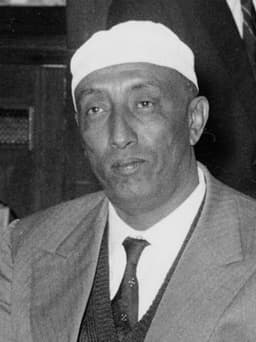
Haji Bashir Ismail Yusuf
Politician · Modern
43.3Total

Zoran Zaev
Politician · Modern
53.4Total
Basic Information
Born
1912
1974
Died
1984
—
Era
Modern
Modern
Nationality
Somalia
North Macedonia
Occupation
Politician
Politician
Civilization
Other
Western
Score Comparison
Military (10%)
50.0
50.0
Political (20%)
30.8
60.0
Influence (20%)
46.3
54.1
Legacy (20%)
37.5
43.3
Leadership (15%)
55.3
72.0
Strategy (15%)
44.0
42.5
TOTAL
43.3
53.4
Haji Bashir Ismail Yusuf — Complete Timeline
1956 AD
Elected First President of Somali National AssemblyPolitical Action◆ Major
Haji Bashir Ismail Yusuf was elected as the first President of the Somali National Assembly in 1956, serving as the head of the legislative body during the transition to independence. This established the parliamentary framework for the newly emerging Somali state.
Independence EraParliamentLeadership
Impact: nationalconstructive
1960 AD
Presided Over Independence LegislationPolitical Action◆ Major
As President of the National Assembly, Haji Bashir Ismail Yusuf oversaw the legislative processes leading to Somalia's independence from Italy and Britain on July 1, 1960. He played a key role in unifying the former colonies into the Somali Republic.
IndependenceUnificationLegislation
Impact: nationalconstructive
Zoran Zaev — Complete Timeline
2017 AD
Elected Prime Minister of MacedoniaPolitical Action◆ Major
Zaev became Prime Minister after his SDSM party formed a coalition with ethnic Albanian parties. He pledged to resolve the long-standing name dispute with Greece and pursue Euro-Atlantic integration.
ElectionGovernmentMacedonia
Impact: nationalconstructive
2018 AD
Signed the Prespa Agreement with GreecePolitical Action
Zaev signed the Prespa Agreement with Greek Prime Minister Alexis Tsipras, changing the country's name to North Macedonia in exchange for Greece lifting its veto on NATO and EU accession. This resolved a 27-year dispute.
Name DisputeTreatyNATOEU
Impact: regionalconstructive
Referendum on the Prespa AgreementPolitical Action◆ Major
Zaev held a non-binding referendum on the Prespa Agreement, which was approved by 91% of voters, but turnout was only 37%. The low turnout weakened his mandate, but the agreement was ratified by parliament.
ReferendumName ChangeDemocracy
Impact: nationalconstructive
2020 AD
North Macedonia joined NATOPolitical Action◆ Major
Following the Prespa Agreement, North Macedonia became the 30th member of NATO, fulfilling a key foreign policy goal. Zaev's government achieved this milestone despite domestic opposition.
NATOIntegrationForeign Policy
Impact: regionalconstructive
Resigned as Prime MinisterPolitical Action◆ Major
Zaev resigned after his party suffered losses in local elections, citing the need for new leadership. His resignation came amid challenges from the COVID-19 pandemic and EU accession delays.
ResignationPoliticsNorth Macedonia
Impact: national
This comparison has not been analyzed yet.
One-time AI generation (~1 minute). Scores and timeline are already available below.
Rankings
🥇
Zoran ZaevLeader
Mil: 50.0Pol: 60.0Inf: 54.1
53.4
🥈
Haji Bashir Ismail Yusuf
Mil: 50.0Pol: 30.8Inf: 46.3
43.3
+10.1 behind
How This Comparison Works
Algorithm
Each figure is scored on 6 dimensions (0—100 scale) based on structured historical data: Military (10%), Political (20%), Influence (20%), Legacy (20%), Leadership (15%), Strategy (15%). The weighted total produces the final ranking.
Data Sources
Scores are computed from structured sub-indicators in the database. Scale factors adjust for era (Ancient ×0.85, Modern ×1.0) and civilization size (Eastern ×1.05, Other ×0.80) to account for differences in population and military scale.
Maximum 3 Figures
Comparisons are limited to 2—3 figures to ensure readability and statistical meaningfulness.
Error Margins
±5 points per dimension — Sub-scores are derived from historical records with inherent uncertainty. Two figures within 5 points on a dimension should be considered roughly equivalent in that area.
Total Score Accuracy
±3 points overall — The weighted combination of 6 dimensions produces a total score with approximately ±3 points of uncertainty. Differences of less than 3 points are not statistically significant— the figures are effectively tied.
Known Limitations
- Historical records are incomplete and uneven across civilizations
- Figures from oral-tradition societies may be underrepresented
- Occupation labels can misclassify multi-role figures
- Scores measure capability and impact, not moral character
- Quantitative scoring is a comparison tool, not absolute truth
Capability Radar
Military (10%) — Battles & Warfare
Battles
24
29
Win Rate
26
29
Expansion
29
33
Political (20%) — Governance & Reform
Reform
20
65
Diplomacy
25
75
Economy
15
55
Influence (20%) — Cultural & Global Reach
Cultural
10
30
Global
5
35
Legacy (20%) — Historical Impact
Historical
15
40
Longevity
10
20
Leadership (15%) — Power & Stability
Tenure
30
60
Stability
20
50
Strategy (15%) — Tactics & Innovation
Strategy
29
36
Tactics
34
43
Reform
35
43
Similar Comparisons
Comments & Discussion
No comments yet. Be the first to share your thoughts!