Loading...
Habib Bourguiba vs Malcolm Turnbull
Habib Bourguiba leads by 15.1 pts · 2 figures compared
…
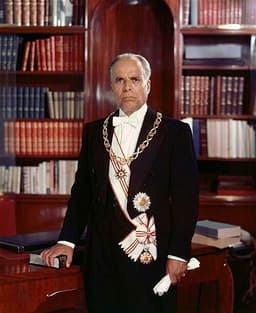
Habib Bourguiba
Politician · Modern
64.4Total

Malcolm Turnbull
Politician · Modern
49.3Total
Basic Information
Born
1903
1954
Died
2000
—
Era
Modern
Modern
Nationality
Tunisia
Australia
Occupation
Politician
Politician
Civilization
Middle Eastern
Western
Score Comparison
Military (10%)
39.9
11.2
Political (20%)
82.0
62.7
Influence (20%)
68.0
53.3
Legacy (20%)
55.0
42.5
Leadership (15%)
80.0
74.0
Strategy (15%)
53.8
37.0
TOTAL
64.4
49.3
Habib Bourguiba — Complete Timeline
1956 AD
Code of Personal StatusReform◆ Major
Bourguiba enacted the Code of Personal Status, a progressive family law that abolished polygamy, established legal minimum age for marriage, and granted women rights to divorce and custody. This reform was unprecedented in the Arab world and modernized Tunisian society.
Women's RightsLegal ReformSocial Change
Impact: nationalprogressive
Tunisian IndependencePolitical Action
Habib Bourguiba led Tunisia to independence from France through a combination of political negotiation and nationalist pressure. He became the first Prime Minister of independent Tunisia, ending 75 years of French protectorate rule.
IndependenceDecolonizationNationalism
Impact: nationalconstructive
1957 AD
Proclamation of the RepublicPolitical Action◆ Major
Bourguiba abolished the Tunisian monarchy and proclaimed the Republic of Tunisia, with himself as President. This move consolidated his power and established a presidential system that would dominate Tunisian politics for decades.
RepublicConstitutional ChangePresidency
Impact: national
1961 AD
Bizerte CrisisWar◆ Major
Bourguiba demanded the evacuation of the French naval base at Bizerte. When negotiations failed, Tunisian forces blockaded the base, leading to a violent confrontation with French troops. The crisis resulted in hundreds of Tunisian casualties and strained Franco-Tunisian relations.
ConflictDecolonizationBizerte
Impact: regionaltragic
1987 AD
Removal from PowerPolitical Action◆ Major
Prime Minister Zine El Abidine Ben Ali removed Bourguiba from office in a bloodless coup, citing his failing health and inability to govern. Bourguiba was placed under house arrest, ending his 30-year presidency and his role as Tunisia's founding father.
CoupSuccessionBen Ali
Impact: nationaltragic
Malcolm Turnbull — Complete Timeline
2008 AD
Apology to the Stolen Generations (as Opposition Leader)Political Action
As Opposition Leader, Malcolm Turnbull supported the Rudd government's apology to the Stolen Generations. He spoke in Parliament in favor of the apology, emphasizing the need for bipartisan support for Indigenous reconciliation.
Indigenous RightsReconciliation
Impact: nationalconstructive
2016 AD
National Broadband Network (NBN) rolloutReform◆ Major
Turnbull, as Communications Minister and later PM, oversaw the rollout of the National Broadband Network. He shifted from the original fiber-to-the-premises model to a mixed-technology approach, which reduced costs but drew criticism for slower speeds.
InfrastructureTechnology
Impact: nationalconstructive
2017 AD
Prime Ministership and same-sex marriage plebiscitePolitical Action◆ Major
Turnbull's government conducted a voluntary postal plebiscite on same-sex marriage, which returned a 61.6% 'Yes' vote. He then facilitated the passage of legislation legalizing same-sex marriage in Australia, despite internal party opposition.
LGBTQ RightsSocial Reform
Impact: nationalprogressive
2018 AD
Leadership spill and loss of Prime MinistershipPolitical Action◆ Major
Turnbull was ousted as Prime Minister in a Liberal Party leadership spill, losing to Scott Morrison. The spill was triggered by poor polling and internal divisions over energy policy, ending his tenure after 15 months.
Leadership SpillPolitical Defeat
Impact: nationaltragic
Expert Analysis
Origins
Habib Bourguiba was born on August 3, 1903, in Monastir, Tunisia, then a French protectorate. His father was a former army officer, and his mother was a homemaker. Bourguiba attended the Sadiki College in Tunis and later studied law and political science at the University of Paris, where he was exposed to nationalist ideas. He returned to Tunisia in 1927 and began his political activism, joining the Destour party and later founding the Neo Destour in 1934.
Malcolm Turnbull was born on October 24, 1954, in Sydney, Australia. His father was a hotel broker, and his mother was a writer and actress. Turnbull attended Vaucluse Public School and later Sydney Grammar School before studying arts and law at the University of Sydney. He then earned a Rhodes Scholarship to study at Oxford University. Before entering politics, Turnbull had a successful career as a lawyer, investment banker, and venture capitalist.
Rise to Power
Bourguiba rose to prominence by leading the Tunisian nationalist movement. He was arrested multiple times by French authorities, including a period of exile. His strategy combined political negotiation with mass mobilization. In 1954, France granted Tunisia internal autonomy, and on March 20, 1956, Tunisia achieved full independence. Bourguiba became Prime Minister, and in 1957, he abolished the monarchy and became the first President of Tunisia.
Turnbull entered politics in 2004, winning the seat of Wentworth for the Liberal Party. He quickly rose through the ranks, becoming Minister for the Environment and Water Resources in 2007. In 2008, he became Leader of the Opposition but lost the position in 2009 after a leadership spill. He returned as Communications Minister in 2013 under Prime Minister Tony Abbott. In 2015, Turnbull challenged Abbott and won the leadership, becoming Prime Minister of Australia.
Leadership & Governance
Bourguiba's leadership was characterized by a strong centralized state and a focus on modernization. He enacted the Code of Personal Status in 1956, which abolished polygamy, required women's consent for marriage, and set a minimum marriage age. He promoted education and women's rights, including access to contraception. In foreign policy, he pursued a non-aligned stance but maintained close ties with the West. His governance style was authoritarian, suppressing political opposition and controlling the press.
Turnbull's leadership was more moderate and consensus-driven. As Prime Minister, he focused on economic reform, including corporate tax cuts and innovation policy. He oversaw the National Broadband Network rollout, shifting from fiber-to-the-premises to a multi-technology mix. His most notable achievement was the same-sex marriage plebiscite in 2017, which resulted in a 61.6% 'Yes' vote and subsequent legalization. Turnbull's leadership was hampered by internal party divisions, particularly over climate change and energy policy.
Triumph & Tragedy
Bourguiba's greatest triumph was leading Tunisia to independence and establishing a modern state. His progressive social reforms, especially the Code of Personal Status, were groundbreaking for the Arab world. However, his later years were marked by authoritarianism, economic stagnation, and a personality cult. The Bizerte Crisis in 1961 resulted in hundreds of Tunisian deaths and damaged his reputation. He was removed from power in 1987 by Prime Minister Ben Ali in a bloodless coup.
Turnbull's triumph was the successful same-sex marriage plebiscite, which he managed despite opposition within his own party. He also avoided a recession during his tenure. His tragedy was his inability to unite the Liberal Party and his eventual ousting in a leadership spill in 2018, losing to Scott Morrison. His legacy is mixed, as many of his policy ambitions were blocked by internal dissent.
Character & Destiny
Bourguiba was charismatic, decisive, and determined. He had a vision for a modern, secular Tunisia and was willing to use authoritarian means to achieve it. His personality cult, with titles like 'Supreme Warrior', reflected his dominant role. However, his refusal to groom a successor led to a power vacuum. His character drove Tunisia's progress but also its stagnation.
Turnbull was pragmatic, articulate, and moderate. He was known for his legal and business acumen but struggled with the rough-and-tumble of party politics. His moderate stance on climate change and social issues alienated the conservative wing of his party. His character made him a capable leader in times of stability but vulnerable in a fractured political environment.
Legacy
Bourguiba's legacy is profound in Tunisia. He is remembered as the father of the nation, and his social reforms have endured. The Code of Personal Status remains a cornerstone of Tunisian society. However, his authoritarian governance and economic mismanagement contributed to the conditions that led to the 2011 Arab Spring. His political score of 82.0 reflects his impact, while his legacy score of 55.0 shows mixed long-term effects.
Turnbull's legacy is more limited. He advanced same-sex marriage, a significant social change, but his economic and infrastructure policies were incremental. His leadership score of 74.0 indicates his competence, but his total score of 49.3 reflects a relatively short and contentious tenure. He is remembered as a moderate who failed to bridge divisions in his party.
Conclusion
Habib Bourguiba had a greater impact than Malcolm Turnbull. Bourguiba's political score of 82.0 and leadership score of 80.0 far exceed Turnbull's 62.7 and 74.0, respectively. Bourguiba fundamentally transformed Tunisian society and remains a central figure in the nation's history, while Turnbull's achievements, though notable, were more modest and within a stable democracy. Bourguiba's total score of 64.4 against Turnbull's 49.3 underscores his greater influence and legacy.
Rankings
🥇
Habib BourguibaLeader
Mil: 39.9Pol: 82.0Inf: 68.0
64.4
🥈
Malcolm Turnbull
Mil: 11.2Pol: 62.7Inf: 53.3
49.3
+15.1 behind
How This Comparison Works
Algorithm
Each figure is scored on 6 dimensions (0—100 scale) based on structured historical data: Military (10%), Political (20%), Influence (20%), Legacy (20%), Leadership (15%), Strategy (15%). The weighted total produces the final ranking.
Data Sources
Scores are computed from structured sub-indicators in the database. Scale factors adjust for era (Ancient ×0.85, Modern ×1.0) and civilization size (Eastern ×1.05, Other ×0.80) to account for differences in population and military scale.
Maximum 3 Figures
Comparisons are limited to 2—3 figures to ensure readability and statistical meaningfulness.
Error Margins
±5 points per dimension — Sub-scores are derived from historical records with inherent uncertainty. Two figures within 5 points on a dimension should be considered roughly equivalent in that area.
Total Score Accuracy
±3 points overall — The weighted combination of 6 dimensions produces a total score with approximately ±3 points of uncertainty. Differences of less than 3 points are not statistically significant— the figures are effectively tied.
Known Limitations
- Historical records are incomplete and uneven across civilizations
- Figures from oral-tradition societies may be underrepresented
- Occupation labels can misclassify multi-role figures
- Scores measure capability and impact, not moral character
- Quantitative scoring is a comparison tool, not absolute truth
Capability Radar
Military (10%) — Battles & Warfare
Battles
5
23
Win Rate
5
25
Expansion
5
25
Political (20%) — Governance & Reform
Reform
90
55
Diplomacy
85
60
Economy
75
55
Influence (20%) — Cultural & Global Reach
Cultural
70
30
Global
65
30
Legacy (20%) — Historical Impact
Historical
75
35
Longevity
65
20
Leadership (15%) — Power & Stability
Tenure
85
45
Stability
70
40
Strategy (15%) — Tactics & Innovation
Strategy
5
34
Tactics
5
35
Reform
10
38
Similar Comparisons
Comments & Discussion
No comments yet. Be the first to share your thoughts!