Loading...
Guillermo Lasso vs Napoleon Bonaparte
Napoleon Bonaparte leads by 18.0 pts · 2 figures compared
…
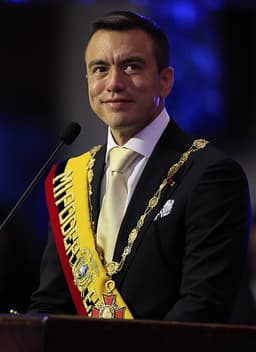
Guillermo Lasso
Politician · Modern
52.9Total

Napoleon Bonaparte
General · Modern
70.9Total
Basic Information
Born
1955
1769
Died
—
1821
Era
Modern
Modern
Nationality
Ecuador
France
Occupation
Politician
General
Civilization
Western
Western
Score Comparison
Military (10%)
48.4
94.0
Political (20%)
68.0
72.0
Influence (20%)
51.0
40.0
Legacy (20%)
39.2
80.0
Leadership (15%)
74.0
78.0
Strategy (15%)
41.7
90.0
TOTAL
52.9
70.9
Guillermo Lasso — Complete Timeline
2021 AD
Elected President of EcuadorPolitical Action◆ Major
Guillermo Lasso won the 2021 presidential election runoff against Andr
ElectionConservativeEconomic Reform
Impact: national
2022 AD
Faced massive indigenous protests over fuel pricesPolitical Action◆ Major
In June 2022, Ecuador experienced 18 days of nationwide protests led by indigenous groups against rising fuel prices and living costs. The protests resulted in at least six deaths and forced Lasso to declare a state of emergency in several provinces, eventually leading to negotiations.
ProtestsIndigenousEconomic Crisis
Impact: nationaldestructive
2023 AD
Dissolved Congress and triggered early electionsPolitical Action◆ Major
Facing an impeachment trial for alleged embezzlement, Lasso invoked the 'muerte cruzada' constitutional mechanism on May 17, 2023, dissolving the National Assembly and calling for early elections. This was the first time a president used this power, ending his term early.
Constitutional CrisisImpeachmentEarly Elections
Impact: nationaldestructive
Napoleon Bonaparte — Complete Timeline
1799 AD
Coup of 18 BrumaireOther◆ Major
Napoleon Bonaparte, with support from his brother Lucien and key political figures, overthrew the Directory in a bloodless coup. He established the Consulate with himself as First Consul, effectively becoming the ruler of France. This event ended the French Revolution's most unstable period.
French RevolutionCoupRise to Power
Impact: regional
1804 AD
Promulgation of the Napoleonic CodeOther◆ Major
Napoleon enacted the Civil Code of the French, known as the Napoleonic Code, a comprehensive set of laws that replaced the fragmented feudal legal systems. The code established legal equality, protected property rights, and secularized law. It became the basis for legal systems in many European and world countries.
Legal ReformNapoleonic CodeCivil Law
Impact: globalconstructive
1805 AD
Battle of AusterlitzWar◆ Major
Napoleon's Grande Arm
Napoleonic WarsBattleDecisive Victory
Impact: global
1812 AD
Invasion of RussiaWar◆ Major
Napoleon led the Grande Arm
Napoleonic WarsInvasionDisaster
Impact: globaldestructive
1815 AD
Battle of WaterlooWar◆ Major
Napoleon's French army was defeated by the combined forces of the Duke of Wellington's Anglo-Allied army and Gebhard Leberecht von Bl
Napoleonic WarsBattleFinal Defeat
Impact: globaldestructive
Expert Analysis
guillermo-lasso-vs-napoleon-bonaparte
**The Emperor and the Banker: Two Paths to Power, Two Different Worlds**
In the spring of 1815, Napoleon Bonaparte stood before his Grande Armée, newly escaped from exile on Elba, and watched as the Bourbon king’s soldiers defected to him by the thousands. Less than two centuries later, on a May morning in 2023, Guillermo Lasso sat alone in the presidential palace of Quito, signing a decree that would dissolve Ecuador’s National Assembly and trigger his own political suicide. Both men had reached the summit of power. One would conquer a continent; the other could barely hold his own country together. Why did these two modern leaders—both products of the Western tradition, both ambitious and intelligent—travel such radically different arcs? The answer lies not in their era, but in the nature of their ambition and the tools they wielded.
**Origins**
Napoleone di Buonaparte was born in 1769 on the Mediterranean island of Corsica, a territory only recently annexed by France. His family belonged to the minor nobility—poor, proud, and resentful of French rule. Yet young Napoleon, sent to military school in mainland France at age nine, absorbed the Enlightenment ideals of meritocracy and rational law. He was a solitary, fiercely intelligent outsider who read Rousseau and studied artillery mathematics. His world was one of absolute stakes: the French Revolution had abolished the old order, and a man of talent could rise to the top—or lose his head. Desperation and opportunity fused in him.
Guillermo Lasso was born in 1955 in Guayaquil, Ecuador, into a middle-class family that had lost its fortune. His father died when he was young, and Lasso began working as a teenager, eventually climbing the ranks of Ecuador’s banking sector. By his forties, he was a multimillionaire. His world was one of institutions: banks, political parties, international financial organizations. The stakes were high—corruption scandals, economic crises—but they were not the stakes of a firing squad or a throne. Lasso’s rise was methodical, a slow accumulation of capital and connections in a democracy where power was negotiated, not seized.
**Rise to Power**
Napoleon’s ascent was a series of detonations. At 24, he drove the British out of Toulon with a brilliant artillery plan. At 26, he suppressed a royalist uprising in Paris with a “whiff of grapeshot.” At 27, he conquered Italy, winning battles at Lodi, Arcole, and Rivoli against larger Austrian armies. Each victory was a self-reinforcing legend. His 1798 Egyptian campaign failed strategically but succeeded as propaganda: he returned to France a hero, and in 1799, at age 30, he overthrew the Directory in a coup d’état. The Revolution had created a vacuum; Napoleon filled it with his own will.
Lasso’s rise was slower, more patient—and ultimately more fragile. He ran for president three times. In 2013, he lost to Rafael Correa’s handpicked successor. In 2017, he lost narrowly to Lenín Moreno. Only in 2021, with the country reeling from COVID-19 and economic collapse, did he finally defeat Andrés Arauz, a Correa ally, by a margin of 52% to 48%. He took office on May 24, 2021, at age 65. His path was democratic, but it was also precarious: he had won not by inspiring a nation, but by being the less unacceptable option to a weary electorate.
**Leadership & Governance**
Napoleon governed with the same energy he brought to battle. He centralized the French state, created the Bank of France, and—most famously—codified French law in the Napoleonic Code, which abolished feudal privileges, protected property rights, and established secular legal equality. It was a revolutionary document, exported across Europe wherever his armies marched. He built roads, standardized education, and negotiated the Concordat with the Pope to stabilize the Church. His military genius, scoring 93 in strategy, was matched by a political score of 75—not visionary, but brutally effective. He knew that power flowed from victory, and victory flowed from speed, initiative, and the morale of his soldiers.
Lasso, by contrast, governed in a state of permanent crisis. He inherited an economy in recession, a pandemic still raging, and a deeply polarized society. His political score of 70.8 reflects a moderate competence: he cut fuel subsidies, negotiated with the IMF, and launched a vaccination campaign. But he lacked Napoleon’s ability to command loyalty. In June 2022, when indigenous groups launched 18 days of nationwide protests against rising fuel prices, Lasso responded by declaring a state of emergency and deploying the military. It was a show of force, but it solved nothing—the protests only ended after he agreed to negotiate. His leadership score of 72 is respectable, but it was not enough to govern a fractured nation.
**Triumph & Tragedy**
Napoleon’s greatest moment was Austerlitz, December 2, 1805, where he lured the combined Russian and Austrian armies into a trap and destroyed them. It was a masterpiece of deception and timing. His greatest failure was the 1812 invasion of Russia: an army of 600,000 men entered, and fewer than 100,000 returned. The disaster shattered his aura of invincibility. He was exiled to Elba in 1814, returned for the Hundred Days in 1815, and was finally defeated at Waterloo on June 18, 1815, by the Duke of Wellington and Prussian forces. He died in exile on Saint Helena in 1821, a prisoner of the British.
Lasso’s triumph was simply surviving—and even that proved temporary. His greatest moment was perhaps his inauguration itself, a peaceful transfer of power in a country that had seen three presidents in a single decade. His greatest failure came in May 2023, when facing an impeachment trial for alleged embezzlement, he invoked the “muerte cruzada” constitutional mechanism, dissolving the National Assembly and triggering early elections. It was a desperate move, and it worked in the short term: the trial ended. But it also ended his presidency. He left office in November 2023, his legacy a single, contested term.
**Character & Destiny**
Napoleon was driven by an insatiable will to dominate. “Impossible,” he once said, “is a word to be found only in the dictionary of fools.” He believed he could shape history through sheer force of mind and courage. This made him magnificent—and also doomed him. He could not stop. He invaded Russia because he could not bear to leave a rival undefeated. He rejected peace offers because conquest had become his identity. His character was his destiny: a man who could win any battle except the one against his own ambition.
Lasso was driven by a more modest ambition: to stabilize a country and restore investor confidence. He was a technocrat, not a visionary. His character was cautious, pragmatic, risk-averse—until he was cornered. Then he chose the nuclear option. It was a decision that revealed something deeper: that even a banker, when threatened, can act like a revolutionary. But where Napoleon’s gambles were calculated from strength, Lasso’s were born of weakness. His character did not shape history; history shaped him.
**Legacy**
Napoleon’s legacy is massive and contested. He is remembered as a military genius (military score: 94), a reformer who spread the Napoleonic Code across Europe, and a tyrant who caused millions of deaths. His influence score of 82 reflects his lasting impact on law, warfare, and nationalism. He changed the world, for better and worse.
Lasso’s legacy is modest and local. His political score of 70.8 and influence of 70.4 place him as a competent but forgettable president in a region of stronger personalities. He will be remembered, if at all, as the banker who tried to save Ecuador’s economy but could not heal its divisions. His legacy score of 53.6 is honest: he did not change his country’s trajectory.
**Conclusion**
Napoleon and Lasso both climbed to the peak of power, but they climbed different mountains. Napoleon’s world was one of absolute sovereignty, where a single man could command armies and rewrite laws. Lasso’s world was one of democratic constraints, where power is borrowed from voters and checked by courts and protests. Their different outcomes were not a matter of talent—Napoleon’s strategy score of 93 versus Lasso’s 35.3 is a chasm—but of context. The Corsican could become emperor because the Revolution had smashed every institution. The Ecuadorian could only become a temporary president because institutions, however flawed, still held. In the end, one man conquered Europe and died in exile; the other governed a small country and left quietly. Both stories remind us that history is not just about individuals, but about the stage they are given to act upon.
Rankings
🥇
Napoleon BonaparteLeader
Mil: 94.0Pol: 72.0Inf: 40.0
70.9
🥈
Guillermo Lasso
Mil: 48.4Pol: 68.0Inf: 51.0
52.9
+18.0 behind
How This Comparison Works
Algorithm
Each figure is scored on 6 dimensions (0—100 scale) based on structured historical data: Military (10%), Political (20%), Influence (20%), Legacy (20%), Leadership (15%), Strategy (15%). The weighted total produces the final ranking.
Data Sources
Scores are computed from structured sub-indicators in the database. Scale factors adjust for era (Ancient ×0.85, Modern ×1.0) and civilization size (Eastern ×1.05, Other ×0.80) to account for differences in population and military scale.
Maximum 3 Figures
Comparisons are limited to 2—3 figures to ensure readability and statistical meaningfulness.
Error Margins
±5 points per dimension — Sub-scores are derived from historical records with inherent uncertainty. Two figures within 5 points on a dimension should be considered roughly equivalent in that area.
Total Score Accuracy
±3 points overall — The weighted combination of 6 dimensions produces a total score with approximately ±3 points of uncertainty. Differences of less than 3 points are not statistically significant— the figures are effectively tied.
Known Limitations
- Historical records are incomplete and uneven across civilizations
- Figures from oral-tradition societies may be underrepresented
- Occupation labels can misclassify multi-role figures
- Scores measure capability and impact, not moral character
- Quantitative scoring is a comparison tool, not absolute truth
Capability Radar
Military (10%) — Battles & Warfare
Battles
31
95
Win Rate
30
90
Expansion
37
95
Political (20%) — Governance & Reform
Reform
40
95
Diplomacy
50
80
Economy
45
85
Influence (20%) — Cultural & Global Reach
Cultural
20
85
Global
25
90
Legacy (20%) — Historical Impact
Historical
20
95
Longevity
15
90
Leadership (15%) — Power & Stability
Tenure
55
85
Stability
35
70
Strategy (15%) — Tactics & Innovation
Strategy
35
95
Tactics
39
98
Reform
47
92
Similar Comparisons
Comments & Discussion
NapoleonsGhost6/17/2026
Comparing Lasso to Napoleon is like comparing a chess grandmaster to a Monopoly player. Napoleon didn't just lead armies - he revolutionized warfare with the corps system and merit-based promotion. Lasso dissolved an assembly he couldn't control; Napoleon dissolved the Directory because he could. One reshaped Europe's legal systems; the other can't stop Ecuador's economic decline. Show me Lasso winning at Austerlitz, then we'll talk.
复兴将军6/17/2026
拿破仑的失败在于过度扩张,但拉索连失败的资格都没有。一个统治过半个欧洲,签署过《拿破仑法典》,另一个连本国国会都搞不定。拿破仑被流放时法国人还爱他,拉索却只能落寞退场。这叫比较?这是拿流星跟手电筒比光芒。
DataCenturion6/17/2026
The metrics don't lie: Napoleon commanded over 600,000 men in 1812 alone, fought 60+ battles, and reformed European law. Lasso managed a 4% GDP growth and lost his assembly. But here's the real killer - Napoleon's approval rating after Waterloo was still 40% in France. Lasso hit 20% before quitting. Power isn't just about titles; it's about how many people follow you into the abyss. Emperor wins, 10-0.
古典学究6/17/2026
从古典政治哲学看,拿破仑是马基雅维利式的君主,懂得命运女神只帮助勇敢者。拉索却犯了温和派的老毛病:想改革却不敢流血。拿破仑知道权力需要恐惧与威望并存,拉索活像西塞罗的改良版——满口仁义,却连叛徒都镇压不了。公元前49年的卢比孔河,可比2023年的宪法数字庄严得多。
RevisionistEdge6/17/2026
Stop romanticizing imperialism. Napoleon was a dictator who restored slavery, killed millions, and crowned himself emperor while claiming to spread revolution. Lasso at least didn't invade Russia. The comparison exposes our bias: we glorify conquerors but mock democrats who struggle with messy institutions. Napoleon's "greatness" came from bayonets and censorship. Lasso's failure? Actually trying constitutional reform in a fractured nation.