Loading...
This comparison has not been analyzed yet.
One-time AI generation (~1 minute). Scores and timeline are already available below.
Guan Xing vs Hamilcar Barca
Hamilcar Barca leads by 28.8 pts · 2 figures compared
…
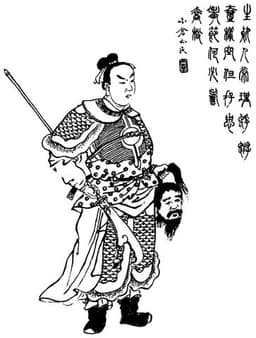
Guan Xing
General · Ancient
40.6Total

Hamilcar Barca
General · Ancient
69.4Total
Basic Information
Born
198
-275
Died
234
-228
Era
Ancient
Ancient
Nationality
China
Carthage
Occupation
General
General
Civilization
Eastern
Middle Eastern
Score Comparison
Military (10%)
38.3
90.0
Political (20%)
39.4
68.0
Influence (20%)
51.0
72.0
Legacy (20%)
33.3
55.0
Leadership (15%)
35.4
68.0
Strategy (15%)
45.0
82.0
TOTAL
40.6
69.4
Guan Xing — Complete Timeline
220 AD
Succeeded Guan Yu as GeneralPolitical Action
After Guan Yu's death, Guan Xing inherited his father's title and military command. He was appointed a general in Shu, though his career was cut short by his early death.
InheritanceShu HanMilitary
Impact: national
222 AD
Participated in Yi Ling CampaignWar
Guan Xing fought in the Battle of Yi Ling (Xiaoting) under Liu Bei against Wu. He commanded a unit and survived the disastrous defeat, retreating with the remnants of Shu forces.
Yi LingShu HanBattle
Impact: regional
234 AD
Died Young in Shu ServiceOther
Guan Xing died at a relatively young age, around 36, while still serving Shu. His early death prevented him from achieving the military prominence of his father, Guan Yu.
DeathShu HanGeneral
tragic
Hamilcar Barca — Complete Timeline
247 BC
Appointed Commander of Carthaginian Forces in SicilyWar◆ Major
Hamilcar Barca was given command of Carthaginian forces in Sicily during the First Punic War. He established a base at Mount Eryx and conducted guerrilla warfare against the Romans, achieving several victories despite limited resources.
First Punic WarSicilyMilitary Command
Impact: regional
241 BC
Negotiated the Treaty of Lutatius Ending the First Punic WarPolitical Action◆ Major
Hamilcar Barca was authorized to negotiate peace terms with Rome after Carthage's defeat at the Aegates Islands. The Treaty of Lutatius required Carthage to evacuate Sicily and pay heavy indemnities, ending the First Punic War.
First Punic WarPeace TreatyCarthage
Impact: regionaltragic
237 BC
Led the Carthaginian Campaign in SpainWar◆ Major
Hamilcar Barca led a Carthaginian expedition to Spain to compensate for the loss of Sicily. He conquered large territories, established the city of Akra Leuke, and built a power base that provided resources and troops for the Second Punic War.
SpainExpansionSecond Punic War
Impact: regionalconstructive
228 BC
Drowned in the Júcar RiverOther◆ Major
Hamilcar Barca drowned while retreating from a battle against the Oretani tribe in Spain. His death left his son-in-law Hasdrubal the Fair in command of Carthaginian forces in Spain, and later his son Hannibal took over.
DeathSpainSuccession
Impact: regionaltragic
This comparison has not been analyzed yet.
One-time AI generation (~1 minute). Scores and timeline are already available below.
Rankings
🥇
Hamilcar BarcaLeader
Mil: 90.0Pol: 68.0Inf: 72.0
69.4
🥈
Guan Xing
Mil: 38.3Pol: 39.4Inf: 51.0
40.6
+28.8 behind
How This Comparison Works
Algorithm
Each figure is scored on 6 dimensions (0—100 scale) based on structured historical data: Military (10%), Political (20%), Influence (20%), Legacy (20%), Leadership (15%), Strategy (15%). The weighted total produces the final ranking.
Data Sources
Scores are computed from structured sub-indicators in the database. Scale factors adjust for era (Ancient ×0.85, Modern ×1.0) and civilization size (Eastern ×1.05, Other ×0.80) to account for differences in population and military scale.
Maximum 3 Figures
Comparisons are limited to 2—3 figures to ensure readability and statistical meaningfulness.
Error Margins
±5 points per dimension — Sub-scores are derived from historical records with inherent uncertainty. Two figures within 5 points on a dimension should be considered roughly equivalent in that area.
Total Score Accuracy
±3 points overall — The weighted combination of 6 dimensions produces a total score with approximately ±3 points of uncertainty. Differences of less than 3 points are not statistically significant— the figures are effectively tied.
Known Limitations
- Historical records are incomplete and uneven across civilizations
- Figures from oral-tradition societies may be underrepresented
- Occupation labels can misclassify multi-role figures
- Scores measure capability and impact, not moral character
- Quantitative scoring is a comparison tool, not absolute truth
Capability Radar
Military (10%) — Battles & Warfare
Battles
5
75
Win Rate
5
80
Expansion
0
85
Political (20%) — Governance & Reform
Reform
0
65
Diplomacy
0
70
Economy
0
68
Influence (20%) — Cultural & Global Reach
Cultural
5
60
Global
0
65
Legacy (20%) — Historical Impact
Historical
5
75
Longevity
5
70
Leadership (15%) — Power & Stability
Tenure
5
60
Stability
0
55
Strategy (15%) — Tactics & Innovation
Strategy
5
82
Tactics
5
78
Reform
0
70
Similar Comparisons
Comments & Discussion
No comments yet. Be the first to share your thoughts!