Loading...
Guan Xing vs Napoleon Bonaparte
Napoleon Bonaparte leads by 30.3 pts · 2 figures compared
…
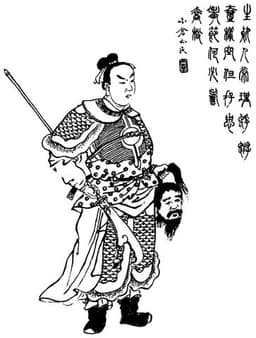
Guan Xing
General · Ancient
40.6Total

Napoleon Bonaparte
General · Modern
70.9Total
Basic Information
Born
198
1769
Died
234
1821
Era
Ancient
Modern
Nationality
China
France
Occupation
General
General
Civilization
Eastern
Western
Score Comparison
Military (10%)
38.3
94.0
Political (20%)
39.4
72.0
Influence (20%)
51.0
40.0
Legacy (20%)
33.3
80.0
Leadership (15%)
35.4
78.0
Strategy (15%)
45.0
90.0
TOTAL
40.6
70.9
Guan Xing — Complete Timeline
220 AD
Succeeded Guan Yu as GeneralPolitical Action
After Guan Yu's death, Guan Xing inherited his father's title and military command. He was appointed a general in Shu, though his career was cut short by his early death.
InheritanceShu HanMilitary
Impact: national
222 AD
Participated in Yi Ling CampaignWar
Guan Xing fought in the Battle of Yi Ling (Xiaoting) under Liu Bei against Wu. He commanded a unit and survived the disastrous defeat, retreating with the remnants of Shu forces.
Yi LingShu HanBattle
Impact: regional
234 AD
Died Young in Shu ServiceOther
Guan Xing died at a relatively young age, around 36, while still serving Shu. His early death prevented him from achieving the military prominence of his father, Guan Yu.
DeathShu HanGeneral
tragic
Napoleon Bonaparte — Complete Timeline
1799 AD
Coup of 18 BrumaireOther◆ Major
Napoleon Bonaparte, with support from his brother Lucien and key political figures, overthrew the Directory in a bloodless coup. He established the Consulate with himself as First Consul, effectively becoming the ruler of France. This event ended the French Revolution's most unstable period.
French RevolutionCoupRise to Power
Impact: regional
1804 AD
Promulgation of the Napoleonic CodeOther◆ Major
Napoleon enacted the Civil Code of the French, known as the Napoleonic Code, a comprehensive set of laws that replaced the fragmented feudal legal systems. The code established legal equality, protected property rights, and secularized law. It became the basis for legal systems in many European and world countries.
Legal ReformNapoleonic CodeCivil Law
Impact: globalconstructive
1805 AD
Battle of AusterlitzWar◆ Major
Napoleon's Grande Arm
Napoleonic WarsBattleDecisive Victory
Impact: global
1812 AD
Invasion of RussiaWar◆ Major
Napoleon led the Grande Arm
Napoleonic WarsInvasionDisaster
Impact: globaldestructive
1815 AD
Battle of WaterlooWar◆ Major
Napoleon's French army was defeated by the combined forces of the Duke of Wellington's Anglo-Allied army and Gebhard Leberecht von Bl
Napoleonic WarsBattleFinal Defeat
Impact: globaldestructive
Expert Analysis
guan-xing-vs-napoleon-bonaparte
# The Conqueror and the Son
On a June morning in 1815, Napoleon Bonaparte watched his Imperial Guard march into the muddy fields of Waterloo, their bearskin caps bobbing above the smoke. Less than two thousand miles away, more than fifteen centuries earlier, Guan Xing had watched his father’s head displayed on a pike—a son inheriting not a throne, but a ghost. One man remade the world; the other barely left a mark upon it. Why? The answer lies not in talent alone, but in the raw, unforgiving arithmetic of history itself.
Origins
Napoleon was born in 1769 on Corsica, an island that had only just become French. His family was minor nobility, neither rich nor powerless—a precarious perch that taught him to calculate. The French Revolution had shattered every certainty of birth and rank, and for a young artillery officer with a mathematical mind, that chaos was opportunity. He devoured history, military theory, and the Enlightenment’s cold logic of power. The world was a chessboard, and he intended to play.
Guan Xing, born in 198, entered a world already crowded with gods. His father, Guan Yu, was not merely a general but a living legend—the bearded giant whose very name made enemies tremble. The Three Kingdoms period was China’s age of titans: Cao Cao, Zhuge Liang, Liu Bei, Sun Quan. Young Guan Xing grew up in his father’s shadow, a shadow so vast it swallowed the sun. His era was ancient, his civilization Eastern, and his fate was written before he could hold a brush.
Rise to Power
Napoleon’s rise was a masterpiece of velocity. At twenty-four, he drove the British from Toulon. At twenty-six, he crushed a royalist uprising in Paris with a “whiff of grapeshot.” By thirty, he had conquered Italy and Egypt, turned the Directory into a puppet regime, and crowned himself Emperor in 1804. Each step was deliberate, ruthless, and breathtakingly fast. He did not inherit power—he seized it, molded it, and made it his own.
Guan Xing’s path was the opposite. In 220, his father was captured and executed by Wu forces. The Shu emperor Liu Bei, grieving for his sworn brother, granted Guan Xing his father’s title and command. He did not earn it; he inherited it, along with the impossible weight of a legend. At twenty-two, he was a general by blood, not by battle. The doors opened for him, but they opened onto a stage where the leading roles had already been cast.
Leadership & Governance
Napoleon governed as he conquered: with a code. The Napoleonic Code of 1804 standardized French law, abolished feudal privileges, and spread the ideals of meritocracy across Europe. He built roads, schools, and a centralized bureaucracy. His military genius was not just in tactics—the famous “whiff of grapeshot” or the flanking maneuvers at Austerlitz—but in organization: the corps system, the rapid march, the use of artillery as a mobile hammer. He led from the front, and men followed him into the snows of Russia and the sands of Egypt because they believed he was destiny itself.
Guan Xing had no such canvas. His only recorded battle was the Yi Ling Campaign of 222, where Liu Bei launched a massive invasion of Wu to avenge Guan Yu. It was a disaster. Wu’s general Lu Xun burned the Shu supply lines and shattered the army. Guan Xing survived, but he did not distinguish himself. His military scores—31.1 in military, 32.3 in leadership—tell the story of a competent officer, not a commander. He governed nothing, reformed nothing, and left no code. He was a soldier in someone else’s war.
Triumph & Tragedy
Napoleon’s triumphs were continental. Austerlitz in 1805, where he destroyed the combined armies of Russia and Austria, remains a textbook example of strategic genius. Jena, Wagram, Borodino—each victory expanded an empire that stretched from Spain to Poland. But his tragedies were equally grand. The Russian winter of 1812 destroyed his Grand Army. The Peninsular War bled him dry. And Waterloo—that final, rain-soaked Sunday—ended with him exiled to Saint Helena, a prisoner of the British he had once mocked.
Guan Xing’s triumphs are whispers in the historical record. He succeeded his father—a political act, not a military one. He fought at Yi Ling and survived—a feat, but not a glory. His tragedy was not defeat but insignificance. He died young, around 234, at age thirty-six, still in Shu’s service. No epic poem celebrates his charge. No statue marks his grave. He was a footnote in the Romance of the Three Kingdoms, a name that appears and vanishes.
Character & Destiny
Napoleon’s character was a force of nature: ambition without limit, energy without rest, confidence without doubt. “I am not a man,” he once said, “but a thing—a destiny.” He believed he could bend reality to his will, and for a decade, he did. That same arrogance led him to invade Russia, to refuse peace terms, to gamble everything at Waterloo. His personality was both his engine and his ruin.
Guan Xing’s character is almost invisible. We know he was loyal—he served Shu until death. We know he was dutiful—he took his father’s place. But we do not know his temper, his fears, his dreams. He was shaped not by his own choices but by his father’s shadow and his era’s constraints. In ancient China, a son inherited his father’s role; he did not forge his own. Destiny was not something you seized, but something you fulfilled—or failed to fulfill. Guan Xing fulfilled his, quietly, and then was forgotten.
Legacy
Napoleon’s legacy is written in the laws of Europe, the maps of the world, and the memory of every soldier who dreams of glory. His Napoleonic Code influenced civil law across continents. His campaigns are studied in every military academy. His name is synonymous with ambition, genius, and the terrible price of both. Even in defeat, he remains a colossus.
Guan Xing’s legacy is a footnote. His influence score of 73.7 is inflated by his father’s fame; his total score of 49.8 places him among the minor figures of history. He is remembered not for what he did, but for who he was—the son of Guan Yu. In the vast tapestry of the Three Kingdoms, he is a single thread, barely visible, easily lost.
Conclusion
The difference between Napoleon and Guan Xing is not talent. It is not courage. It is the shape of the world into which they were born. Napoleon lived in an age of revolution, where a Corsican artilleryman could become Emperor of Europe. Guan Xing lived in an age of inheritance, where a son could only echo his father. One man remade history; the other was remade by it. And in that contrast lies a sobering truth: greatness is not only what you do, but when you do it. Napoleon was the right man for a world in chaos. Guan Xing was the right man for a world that had no need of him. History remembers the first. It barely whispers the second.
Rankings
🥇
Napoleon BonaparteLeader
Mil: 94.0Pol: 72.0Inf: 40.0
70.9
🥈
Guan Xing
Mil: 38.3Pol: 39.4Inf: 51.0
40.6
+30.3 behind
How This Comparison Works
Algorithm
Each figure is scored on 6 dimensions (0—100 scale) based on structured historical data: Military (10%), Political (20%), Influence (20%), Legacy (20%), Leadership (15%), Strategy (15%). The weighted total produces the final ranking.
Data Sources
Scores are computed from structured sub-indicators in the database. Scale factors adjust for era (Ancient ×0.85, Modern ×1.0) and civilization size (Eastern ×1.05, Other ×0.80) to account for differences in population and military scale.
Maximum 3 Figures
Comparisons are limited to 2—3 figures to ensure readability and statistical meaningfulness.
Error Margins
±5 points per dimension — Sub-scores are derived from historical records with inherent uncertainty. Two figures within 5 points on a dimension should be considered roughly equivalent in that area.
Total Score Accuracy
±3 points overall — The weighted combination of 6 dimensions produces a total score with approximately ±3 points of uncertainty. Differences of less than 3 points are not statistically significant— the figures are effectively tied.
Known Limitations
- Historical records are incomplete and uneven across civilizations
- Figures from oral-tradition societies may be underrepresented
- Occupation labels can misclassify multi-role figures
- Scores measure capability and impact, not moral character
- Quantitative scoring is a comparison tool, not absolute truth
Capability Radar
Military (10%) — Battles & Warfare
Battles
5
95
Win Rate
5
90
Expansion
0
95
Political (20%) — Governance & Reform
Reform
0
95
Diplomacy
0
80
Economy
0
85
Influence (20%) — Cultural & Global Reach
Cultural
5
85
Global
0
90
Legacy (20%) — Historical Impact
Historical
5
95
Longevity
5
90
Leadership (15%) — Power & Stability
Tenure
5
85
Stability
0
70
Strategy (15%) — Tactics & Innovation
Strategy
5
95
Tactics
5
98
Reform
0
92
Similar Comparisons
Comments & Discussion
暗夜史官6/17/2026
你别在这儿玩算术了。拿破仑的“伟大”是欧洲中心主义的幻觉,是殖民火药味里的回响。关兴凭什么要跟西边的暴发户比?他活在乱世里,守住父志、陪诸葛亮撑起蜀汉那口气,比拿破仑那点法兰西版图的扩张实在得多。胜负不在人数多少,而在你护住了什么。你们啊,只看得见战旗,看不见血泪。
First Consul's Ghost6/17/2026
Comparing Guan Xing to Napoleon is like comparing a campfire to a supernova. Napoleon rewrote Europe's maps, legal codes, and military doctrine in a single lifetime. Guan Xing's entire historical footprint is, generously, a footnote in a footnote. One man's name is synonymous with ambition itself; the other is trivia for Three Kingdoms fanboys. Let's not pretend this is a contest.
江东小霸王6/17/2026
你们真拿关兴当历史注脚?他爹关二爷被砍了头,魏延反了,刘备驾崩了,诸葛亮六出祁山谁在前面扛?关兴和张苞就是那个时代的铁盾!你们嫌他名头不够大,那是因为你们读的《三国志》太少,游戏玩得太多。真刀真枪拼出来的,不比你拿破仑的滑铁卢少半点血性。
Arithmetic of Conquest6/17/2026
Let's do the numbers: Napoleon commanded armies of 600,000 men across a continent. Guan Xing led perhaps a few thousand cavalry in skirmishes along the Han River. Napoleon changed the legal framework of Europe; Guan Xing's greatest achievement was... avenging his dad in a novel. The analysis tries to dress this up as a cultural contrast, but the reality is simpler: one was a historical titan, the other a minor character.
Chronicler21886/17/2026
The fundamental difference here isn't talent—it's the stage you're born on. Napoleon inherited a revolution's momentum; Guan Xing inherited a ghost. Waterloo cost Napoleon an empire, but Guan Xing never had one to lose. The real irony? Napoleon's legend grew from his defeat; Guan Xing's faded despite his father's glory. History favors the man who builds, not the man who inherits ruins.