Loading...
Gough Whitlam vs Seewoosagur Ramgoolam
Gough Whitlam leads by 6.2 pts · 2 figures compared
…

Gough Whitlam
Politician · Modern
61.2Total
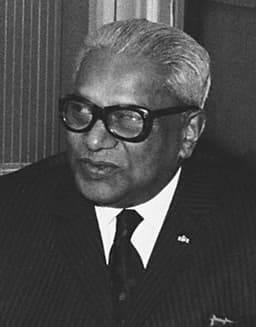
Seewoosagur Ramgoolam
Politician · Modern
55.0Total
Basic Information
Born
1916
1900
Died
2014
1985
Era
Modern
Modern
Nationality
Australia
Mauritius
Occupation
Politician
Politician
Civilization
Western
Other
Score Comparison
Military (10%)
50.0
24.1
Political (20%)
78.0
70.3
Influence (20%)
58.3
55.0
Legacy (20%)
58.0
52.0
Leadership (15%)
74.0
75.0
Strategy (15%)
43.4
40.2
TOTAL
61.2
55.0
Gough Whitlam — Complete Timeline
1972 AD
Elected Prime Minister of AustraliaPolitical Action◆ Major
Whitlam led the Australian Labor Party to victory in the 1972 federal election, ending 23 years of conservative rule. His government immediately withdrew Australian troops from Vietnam and established diplomatic relations with China.
ElectionLabor PartyVietnam War
Impact: nationalprogressive
1974 AD
Abolished University FeesReform◆ Major
Whitlam's government abolished tuition fees for tertiary education, making university attendance free for all Australian students. This policy dramatically increased university enrollment and access for lower-income students.
EducationUniversitySocial Reform
Impact: nationalprogressive
1975 AD
Introduced Universal Healthcare (Medibank)Reform◆ Major
Whitlam's government established Medibank, Australia's first universal public health insurance scheme. The system provided free hospital and medical care to all Australians, funded through a levy on income tax.
HealthcareSocial ReformMedibank
Impact: nationalprogressive
Passed the Racial Discrimination ActReform◆ Major
Whitlam's government enacted the Racial Discrimination Act, making it illegal to discriminate on the basis of race, color, or ethnic origin. The legislation implemented Australia's obligations under the International Convention on the Elimination of All Forms of Racial Discrimination.
Civil RightsAnti-DiscriminationLegislation
Impact: nationalprogressive
Dismissed as Prime MinisterPolitical Action
Governor-General Sir John Kerr dismissed Whitlam as prime minister following a budget deadlock in the Senate. This unprecedented action triggered a constitutional crisis and led to the appointment of Malcolm Fraser as caretaker prime minister.
Constitutional CrisisDismissalGovernor-General
Impact: nationaltragic
Seewoosagur Ramgoolam — Complete Timeline
1948 AD
Elected to the Legislative Council of MauritiusPolitical Action◆ Major
Ramgoolam was elected to the Legislative Council in the 1948 general election, representing the Labour Party. This marked the beginning of his political career in colonial Mauritius.
Political EntryColonial Politics
Impact: nationalconstructive
1961 AD
Became Chief Minister of MauritiusPolitical Action◆ Major
Ramgoolam became Chief Minister of Mauritius after the 1961 constitutional conference in London. He led the push for self-government and eventual independence from Britain.
Self-GovernmentIndependence Movement
Impact: nationalconstructive
1968 AD
Led Mauritius to IndependencePolitical Action
Ramgoolam led Mauritius to independence from the United Kingdom on March 12, 1968, becoming the first Prime Minister. He navigated ethnic tensions between Hindus and Creoles to achieve a peaceful transition.
IndependenceFounding Prime Minister
Impact: nationalconstructive
1976 AD
Implemented free education policyReform◆ Major
Ramgoolam's government introduced free primary and secondary education in Mauritius. This policy significantly increased literacy rates and access to education, laying the foundation for the country's human capital development.
Education ReformSocial Policy
Impact: nationalprogressive
1982 AD
Lost 1982 general electionPolitical Action◆ Major
Ramgoolam's Labour Party was defeated in the 1982 general election by the Militant Socialist Movement (MSM) led by Anerood Jugnauth. The defeat ended his 14-year tenure as Prime Minister, following economic difficulties and unemployment.
Electoral DefeatEnd of Era
Impact: nationaltragic
1983 AD
Appointed Governor-General of MauritiusPolitical Action
Ramgoolam was appointed Governor-General of Mauritius, a ceremonial role representing the British monarch. He served until his death in 1985, providing continuity and stability after his electoral loss.
Ceremonial RolePost-Prime Minister
Impact: national
Expert Analysis
Origins
Gough Whitlam was born on July 11, 1916, in Kew, Victoria, Australia, into a legal and political family. His father, Fred Whitlam, was a federal public servant and later a Crown Solicitor. Whitlam studied arts and law at the University of Sydney, graduating in 1946 after serving in the Royal Australian Air Force during World War II. His early career as a barrister and his involvement in the Australian Labor Party shaped his progressive ideals.
Seewoosagur Ramgoolam was born on September 18, 1900, in Belle Rive, Mauritius, into a modest Indian immigrant family. He studied medicine at University College London, becoming a doctor. His exposure to Indian independence movements and British politics during his time in London (1921-1935) influenced his nationalist views. Returning to Mauritius, he entered politics, joining the Labour Party to advocate for workers' rights and self-governance.
Rise to Power
Whitlam entered federal parliament in 1952 as the member for Werriwa. His rise was gradual; he became deputy leader of the Labor Party in 1960 and leader in 1967. He modernized the party platform, focusing on social reforms and ending conscription. The 1972 election saw Labor win after 23 years in opposition, with Whitlam becoming prime minister on December 5, 1972. His victory was driven by urban voters and a promise of change.
Ramgoolam's political ascent began with his election to the Legislative Council in 1948. He became Chief Minister in 1961 after constitutional reforms. His leadership was pivotal in negotiating independence from Britain, which was achieved on March 12, 1968. Ramgoolam navigated ethnic tensions between Hindus, Muslims, and Creoles, forming coalitions to maintain stability. He became the first Prime Minister of independent Mauritius.
Leadership & Governance
Whitlam's governance was characterized by rapid, ambitious reforms. He introduced universal healthcare (Medibank) in 1975, abolished university fees, and enacted the Racial Discrimination Act (1975). His government expanded federal power over states, funded the arts, and recognized China. However, his style was confrontational, and he faced a hostile Senate. The 1975 budget deadlock led to his dismissal by Governor-General Sir John Kerr—a constitutional crisis that ended his tenure.
Ramgoolam pursued a consensus-driven approach. He implemented free primary and secondary education, expanding literacy from 58% in 1960 to over 85% by 1980. His government invested in infrastructure, tourism, and textile exports, laying the foundation for Mauritius's economic transformation. He maintained stability through ethnic balancing, but his later years saw economic stagnation and corruption allegations. His political score of 70.3 reflects his coalition-building skills, but his strategy score of 40.2 indicates reactive policies.
Triumph & Tragedy
Whitlam's greatest triumph was Medicare, which remains a cornerstone of Australian society. The Racial Discrimination Act was a landmark in human rights. His government also withdrew troops from Vietnam and recognized the People's Republic of China. His tragedy was his dismissal; the '75 crisis damaged public trust in the constitution. Whitlam's legacy score of 58.0 reflects the mixed judgment of his tenure.
Ramgoolam's triumph was leading Mauritius to independence peacefully. Free education transformed the country's human capital. However, his failure was losing the 1982 election after 16 years, as his government was seen as corrupt and out of touch. His legacy score of 52.0 recognizes his foundational role but also his inability to adapt.
Character & Destiny
Whitlam was charismatic, intellectual, and combative. He believed in executive power and pushed boundaries, leading to his downfall. His leadership score of 74.0 indicates strong vision but poor crisis management. His dismissal was a direct result of his refusal to compromise.
Ramgoolam was patient, pragmatic, and diplomatic. He prioritized unity over ideology. His leadership score of 75.0 reflects his ability to hold a multi-ethnic coalition together. However, his cautiousness led to missed opportunities for deeper reform.
Legacy
Whitlam's reforms endured: Medicare, free university education, and anti-discrimination laws are integral to Australia. His dismissal remains a cautionary tale about executive overreach. He scored 58.3 in influence, reflecting his lasting impact on policy.
Ramgoolam is revered as the 'Father of the Nation' in Mauritius. His policies set the stage for Mauritius's economic success, but his personal legacy is tied to independence. His influence score of 55.0 shows his foundational but less transformative role.
Conclusion
Whitlam had a greater impact on Australia than Ramgoolam had on Mauritius, as his reforms were more sweeping and durable. Whitlam's total score of 61.2 versus Ramgoolam's 55.0 reflects this. While Ramgoolam's independence leadership was essential, Whitlam's policies reshaped Australian society. The data supports Whitlam as the more transformative figure.
Rankings
🥇
Gough WhitlamLeader
Mil: 50.0Pol: 78.0Inf: 58.3
61.2
🥈
Seewoosagur Ramgoolam
Mil: 24.1Pol: 70.3Inf: 55.0
55.0
+6.2 behind
How This Comparison Works
Algorithm
Each figure is scored on 6 dimensions (0—100 scale) based on structured historical data: Military (10%), Political (20%), Influence (20%), Legacy (20%), Leadership (15%), Strategy (15%). The weighted total produces the final ranking.
Data Sources
Scores are computed from structured sub-indicators in the database. Scale factors adjust for era (Ancient ×0.85, Modern ×1.0) and civilization size (Eastern ×1.05, Other ×0.80) to account for differences in population and military scale.
Maximum 3 Figures
Comparisons are limited to 2—3 figures to ensure readability and statistical meaningfulness.
Error Margins
±5 points per dimension — Sub-scores are derived from historical records with inherent uncertainty. Two figures within 5 points on a dimension should be considered roughly equivalent in that area.
Total Score Accuracy
±3 points overall — The weighted combination of 6 dimensions produces a total score with approximately ±3 points of uncertainty. Differences of less than 3 points are not statistically significant— the figures are effectively tied.
Known Limitations
- Historical records are incomplete and uneven across civilizations
- Figures from oral-tradition societies may be underrepresented
- Occupation labels can misclassify multi-role figures
- Scores measure capability and impact, not moral character
- Quantitative scoring is a comparison tool, not absolute truth
Capability Radar
Military (10%) — Battles & Warfare
Battles
27
25
Win Rate
31
27
Expansion
33
29
Political (20%) — Governance & Reform
Reform
85
80
Diplomacy
70
85
Economy
60
75
Influence (20%) — Cultural & Global Reach
Cultural
65
60
Global
55
60
Legacy (20%) — Historical Impact
Historical
70
70
Longevity
55
65
Leadership (15%) — Power & Stability
Tenure
55
85
Stability
30
80
Strategy (15%) — Tactics & Innovation
Strategy
39
35
Tactics
42
35
Reform
45
41
Similar Comparisons
Comments & Discussion
No comments yet. Be the first to share your thoughts!