Loading...
This comparison has not been analyzed yet.
One-time AI generation (~1 minute). Scores and timeline are already available below.
Goodluck Jonathan vs Thomas Klestil
Goodluck Jonathan leads by 1.9 pts · 2 figures compared
…
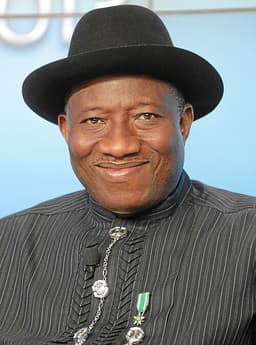
Goodluck Jonathan
Politician · Modern
54.1Total

Thomas Klestil
Politician · Modern
52.2Total
Basic Information
Born
1957
1932
Died
—
—
Era
Modern
Modern
Nationality
Nigeria
Austria
Occupation
Politician
Politician
Civilization
Other
Western
Score Comparison
Military (10%)
26.9
50.0
Political (20%)
68.0
68.0
Influence (20%)
56.4
51.8
Legacy (20%)
49.2
40.0
Leadership (15%)
72.0
66.0
Strategy (15%)
40.5
41.7
TOTAL
54.1
52.2
Goodluck Jonathan — Complete Timeline
2010 AD
Election as President of NigeriaPolitical Action◆ Major
Goodluck Jonathan became president following the death of President Umaru Yar'Adua. He was later elected in his own right in the 2011 presidential election, winning a majority of votes.
ElectionSuccessionPresidency
Impact: national
2012 AD
Subsidy removal protestsPolitical Action◆ Major
Jonathan's government attempted to remove fuel subsidies, leading to nationwide protests known as the 'Occupy Nigeria' movement. The protests forced the government to partially reverse the policy, highlighting public discontent.
ProtestsSubsidyEconomic Policy
Impact: nationaldestructive
2015 AD
2015 presidential election defeatPolitical Action
Jonathan lost the 2015 presidential election to Muhammadu Buhari. In a historic move, he conceded defeat before the official results were announced, preventing post-election violence and setting a precedent for peaceful democratic transitions in Nigeria.
ElectionConcessionDemocracy
Impact: nationalconstructive
Thomas Klestil — Complete Timeline
1992 AD
Elected President of AustriaPolitical Action◆ Major
Thomas Klestil was elected President of Austria on May 24, 1992, winning 56.9% of the vote against Rudolf Streicher. He took office on July 8, 1992, succeeding Kurt Waldheim.
Presidential ElectionConservative Victory
Impact: nationalconstructive
1998 AD
Re-elected President of AustriaPolitical Action◆ Major
Klestil was re-elected for a second term on April 19, 1998, winning 63.4% of the vote. His re-election was seen as a vote of confidence in his non-partisan approach to the presidency.
Re-electionPresidential Term
Impact: nationalconstructive
2004 AD
Death Two Days Before Leaving OfficeOther◆ Major
Klestil died on July 6, 2004, just two days before his second term was scheduled to end. He suffered a heart attack. His death led to a brief constitutional crisis, with the presidency temporarily assumed by the three National Council presidents.
Death in OfficeConstitutional Crisis
Impact: nationaltragic
This comparison has not been analyzed yet.
One-time AI generation (~1 minute). Scores and timeline are already available below.
Rankings
🥇
Goodluck JonathanLeader
Mil: 26.9Pol: 68.0Inf: 56.4
54.1
🥈
Thomas Klestil
Mil: 50.0Pol: 68.0Inf: 51.8
52.2
+1.9 behind
How This Comparison Works
Algorithm
Each figure is scored on 6 dimensions (0—100 scale) based on structured historical data: Military (10%), Political (20%), Influence (20%), Legacy (20%), Leadership (15%), Strategy (15%). The weighted total produces the final ranking.
Data Sources
Scores are computed from structured sub-indicators in the database. Scale factors adjust for era (Ancient ×0.85, Modern ×1.0) and civilization size (Eastern ×1.05, Other ×0.80) to account for differences in population and military scale.
Maximum 3 Figures
Comparisons are limited to 2—3 figures to ensure readability and statistical meaningfulness.
Error Margins
±5 points per dimension — Sub-scores are derived from historical records with inherent uncertainty. Two figures within 5 points on a dimension should be considered roughly equivalent in that area.
Total Score Accuracy
±3 points overall — The weighted combination of 6 dimensions produces a total score with approximately ±3 points of uncertainty. Differences of less than 3 points are not statistically significant— the figures are effectively tied.
Known Limitations
- Historical records are incomplete and uneven across civilizations
- Figures from oral-tradition societies may be underrepresented
- Occupation labels can misclassify multi-role figures
- Scores measure capability and impact, not moral character
- Quantitative scoring is a comparison tool, not absolute truth
Capability Radar
Military (10%) — Battles & Warfare
Battles
19
28
Win Rate
24
32
Expansion
27
35
Political (20%) — Governance & Reform
Reform
40
45
Diplomacy
65
65
Economy
45
50
Influence (20%) — Cultural & Global Reach
Cultural
30
20
Global
50
20
Legacy (20%) — Historical Impact
Historical
55
25
Longevity
40
15
Leadership (15%) — Power & Stability
Tenure
60
60
Stability
50
55
Strategy (15%) — Tactics & Innovation
Strategy
31
37
Tactics
35
42
Reform
36
41
Similar Comparisons
Comments & Discussion
No comments yet. Be the first to share your thoughts!