Loading...
Goodluck Jonathan vs Hilla Limann
Goodluck Jonathan leads by 15.9 pts · 2 figures compared
…
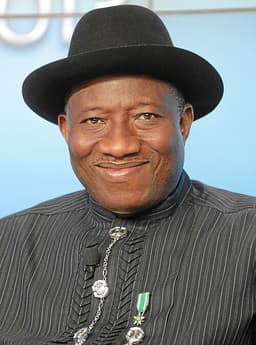
Goodluck Jonathan
Politician · Modern
54.1Total

Hilla Limann
Politician · Modern
38.2Total
Basic Information
Born
1957
1934
Died
—
—
Era
Modern
Modern
Nationality
Nigeria
Ghana
Occupation
Politician
Politician
Civilization
Other
Other
Score Comparison
Military (10%)
26.9
50.0
Political (20%)
68.0
25.0
Influence (20%)
56.4
45.5
Legacy (20%)
49.2
34.2
Leadership (15%)
72.0
34.6
Strategy (15%)
40.5
43.6
TOTAL
54.1
38.2
Goodluck Jonathan — Complete Timeline
2010 AD
Election as President of NigeriaPolitical Action◆ Major
Goodluck Jonathan became president following the death of President Umaru Yar'Adua. He was later elected in his own right in the 2011 presidential election, winning a majority of votes.
ElectionSuccessionPresidency
Impact: national
2012 AD
Subsidy removal protestsPolitical Action◆ Major
Jonathan's government attempted to remove fuel subsidies, leading to nationwide protests known as the 'Occupy Nigeria' movement. The protests forced the government to partially reverse the policy, highlighting public discontent.
ProtestsSubsidyEconomic Policy
Impact: nationaldestructive
2015 AD
2015 presidential election defeatPolitical Action
Jonathan lost the 2015 presidential election to Muhammadu Buhari. In a historic move, he conceded defeat before the official results were announced, preventing post-election violence and setting a precedent for peaceful democratic transitions in Nigeria.
ElectionConcessionDemocracy
Impact: nationalconstructive
Hilla Limann — Complete Timeline
1979 AD
Election as President of GhanaPolitical Action◆ Major
Limann won the 1979 presidential election as the candidate of the People's National Party (PNP). He became President of Ghana's Third Republic, inheriting a country in economic crisis.
ElectionThird RepublicPresident
Impact: nationalconstructive
1981 AD
Overthrow by Jerry RawlingsPolitical Action◆ Major
Limann's government was overthrown in a coup led by Flight Lieutenant Jerry Rawlings. The coup ended the Third Republic and ushered in a prolonged period of military rule under Rawlings' Provisional National Defence Council (PNDC).
CoupOverthrowRawlingsPNDC
Impact: nationaldestructive
Expert Analysis
Origins
Goodluck Jonathan (born 1957) came from a humble background in Otuoke, Bayelsa State, Nigeria. His father was a canoe carver and his mother a trader. He earned a PhD in zoology from the University of Port Harcourt, focusing on molluscs. Hilla Limann (born 1934) was born in Gwollu, northern Ghana, to a farming family. He studied political science and history at the University of Ghana, later earning a PhD from the Sorbonne in Paris. Both emerged from modest beginnings, but Jonathan's academic path was in science, while Limann's was in humanities.
Rise to Power
Jonathan's rise was unusual: he became deputy governor of Bayelsa in 1999, then governor in 2005 after his boss was impeached. In 2007, he was selected as running mate to Umaru Yar'Adua, becoming vice president. When Yar'Adua died in 2010, Jonathan succeeded him, and was elected in his own right in 2011 with 58.9% of the vote. Limann's path was more conventional: he was elected president in 1979 under the Third Republic, winning 35.3% in the first round and 62% in the runoff. He took office on September 24, 1979, inheriting a military-designed constitution.
Leadership & Governance
Jonathan's leadership style was consultative but indecisive. He scored 72.0 in leadership, but 40.5 in strategy. His government attempted to remove fuel subsidies in 2012, sparking the 'Occupy Nigeria' protests, which forced a partial reversal. He also grappled with Boko Haram insurgency, declaring a state of emergency. Limann scored 34.6 in leadership and 43.6 in strategy. His governance was hampered by economic decline and military distrust. He attempted to assert civilian control but faced opposition from former military leaders. Both struggled with economic management: Jonathan faced falling oil prices; Limann dealt with high inflation and debt.
Triumph & Tragedy
Jonathan's greatest triumph was his peaceful concession in the 2015 election, conceding defeat to Muhammadu Buhari before the official results were announced. This move earned praise and scored 68.0 in political skill. His tragedy was his inability to contain Boko Haram, which seized territories. Limann's triumph was overseeing the transition to civilian rule, but his tragedy was his overthrow by Jerry Rawlings on December 31, 1981, after just over two years in office. Limann's total score is 38.2, reflecting his short tenure.
Character & Destiny
Jonathan was known for his calm demeanor and willingness to compromise. His concession demonstrated a commitment to democratic norms. Limann was perceived as weak and ineffective, unable to consolidate power. His character—cautious and intellectual—was ill-suited for the volatile political climate. Jonathan's destiny was shaped by his historic act; Limann's by his overthrow. Jonathan's influence score is 56.4, Limann's 45.5.
Legacy
Jonathan's legacy is largely positive: he is remembered as the first Nigerian president to concede defeat, strengthening democracy. His legacy score is 49.2. Limann's legacy is minimal; he is often overlooked, remembered as the president who was overthrown. His legacy score is 34.2. Jonathan's impact on African democracy is more significant, as his example influenced future transitions.
Conclusion
Goodluck Jonathan had greater impact than Hilla Limann. With a total score of 54.1 against Limann's 38.2, Jonathan's peaceful concession set a precedent in Africa. While Limann's tenure was cut short, Jonathan's act of statesmanship has enduring relevance. Clearly, Jonathan's influence on democratic governance outweighs Limann's brief and interrupted rule.
Rankings
🥇
Goodluck JonathanLeader
Mil: 26.9Pol: 68.0Inf: 56.4
54.1
🥈
Hilla Limann
Mil: 50.0Pol: 25.0Inf: 45.5
38.2
+15.9 behind
How This Comparison Works
Algorithm
Each figure is scored on 6 dimensions (0—100 scale) based on structured historical data: Military (10%), Political (20%), Influence (20%), Legacy (20%), Leadership (15%), Strategy (15%). The weighted total produces the final ranking.
Data Sources
Scores are computed from structured sub-indicators in the database. Scale factors adjust for era (Ancient ×0.85, Modern ×1.0) and civilization size (Eastern ×1.05, Other ×0.80) to account for differences in population and military scale.
Maximum 3 Figures
Comparisons are limited to 2—3 figures to ensure readability and statistical meaningfulness.
Error Margins
±5 points per dimension — Sub-scores are derived from historical records with inherent uncertainty. Two figures within 5 points on a dimension should be considered roughly equivalent in that area.
Total Score Accuracy
±3 points overall — The weighted combination of 6 dimensions produces a total score with approximately ±3 points of uncertainty. Differences of less than 3 points are not statistically significant— the figures are effectively tied.
Known Limitations
- Historical records are incomplete and uneven across civilizations
- Figures from oral-tradition societies may be underrepresented
- Occupation labels can misclassify multi-role figures
- Scores measure capability and impact, not moral character
- Quantitative scoring is a comparison tool, not absolute truth
Capability Radar
Military (10%) — Battles & Warfare
Battles
19
23
Win Rate
24
25
Expansion
27
29
Political (20%) — Governance & Reform
Reform
40
10
Diplomacy
65
20
Economy
45
10
Influence (20%) — Cultural & Global Reach
Cultural
30
5
Global
50
5
Legacy (20%) — Historical Impact
Historical
55
10
Longevity
40
5
Leadership (15%) — Power & Stability
Tenure
60
15
Stability
50
5
Strategy (15%) — Tactics & Innovation
Strategy
31
29
Tactics
35
33
Reform
36
38
Similar Comparisons
Comments & Discussion
No comments yet. Be the first to share your thoughts!