Loading...
Glycerius vs King Solomon
King Solomon leads by 26.8 pts · 2 figures compared
…

Glycerius
Emperor · Ancient
38.0Total
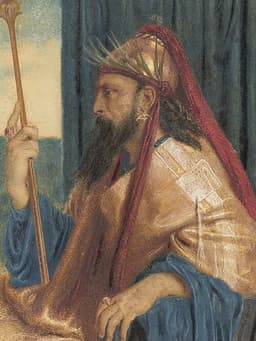
King Solomon
Emperor · Ancient
64.8Total
Basic Information
Born
420
-970
Died
480
-931
Era
Ancient
Ancient
Nationality
Western Roman Empire
Israel
Occupation
Emperor
Emperor
Civilization
Western
Middle Eastern
Score Comparison
Military (10%)
47.5
45.0
Political (20%)
29.3
72.0
Influence (20%)
42.4
65.0
Legacy (20%)
34.2
70.0
Leadership (15%)
39.0
72.0
Strategy (15%)
38.6
50.0
TOTAL
38.0
64.8
Glycerius — Complete Timeline
473 AD
Proclaimed Western Roman EmperorPolitical Action◆ Major
Glycerius was proclaimed Western Roman Emperor at Ravenna by the magister militum Gundobad, succeeding Olybrius. His elevation was not recognized by the Eastern Roman Emperor Leo I, who considered him a usurper.
Imperial SuccessionUsurpation
Impact: regional
474 AD
Deposed by Julius NeposPolitical Action◆ Major
The Eastern Roman Emperor Leo I sent Julius Nepos with a fleet to Italy to depose Glycerius. Nepos landed near Rome, and Glycerius was forced to abdicate without significant resistance. He was then appointed Bishop of Salona in Dalmatia.
DepositionImperial Succession
Impact: regional
King Solomon — Complete Timeline
960 BC
Establishment of the Kingdom's AdministrationReform◆ Major
Solomon reorganized Israel into twelve administrative districts, each responsible for providing provisions for the royal court for one month. This system centralized power and increased tax revenue but also created regional disparities.
AdministrationTaxationReform
Impact: national
957 BC
Construction of the First TempleCultural
Solomon built the First Temple in Jerusalem on Mount Moriah, using materials and craftsmen provided by King Hiram of Tyre. The temple housed the Ark of the Covenant and became the central place of worship for the Israelites.
TempleJerusalemWorship
Impact: globalconstructive
950 BC
Visit of the Queen of ShebaPolitical Action◆ Major
The Queen of Sheba visited Solomon in Jerusalem, bringing spices, gold, and precious stones. She tested his wisdom with riddles and was impressed by his wealth and court. This visit established trade relations between Israel and Sheba.
DiplomacyTradeSheba
Impact: regionalconstructive
Marriage to Foreign WivesPolitical Action◆ Major
Solomon married many foreign women, including Pharaoh's daughter and Moabite, Ammonite, Edomite, Sidonian, and Hittite princesses. These marriages secured political alliances but also introduced foreign religious practices into Israel.
MarriageAlliancesIdolatry
Impact: nationaldestructive
Expert Analysis
Origins
Glycerius, a shadowy figure of the late Western Roman Empire, was proclaimed emperor in 473 AD. He was likely a Roman senator or official, but little is known of his early life. His rise came through the support of the magister militum Gundobad, a powerful military commander of Burgundian origin. Glycerius's background reflects the crumbling state of the Western Empire, where emperors were often puppets of barbarian generals.
King Solomon, son of King David and Bathsheba, was born around 990 BC in Jerusalem. He inherited a united kingdom of Israel and was known for his wisdom, wealth, and building projects. His early life was marked by political intrigue, including the succession struggle with his half-brother Adonijah. Solomon's education and upbringing in the royal court prepared him for leadership.
Rise to Power
Glycerius was proclaimed emperor at Ravenna in March 473 AD after the death of Olybrius. His elevation was not recognized by the Eastern Roman Emperor Leo I, who considered him a usurper. Glycerius's reign lasted only a few months, as Leo sent Julius Nepos with a fleet to depose him. Without significant military or political support, Glycerius was forced to abdicate in June 474 AD. He was later appointed Bishop of Salona, but his power was negligible.
Solomon's rise was more deliberate. He was anointed king while David was still alive, ensuring a smooth transition. After David's death, Solomon consolidated his rule by eliminating rivals like Adonijah and Joab. He secured alliances through marriage, including the daughter of Pharaoh. Solomon's political maneuvering scored 72.0 in political skill, compared to Glycerius's 29.3.
Leadership & Governance
Glycerius's leadership was ineffective. He failed to gain recognition from the Eastern Empire and could not muster support from the Roman army or the Senate. His only notable act was negotiating with the Visigoths, but this had no lasting impact. His leadership score of 39.0 reflects his inability to govern effectively.
Solomon's governance was transformative. He reorganized Israel into twelve administrative districts, each responsible for supplying the royal court for one month. This system improved efficiency and centralized control. He also built a network of fortified cities, including Hazor, Megiddo, and Gezer. Solomon's leadership score of 72.0 shows his ability to manage a complex kingdom. However, his heavy taxation and forced labor led to resentment that later contributed to the kingdom's division.
Triumph & Tragedy
Glycerius's greatest triumph was becoming emperor, even briefly. His greatest failure was his inability to hold power, leading to his deposition without a fight. He scored 47.5 in military and 38.6 in strategy, but these were not enough to defend his throne.
Solomon's greatest triumph was building the First Temple in Jerusalem, which became the center of Israelite worship. He also established diplomatic and trade relations with neighboring kingdoms, such as the visit of the Queen of Sheba. His wealth and wisdom were legendary. However, his greatest failure was his marriage to foreign wives, who turned his heart to other gods, leading to idolatry and divine displeasure. This contributed to the eventual split of the kingdom after his death. Solomon scored 70.0 in legacy, reflecting his enduring religious significance.
Character & Destiny
Glycerius appears as a passive figure, a product of his time rather than a shaper of events. He lacked the ambition or skill to forge his own destiny. His character was likely cautious, as he accepted deposition and a bishopric rather than fighting. Historical assessments of him are minimal; he is a footnote in Roman history.
Solomon's character was complex: wise yet flawed, builder yet destroyer. His wisdom was legendary, but his political acumen did not extend to personal discipline. His decisions shaped the destiny of Israel, leading to a golden age but also sowing seeds of division. His total score of 64.8 reflects a mix of successes and failures.
Legacy
Glycerius's legacy is negligible. He is remembered only as one of many short-lived emperors of the declining Western Roman Empire. His reign had no lasting impact on institutions or culture.
Solomon's legacy is immense. The First Temple became the central symbol of Judaism. His wisdom is celebrated in the books of Proverbs, Ecclesiastes, and Song of Solomon. His administrative reforms influenced later governance. However, his idolatry and heavy-handed policies led to the division of the kingdom into Israel and Judah. Solomon's influence score of 65.0 and legacy score of 70.0 far exceed Glycerius's 42.4 and 34.2.
Conclusion
King Solomon had far greater impact than Glycerius. Solomon's total score of 64.8 dwarfs Glycerius's 38.0, a gap of 26.8 points. While Glycerius was a minor figure in a dying empire, Solomon shaped religion, politics, and culture for millennia. His temple, wisdom, and administrative systems left a lasting mark. Glycerius's brief reign changed nothing. Therefore, Solomon is clearly the more significant historical figure.
Rankings
🥇
King SolomonLeader
Mil: 45.0Pol: 72.0Inf: 65.0
64.8
🥈
Glycerius
Mil: 47.5Pol: 29.3Inf: 42.4
38.0
+26.8 behind
How This Comparison Works
Algorithm
Each figure is scored on 6 dimensions (0—100 scale) based on structured historical data: Military (10%), Political (20%), Influence (20%), Legacy (20%), Leadership (15%), Strategy (15%). The weighted total produces the final ranking.
Data Sources
Scores are computed from structured sub-indicators in the database. Scale factors adjust for era (Ancient ×0.85, Modern ×1.0) and civilization size (Eastern ×1.05, Other ×0.80) to account for differences in population and military scale.
Maximum 3 Figures
Comparisons are limited to 2—3 figures to ensure readability and statistical meaningfulness.
Error Margins
±5 points per dimension — Sub-scores are derived from historical records with inherent uncertainty. Two figures within 5 points on a dimension should be considered roughly equivalent in that area.
Total Score Accuracy
±3 points overall — The weighted combination of 6 dimensions produces a total score with approximately ±3 points of uncertainty. Differences of less than 3 points are not statistically significant— the figures are effectively tied.
Known Limitations
- Historical records are incomplete and uneven across civilizations
- Figures from oral-tradition societies may be underrepresented
- Occupation labels can misclassify multi-role figures
- Scores measure capability and impact, not moral character
- Quantitative scoring is a comparison tool, not absolute truth
Capability Radar
Military (10%) — Battles & Warfare
Battles
5
20
Win Rate
5
25
Expansion
0
20
Political (20%) — Governance & Reform
Reform
10
75
Diplomacy
20
80
Economy
10
85
Influence (20%) — Cultural & Global Reach
Cultural
5
90
Global
5
85
Legacy (20%) — Historical Impact
Historical
10
95
Longevity
5
95
Leadership (15%) — Power & Stability
Tenure
15
70
Stability
10
70
Strategy (15%) — Tactics & Innovation
Strategy
5
25
Tactics
5
30
Reform
0
15
Similar Comparisons
Comments & Discussion
No comments yet. Be the first to share your thoughts!