Loading...
King Solomon vs Napoleon Bonaparte
Napoleon Bonaparte leads by 6.1 pts · 2 figures compared
…
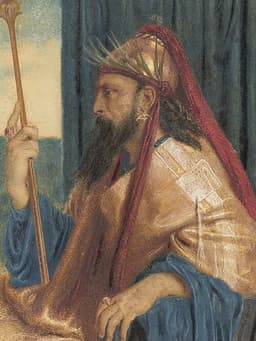
King Solomon
Emperor · Ancient
64.8Total

Napoleon Bonaparte
General · Modern
70.9Total
Basic Information
Born
-970
1769
Died
-931
1821
Era
Ancient
Modern
Nationality
Israel
France
Occupation
Emperor
General
Civilization
Middle Eastern
Western
Score Comparison
Military (10%)
45.0
94.0
Political (20%)
72.0
72.0
Influence (20%)
65.0
40.0
Legacy (20%)
70.0
80.0
Leadership (15%)
72.0
78.0
Strategy (15%)
50.0
90.0
TOTAL
64.8
70.9
King Solomon — Complete Timeline
960 BC
Establishment of the Kingdom's AdministrationReform◆ Major
Solomon reorganized Israel into twelve administrative districts, each responsible for providing provisions for the royal court for one month. This system centralized power and increased tax revenue but also created regional disparities.
AdministrationTaxationReform
Impact: national
957 BC
Construction of the First TempleCultural
Solomon built the First Temple in Jerusalem on Mount Moriah, using materials and craftsmen provided by King Hiram of Tyre. The temple housed the Ark of the Covenant and became the central place of worship for the Israelites.
TempleJerusalemWorship
Impact: globalconstructive
950 BC
Visit of the Queen of ShebaPolitical Action◆ Major
The Queen of Sheba visited Solomon in Jerusalem, bringing spices, gold, and precious stones. She tested his wisdom with riddles and was impressed by his wealth and court. This visit established trade relations between Israel and Sheba.
DiplomacyTradeSheba
Impact: regionalconstructive
Marriage to Foreign WivesPolitical Action◆ Major
Solomon married many foreign women, including Pharaoh's daughter and Moabite, Ammonite, Edomite, Sidonian, and Hittite princesses. These marriages secured political alliances but also introduced foreign religious practices into Israel.
MarriageAlliancesIdolatry
Impact: nationaldestructive
Napoleon Bonaparte — Complete Timeline
1799 AD
Coup of 18 BrumaireOther◆ Major
Napoleon Bonaparte, with support from his brother Lucien and key political figures, overthrew the Directory in a bloodless coup. He established the Consulate with himself as First Consul, effectively becoming the ruler of France. This event ended the French Revolution's most unstable period.
French RevolutionCoupRise to Power
Impact: regional
1804 AD
Promulgation of the Napoleonic CodeOther◆ Major
Napoleon enacted the Civil Code of the French, known as the Napoleonic Code, a comprehensive set of laws that replaced the fragmented feudal legal systems. The code established legal equality, protected property rights, and secularized law. It became the basis for legal systems in many European and world countries.
Legal ReformNapoleonic CodeCivil Law
Impact: globalconstructive
1805 AD
Battle of AusterlitzWar◆ Major
Napoleon's Grande Arm
Napoleonic WarsBattleDecisive Victory
Impact: global
1812 AD
Invasion of RussiaWar◆ Major
Napoleon led the Grande Arm
Napoleonic WarsInvasionDisaster
Impact: globaldestructive
1815 AD
Battle of WaterlooWar◆ Major
Napoleon's French army was defeated by the combined forces of the Duke of Wellington's Anglo-Allied army and Gebhard Leberecht von Bl
Napoleonic WarsBattleFinal Defeat
Impact: globaldestructive
Expert Analysis
king-solomon-vs-napoleon-bonaparte
# The Emperor and the Sage: Napoleon and Solomon Across the Ages
On a June morning in 1815, Napoleon Bonaparte stood on a muddy ridge near Waterloo, watching his elite Imperial Guard march into the jaws of British cannon fire. Less than three thousand miles away and nearly three thousand years earlier, King Solomon sat on a throne of ivory overlaid with gold, receiving the Queen of Sheba as she tested him with riddles. One man commanded the most formidable army Europe had ever seen; the other commanded nothing but respect—and yet both reshaped the world in their own image. What drove these two figures to such different fates, and why does one remain a byword for military genius while the other endures as a symbol of wisdom?
Origins
Napoleon was born in 1769 on the Mediterranean island of Corsica, a territory only recently annexed by France. His family was minor nobility, struggling in the shadow of revolution. From childhood, he carried the chip of an outsider on his shoulder—a Corsican who would conquer France itself. The era of Enlightenment and upheaval gave him a world in flux, where a young artillery officer could rise faster than any nobleman of the old regime.
Solomon, by contrast, was born around 970 BCE into the golden age of ancient Israel. He was the son of King David, a warrior-king who had unified the tribes, and Bathsheba, a woman of fierce ambition. His inheritance was not conquest but consolidation: a kingdom already forged, a capital in Jerusalem, and a temple waiting to be built. Where Napoleon’s world was one of collapsing thrones, Solomon’s was one of rising stability.
Rise to Power
Napoleon’s ascent was a masterclass in seizing the moment. At twenty-four, he drove the British out of Toulon with brilliant artillery placement. By 1796, at just twenty-six, he commanded the French army in Italy, where he defeated larger Austrian forces through speed and audacity. His 1799 coup d’état made him First Consul, and by 1804 he crowned himself Emperor in Notre-Dame. Each step was a gamble, each victory a calculated risk.
Solomon’s rise was quieter but no less decisive. He did not fight for his throne—he inherited it. But he secured it ruthlessly. Upon becoming king around 970 BCE, he eliminated his rivals, including his half-brother Adonijah, who had attempted to claim the crown. Where Napoleon conquered nations, Solomon consolidated a kingdom. His key turning point came not on a battlefield but in a dream: at Gibeon, God offered him anything he wished, and he asked for wisdom—a choice that defined his entire reign.
Leadership & Governance
Napoleon governed with the energy of a perpetual campaign. He reorganized France into departments, established the Bank of France, and most famously, codified the Napoleonic Code—a legal system that enshrined equality before the law, property rights, and secular governance. His military genius is undeniable: his score of 94 in military and 93 in strategy reflects a man who could read a battlefield like a chessboard. At Austerlitz in 1805, he destroyed a combined Russian and Austrian army with a feigned retreat that remains a textbook maneuver.
Solomon’s leadership was of a different order. With a military score of only 30.5, he was no general. Instead, he ruled through administration and diplomacy. Around 960 BCE, he reorganized Israel into twelve administrative districts, each responsible for supplying the royal household for one month of the year. This system turned a loose confederation of tribes into a centralized state. His greatest achievement was the First Temple, completed around 957 BCE on Mount Moriah, built with cedar from Lebanon and craftsmen from Tyre. It was not a fortress but a house of worship—a symbol of unity rather than conquest.
Triumph & Tragedy
Napoleon’s triumph was his empire at its height in 1810, stretching from Spain to Poland. His tragedy was the invasion of Russia in 1812, where he lost over 400,000 men to the winter and the scorched-earth retreat. Exiled to Elba, he returned for a hundred days, only to meet final defeat at Waterloo in 1815. He died in 1821 on the remote island of Saint Helena, alone with his memoirs.
Solomon’s triumph was the visit of the Queen of Sheba around 950 BCE, a diplomatic masterpiece that brought gold, spices, and prestige. His tragedy was quieter but deeper: his marriage to foreign wives—Pharaoh’s daughter, Moabites, Ammonites—led him to tolerate their gods, building altars to Ashtoreth and Molech. According to tradition, this apostasy fractured the kingdom after his death, splitting Israel into north and south. His wisdom could not save him from his own desires.
Character & Destiny
Napoleon was driven by an insatiable hunger for glory. “Impossible is a word to be found only in the dictionary of fools,” he once said. His personality was a storm—brilliant, impatient, and ultimately self-destructive. He trusted no one fully, centralized all power, and believed his destiny was to remake Europe. That belief carried him to Moscow and then to ruin.
Solomon was a study in contradictions. He was the wisest man on earth, yet he made some of the most foolish decisions. He wrote Proverbs and Ecclesiastes, yet he accumulated seven hundred wives and three hundred concubines. His personality was that of a builder and a thinker, not a warrior. He sought peace through wealth and alliances, but in doing so, planted the seeds of his kingdom’s collapse. Where Napoleon’s flaw was hubris, Solomon’s was complacency.
Legacy
Napoleon left behind a mixed inheritance. His military campaigns killed millions, but his Napoleonic Code influenced legal systems across Europe and the Americas. He is remembered as both a tyrant and a reformer, a man who crowned himself emperor yet spread revolutionary ideals. His legacy score of 78 reflects this ambiguity.
Solomon’s legacy is more spiritual than political. The Temple he built was destroyed, but its memory endures in Judaism, Christianity, and Islam. His wisdom literature—Proverbs, Ecclesiastes, the Song of Songs—continues to be read and quoted. He is remembered not as a conqueror but as a sage, a man who asked for understanding above all else.
Conclusion
Napoleon and Solomon stand at opposite ends of the human experience. One conquered the world and lost himself; the other built a kingdom and found his voice in the pages of scripture. Both were flawed, both were brilliant, and both remind us that power is a double-edged sword. Napoleon’s story is a warning about ambition without wisdom; Solomon’s is a meditation on wisdom without discipline. In the end, perhaps the greatest lesson is this: the empire of the soul outlasts any empire of the sword.
Rankings
🥇
Napoleon BonaparteLeader
Mil: 94.0Pol: 72.0Inf: 40.0
70.9
🥈
King Solomon
Mil: 45.0Pol: 72.0Inf: 65.0
64.8
+6.1 behind
How This Comparison Works
Algorithm
Each figure is scored on 6 dimensions (0—100 scale) based on structured historical data: Military (10%), Political (20%), Influence (20%), Legacy (20%), Leadership (15%), Strategy (15%). The weighted total produces the final ranking.
Data Sources
Scores are computed from structured sub-indicators in the database. Scale factors adjust for era (Ancient ×0.85, Modern ×1.0) and civilization size (Eastern ×1.05, Other ×0.80) to account for differences in population and military scale.
Maximum 3 Figures
Comparisons are limited to 2—3 figures to ensure readability and statistical meaningfulness.
Error Margins
±5 points per dimension — Sub-scores are derived from historical records with inherent uncertainty. Two figures within 5 points on a dimension should be considered roughly equivalent in that area.
Total Score Accuracy
±3 points overall — The weighted combination of 6 dimensions produces a total score with approximately ±3 points of uncertainty. Differences of less than 3 points are not statistically significant— the figures are effectively tied.
Known Limitations
- Historical records are incomplete and uneven across civilizations
- Figures from oral-tradition societies may be underrepresented
- Occupation labels can misclassify multi-role figures
- Scores measure capability and impact, not moral character
- Quantitative scoring is a comparison tool, not absolute truth
Capability Radar
Military (10%) — Battles & Warfare
Battles
20
95
Win Rate
25
90
Expansion
20
95
Political (20%) — Governance & Reform
Reform
75
95
Diplomacy
80
80
Economy
85
85
Influence (20%) — Cultural & Global Reach
Cultural
90
85
Global
85
90
Legacy (20%) — Historical Impact
Historical
95
95
Longevity
95
90
Leadership (15%) — Power & Stability
Tenure
70
85
Stability
70
70
Strategy (15%) — Tactics & Innovation
Strategy
25
95
Tactics
30
98
Reform
15
92
Similar Comparisons
Comments & Discussion
No comments yet. Be the first to share your thoughts!