Loading...
George Monck vs Jimmy Doolittle
Jimmy Doolittle leads by 8.1 pts · 2 figures compared
…
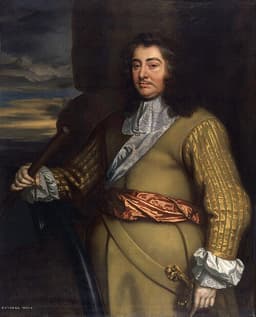
George Monck
General · Modern
55.2Total

Jimmy Doolittle
General · Modern
63.3Total
Basic Information
Born
1608
1896
Died
1670
1993
Era
Modern
Modern
Nationality
England
United States
Occupation
General
General
Civilization
Western
Western
Score Comparison
Military (10%)
30.0
52.5
Political (20%)
45.0
68.0
Influence (20%)
59.0
68.0
Legacy (20%)
52.0
55.0
Leadership (15%)
78.0
68.0
Strategy (15%)
60.0
69.1
TOTAL
55.2
63.3
George Monck — Complete Timeline
1650 AD
Battle of DunbarWar◆ Major
George Monck commanded a parliamentary army at the Battle of Dunbar, defeating a Scottish force loyal to Charles II. The victory secured English control over Scotland and demonstrated Monck's military effectiveness.
BattleEnglish Civil WarScotland
Impact: regional
1660 AD
March on LondonPolitical Action
George Monck marched his army from Scotland to London, where he forced the Rump Parliament to readmit excluded members and call for new elections. This action paved the way for the Restoration of the monarchy.
RestorationPolitical ActionMonarchy
Impact: national
Restoration of Charles IIPolitical Action
Monck facilitated the return of Charles II from exile, negotiating the terms of the Restoration. He was appointed Captain-General of the army and created Duke of Albemarle for his role in restoring the monarchy.
RestorationCharles IIMonarchy
Impact: nationalconstructive
Jimmy Doolittle — Complete Timeline
1932 AD
Set World Speed Record for LandplanesInvention◆ Major
Doolittle set a world speed record for landplanes, flying a Gee Bee R-1 at 296 mph. He was a pioneer in aviation engineering and instrument flying, developing techniques for blind flying using radio navigation.
AviationSpeed RecordInnovation
Impact: globalconstructive
1942 AD
Led the Doolittle Raid on TokyoWar◆ Major
Doolittle planned and led the first US air raid on the Japanese home islands, launching 16 B-25 bombers from the USS Hornet. The raid caused little physical damage but boosted US morale and forced Japan to recall forces for home defense.
World War IIDoolittle RaidAir Raid
Impact: global
Commanded Twelfth Air Force in North AfricaWar◆ Major
Doolittle commanded the Twelfth Air Force during Operation Torch, the Allied invasion of North Africa. He coordinated air support for ground forces and established air superiority over the region.
World War IINorth AfricaAir Force
Impact: regional
1944 AD
Commanded Eighth Air Force in EuropeWar◆ Major
Doolittle commanded the US Eighth Air Force during the strategic bombing campaign against Nazi Germany. He implemented fighter escort tactics that reduced bomber losses and increased effectiveness of daylight precision bombing.
World War IIStrategic BombingEighth Air Force
Impact: global
Expert Analysis
Origins
**George Monck** (1608-1670) was born into a gentry family in Devon, England. His father, Sir Thomas Monck, died when George was young. He began his military career as a volunteer in the Dutch army, learning siege warfare and discipline. Returning to England, he fought for King Charles I against the Irish rebels, but during the English Civil War, he switched sides to the Parliamentarians after being captured. This early pragmatism foreshadowed his later political maneuvering.
**Jimmy Doolittle** (1896-1993) was born in Alameda, California, to a carpenter father. He grew up in Nome, Alaska, where he developed a fascination with mechanics and flying. He studied at the University of California, Berkeley, and later earned a doctorate in aeronautical engineering from MIT in 1925. His early career as a test pilot and air racer set speed records and advanced instrument flying, making him a leading aviation pioneer.
Rise to Power
Monck rose to prominence during the Wars of the Three Kingdoms. After serving as a Royalist, he was captured by Parliamentarians and convinced to switch sides. He commanded effectively in Ireland and Scotland. His key turning point came in 1650 when he defeated the Scots at the Battle of Dunbar, securing English control. By 1653, he was appointed General-at-Sea, sharing command with Blake and Deane. After Cromwell's death and the collapse of the Protectorate, Monck marched his army from Scotland to London in 1660, forcing the Rump Parliament to readmit excluded members and call for new elections, leading to the Restoration.
Doolittle's rise was rooted in aviation innovation. He set a world speed record for landplanes in 1932, flying a Gee Bee R-1 at 296 mph. He pioneered instrument flying, developing techniques for blind takeoffs and landings. When WWII began, he returned to active duty as a lieutenant colonel. His defining moment came in 1942 when he planned and led the Doolittle Raid, launching 16 B-25 bombers from the USS Hornet to bomb Tokyo. The raid caused little physical damage but boosted US morale and forced Japan to alter its strategy. Doolittle was promoted to brigadier general and awarded the Medal of Honor.
Leadership & Governance
Monck's leadership style was cautious and pragmatic. He avoided extreme positions, earning trust from both Parliamentarians and Royalists. As Captain-General under Charles II, he supported the king but advised moderation. He scored 78.0 in leadership but only 30.0 in military, reflecting his role as a political stabilizer rather than a battlefield commander. His governance focused on restoring order: he suppressed the Fifth Monarchists and disbanded the New Model Army, ensuring a peaceful transition.
Doolittle scored 68.0 in leadership and 69.1 in strategy. He commanded the Twelfth Air Force in North Africa during Operation Torch, coordinating air support for ground forces. Later, as commander of the Eighth Air Force in Europe, he implemented fighter escort tactics that reduced bomber losses. His leadership emphasized innovation and delegation, allowing subordinates to execute aggressive tactics. He scored 52.5 in military, reflecting his impact as an organizer and strategist rather than a frontline commander.
Triumph & Tragedy
Monck's greatest success was the Restoration of Charles II in 1660, ending a decade of political chaos. He negotiated terms that ensured a stable monarchy and was rewarded with the title Duke of Albemarle. His failure came during the Second Anglo-Dutch War (1665-1667): as commander of the fleet, he fought the Four Days' Battle and the Raid on the Medway, where the Dutch burned English ships. The disaster tarnished his reputation, and he died soon after.
Doolittle's triumph was the Doolittle Raid, which earned him the Medal of Honor and proved that Japan was vulnerable. His later command of the Eighth Air Force helped cripple Germany's war industry. However, he faced tragedy in his personal life: his son, James Jr., died by suicide in 1958 after struggling with mental health. Doolittle also suffered criticism for the high casualties in early bombing missions before his fighter escort reforms.
Character & Destiny
Monck was known for his discretion and loyalty to the nation over party. He kept his own counsel, rarely revealing his plans until execution. His character shaped his fate: by avoiding extremes, he became the key figure in the Restoration. Historians assess him as a "kingmaker" but note his lack of strategic brilliance. His score of 59.0 in influence reflects his pivotal but short-lived power.
Doolittle was bold and innovative, driven by a passion for aviation. His risk-taking led to the Doolittle Raid, which could have been a disaster. His character combined scientific rigor with military daring. He scored 68.0 in influence and 68.0 in political, indicating his impact on air power doctrine and public perception.
Legacy
Monck's legacy is the Restoration of the monarchy, which shaped English history for centuries. He helped establish the principle that the army should be subordinate to civilian authority. His actions prevented a military dictatorship. However, his name is less known than Cromwell's or Charles II's. He scored 52.0 in legacy.
Doolittle's legacy is immense in aviation and military history. The Doolittle Raid became a symbol of American ingenuity. His work on instrument flying and fighter tactics influenced air combat for decades. He received the Presidential Medal of Freedom and is remembered as an aviation pioneer. He scored 55.0 in legacy, but his influence on technology and strategy endures.
Conclusion
Jimmy Doolittle had greater impact than George Monck. While Monck's role in the Restoration was crucial, it was a single political act within a narrow context. Doolittle's contributions spanned aviation technology, military strategy, and public morale. His scores total 63.3 against Monck's 55.2, reflecting broader influence. Doolittle's innovations in instrument flying and fighter escort tactics changed how wars are fought, while Monck's achievements were more ephemeral. Thus, Doolittle emerges as the more significant figure in history.
Rankings
🥇
Jimmy DoolittleLeader
Mil: 52.5Pol: 68.0Inf: 68.0
63.3
🥈
George Monck
Mil: 30.0Pol: 45.0Inf: 59.0
55.2
+8.1 behind
How This Comparison Works
Algorithm
Each figure is scored on 6 dimensions (0—100 scale) based on structured historical data: Military (10%), Political (20%), Influence (20%), Legacy (20%), Leadership (15%), Strategy (15%). The weighted total produces the final ranking.
Data Sources
Scores are computed from structured sub-indicators in the database. Scale factors adjust for era (Ancient ×0.85, Modern ×1.0) and civilization size (Eastern ×1.05, Other ×0.80) to account for differences in population and military scale.
Maximum 3 Figures
Comparisons are limited to 2—3 figures to ensure readability and statistical meaningfulness.
Error Margins
±5 points per dimension — Sub-scores are derived from historical records with inherent uncertainty. Two figures within 5 points on a dimension should be considered roughly equivalent in that area.
Total Score Accuracy
±3 points overall — The weighted combination of 6 dimensions produces a total score with approximately ±3 points of uncertainty. Differences of less than 3 points are not statistically significant— the figures are effectively tied.
Known Limitations
- Historical records are incomplete and uneven across civilizations
- Figures from oral-tradition societies may be underrepresented
- Occupation labels can misclassify multi-role figures
- Scores measure capability and impact, not moral character
- Quantitative scoring is a comparison tool, not absolute truth
Capability Radar
Military (10%) — Battles & Warfare
Battles
45
65
Win Rate
55
60
Expansion
20
30
Political (20%) — Governance & Reform
Reform
55
50
Diplomacy
70
45
Economy
40
30
Influence (20%) — Cultural & Global Reach
Cultural
30
65
Global
35
70
Legacy (20%) — Historical Impact
Historical
60
75
Longevity
40
60
Leadership (15%) — Power & Stability
Tenure
65
40
Stability
75
35
Strategy (15%) — Tactics & Innovation
Strategy
60
75
Tactics
50
85
Reform
30
70
Similar Comparisons
Comments & Discussion
No comments yet. Be the first to share your thoughts!