Loading...
This comparison has not been analyzed yet.
One-time AI generation (~1 minute). Scores and timeline are already available below.
George IV of the United Kingdom vs Jivaji Rao Scindia
Jivaji Rao Scindia leads by 11.2 pts · 2 figures compared
…
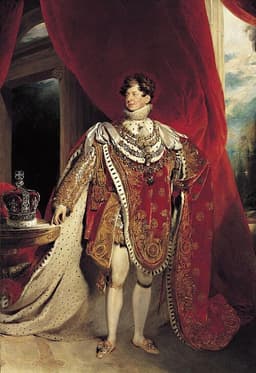
George IV of the United Kingdom
Emperor · Modern
41.1Total

Jivaji Rao Scindia
Emperor · Modern
52.3Total
Basic Information
Born
1762
1916
Died
1830
1961
Era
Modern
Modern
Nationality
United Kingdom
India
Occupation
Emperor
Emperor
Civilization
Western
Indian
Score Comparison
Military (10%)
27.7
22.6
Political (20%)
27.9
72.0
Influence (20%)
50.2
53.3
Legacy (20%)
37.5
44.2
Leadership (15%)
41.5
72.0
Strategy (15%)
60.0
41.0
TOTAL
41.1
52.3
George IV of the United Kingdom — Complete Timeline
1788 AD
Regency Crisis of 1788Political Action◆ Major
When George III became temporarily insane, the Prince of Wales (future George IV) sought to become regent. The crisis ended when the king recovered, but it established a precedent for parliamentary control over regency.
RegencyCrisisSuccession
Impact: national
1811 AD
Appointed Prince RegentPolitical Action◆ Major
Following George III's final mental collapse, the Prince of Wales was formally appointed Prince Regent under the Regency Act 1811. He exercised royal powers for nine years while his father lived in seclusion.
RegencyGovernmentSuccession
Impact: national
Regency Era Patronage of the ArtsCultural◆ Major
As Prince Regent, George IV commissioned John Nash to design Regent Street, Regent's Park, and the Royal Pavilion in Brighton. His patronage defined the architectural and cultural style of the Regency period.
ArchitecturePatronageRegency
Impact: nationalconstructive
1820 AD
Accession as King George IVPolitical Action◆ Major
Upon George III's death, the Prince Regent became King George IV. His accession was marred by his attempt to divorce Queen Caroline, leading to a public scandal and the Pains and Penalties Bill of 1820.
AccessionScandalDivorce
Impact: national
1821 AD
State Visit to IrelandPolitical Action
George IV became the first British monarch to visit Ireland since the Acts of Union. The visit aimed to promote loyalty but was overshadowed by the ongoing Catholic Emancipation debate.
VisitIrelandUnion
Impact: national
1829 AD
Catholic Emancipation OppositionPolitical Action◆ Major
George IV reluctantly signed the Roman Catholic Relief Act 1829, granting Catholic Emancipation. He had opposed the measure but yielded to Prime Minister Wellington's threat of resignation.
Catholic EmancipationLegislationReligion
Impact: national
Jivaji Rao Scindia — Complete Timeline
1947 AD
Accession of Gwalior to IndiaPolitical Action◆ Major
Jivaji Rao Scindia, as the ruling Maharaja of Gwalior, signed the Instrument of Accession, merging the princely state with the Dominion of India. This decision ended Gwalior's sovereignty and integrated it into the Indian Union.
AccessionIndian UnionGwalior
Impact: nationalconstructive
Role in the Integration of Princely StatesPolitical Action◆ Major
Jivaji Rao Scindia played a key role in the integration of princely states into the Indian Union. He served as a member of the Constituent Assembly and worked with Sardar Patel to persuade other princes to accede, facilitating a smooth transition.
IntegrationConstituent AssemblyGwalior
Impact: nationalconstructive
1948 AD
Establishment of Scindia SchoolCultural◆ Major
Jivaji Rao Scindia founded the Scindia School in Gwalior, a prestigious boarding school for boys. The school aimed to provide modern education while preserving Indian cultural values, and it became a leading educational institution in India.
EducationScindia SchoolGwalior
Impact: nationalconstructive
This comparison has not been analyzed yet.
One-time AI generation (~1 minute). Scores and timeline are already available below.
Rankings
🥇
Jivaji Rao ScindiaLeader
Mil: 22.6Pol: 72.0Inf: 53.3
52.3
🥈
George IV of the United Kingdom
Mil: 27.7Pol: 27.9Inf: 50.2
41.1
+11.2 behind
How This Comparison Works
Algorithm
Each figure is scored on 6 dimensions (0—100 scale) based on structured historical data: Military (10%), Political (20%), Influence (20%), Legacy (20%), Leadership (15%), Strategy (15%). The weighted total produces the final ranking.
Data Sources
Scores are computed from structured sub-indicators in the database. Scale factors adjust for era (Ancient ×0.85, Modern ×1.0) and civilization size (Eastern ×1.05, Other ×0.80) to account for differences in population and military scale.
Maximum 3 Figures
Comparisons are limited to 2—3 figures to ensure readability and statistical meaningfulness.
Error Margins
±5 points per dimension — Sub-scores are derived from historical records with inherent uncertainty. Two figures within 5 points on a dimension should be considered roughly equivalent in that area.
Total Score Accuracy
±3 points overall — The weighted combination of 6 dimensions produces a total score with approximately ±3 points of uncertainty. Differences of less than 3 points are not statistically significant— the figures are effectively tied.
Known Limitations
- Historical records are incomplete and uneven across civilizations
- Figures from oral-tradition societies may be underrepresented
- Occupation labels can misclassify multi-role figures
- Scores measure capability and impact, not moral character
- Quantitative scoring is a comparison tool, not absolute truth
Capability Radar
Military (10%) — Battles & Warfare
Battles
35
15
Win Rate
38
10
Expansion
41
10
Political (20%) — Governance & Reform
Reform
5
60
Diplomacy
15
65
Economy
10
50
Influence (20%) — Cultural & Global Reach
Cultural
30
40
Global
10
20
Legacy (20%) — Historical Impact
Historical
20
45
Longevity
15
30
Leadership (15%) — Power & Stability
Tenure
10
55
Stability
20
55
Strategy (15%) — Tactics & Innovation
Strategy
43
20
Tactics
50
20
Reform
49
25
Similar Comparisons
Comments & Discussion
No comments yet. Be the first to share your thoughts!