Loading...
This comparison has not been analyzed yet.
One-time AI generation (~1 minute). Scores and timeline are already available below.
Gaafar Nimeiry vs Theodor Eicke
Gaafar Nimeiry leads by 11.3 pts · 2 figures compared
…
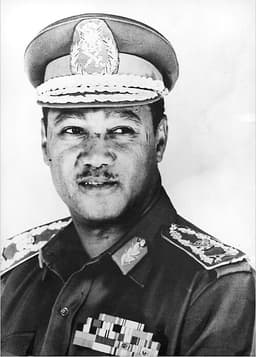
Gaafar Nimeiry
General · Modern
53.1Total

Theodor Eicke
General · Modern
41.8Total
Basic Information
Born
1930
1892
Died
—
1943
Era
Modern
Modern
Nationality
Sudan
Germany
Occupation
General
General
Civilization
Other
Western
Score Comparison
Military (10%)
45.0
50.0
Political (20%)
61.3
26.4
Influence (20%)
54.1
51.8
Legacy (20%)
42.5
40.8
Leadership (15%)
74.0
36.9
Strategy (15%)
41.7
41.7
TOTAL
53.1
41.8
Gaafar Nimeiry — Complete Timeline
1969 AD
1969 Sudanese coup d'étatPolitical Action◆ Major
Gaafar Nimeiry, then a colonel, led the Free Officers Movement in a bloodless coup that overthrew the civilian government of Prime Minister Mohamed Ahmed Mahgoub. Nimeiry established the Revolutionary Command Council (RCC) and declared Sudan a socialist state.
CoupMilitary RuleSocialism
Impact: national
1972 AD
Addis Ababa AgreementPolitical Action◆ Major
Nimeiry signed the Addis Ababa Agreement with the Anyanya rebel group, ending the First Sudanese Civil War (1955-1972). The agreement granted southern Sudan regional autonomy and ended 17 years of conflict, marking a major achievement in Nimeiry's early rule.
Peace AgreementCivil War EndAutonomy
Impact: nationalconstructive
1983 AD
Shift to IslamismReform◆ Major
Nimeiry abandoned his socialist policies and adopted Islamic Sharia law, imposing hudud punishments and dissolving the southern autonomy. This decision alienated the non-Muslim south and reignited civil war, leading to the formation of the Sudan People's Liberation Army (SPLA).
IslamizationShariaCivil War
Impact: nationaldestructive
1985 AD
1985 Sudanese coup d'étatPolitical Action◆ Major
Nimeiry was overthrown by a military coup led by General Abdel Rahman Swar al-Dahab while he was on a visit to the United States. The coup was triggered by widespread protests against economic hardship, corruption, and the ongoing civil war. Nimeiry went into exile in Egypt.
CoupRegime ChangeExile
Impact: national
Theodor Eicke — Complete Timeline
1933 AD
Appointment as Commandant of DachauPolitical Action◆ Major
Eicke was appointed the first commandant of Dachau concentration camp in June 1933. He implemented a brutal regime and developed the SS camp system that became a model for other camps.
HolocaustConcentration CampsNazi Germany
Impact: nationaldestructive
1939 AD
Creation of the SS Totenkopf DivisionWar◆ Major
Eicke organized and commanded the SS Totenkopf Division from concentration camp guards. The division fought in France and on the Eastern Front, known for its brutality.
World War IIWaffen-SSTotenkopf
Impact: regionaldestructive
1943 AD
Death at the Battle of KharkovWar◆ Major
Eicke was killed on February 26, 1943, when his Fieseler Storch aircraft was shot down near Kharkov, Ukraine. He was posthumously awarded the Knight's Cross with Oak Leaves.
World War IIEastern FrontDeath
Impact: regionaltragic
This comparison has not been analyzed yet.
One-time AI generation (~1 minute). Scores and timeline are already available below.
Rankings
🥇
Gaafar NimeiryLeader
Mil: 45.0Pol: 61.3Inf: 54.1
53.1
🥈
Theodor Eicke
Mil: 50.0Pol: 26.4Inf: 51.8
41.8
+11.3 behind
How This Comparison Works
Algorithm
Each figure is scored on 6 dimensions (0—100 scale) based on structured historical data: Military (10%), Political (20%), Influence (20%), Legacy (20%), Leadership (15%), Strategy (15%). The weighted total produces the final ranking.
Data Sources
Scores are computed from structured sub-indicators in the database. Scale factors adjust for era (Ancient ×0.85, Modern ×1.0) and civilization size (Eastern ×1.05, Other ×0.80) to account for differences in population and military scale.
Maximum 3 Figures
Comparisons are limited to 2—3 figures to ensure readability and statistical meaningfulness.
Error Margins
±5 points per dimension — Sub-scores are derived from historical records with inherent uncertainty. Two figures within 5 points on a dimension should be considered roughly equivalent in that area.
Total Score Accuracy
±3 points overall — The weighted combination of 6 dimensions produces a total score with approximately ±3 points of uncertainty. Differences of less than 3 points are not statistically significant— the figures are effectively tied.
Known Limitations
- Historical records are incomplete and uneven across civilizations
- Figures from oral-tradition societies may be underrepresented
- Occupation labels can misclassify multi-role figures
- Scores measure capability and impact, not moral character
- Quantitative scoring is a comparison tool, not absolute truth
Capability Radar
Military (10%) — Battles & Warfare
Battles
25
20
Win Rate
30
15
Expansion
20
15
Political (20%) — Governance & Reform
Reform
40
10
Diplomacy
45
5
Economy
30
5
Influence (20%) — Cultural & Global Reach
Cultural
30
10
Global
25
10
Legacy (20%) — Historical Impact
Historical
35
20
Longevity
20
5
Leadership (15%) — Power & Stability
Tenure
70
25
Stability
20
5
Strategy (15%) — Tactics & Innovation
Strategy
25
20
Tactics
20
25
Reform
30
30
Similar Comparisons
Comments & Discussion
No comments yet. Be the first to share your thoughts!