Loading...
Gaafar Nimeiry vs Mamady Doumbouya
Gaafar Nimeiry leads by 20.4 pts · 2 figures compared
…
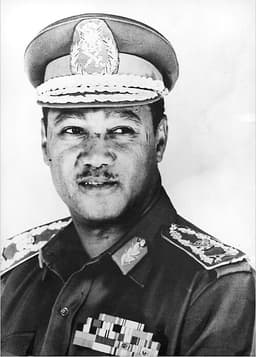
Gaafar Nimeiry
General · Modern
53.1Total
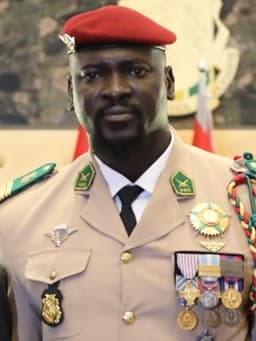
Mamady Doumbouya
General · Modern
32.7Total
Basic Information
Born
1930
1980
Died
—
—
Era
Modern
Modern
Nationality
Sudan
Guinea
Occupation
General
General
Civilization
Other
Other
Score Comparison
Military (10%)
45.0
10.2
Political (20%)
61.3
25.0
Influence (20%)
54.1
47.1
Legacy (20%)
42.5
36.7
Leadership (15%)
74.0
30.0
Strategy (15%)
41.7
25.0
TOTAL
53.1
32.7
Gaafar Nimeiry — Complete Timeline
1969 AD
1969 Sudanese coup d'étatPolitical Action◆ Major
Gaafar Nimeiry, then a colonel, led the Free Officers Movement in a bloodless coup that overthrew the civilian government of Prime Minister Mohamed Ahmed Mahgoub. Nimeiry established the Revolutionary Command Council (RCC) and declared Sudan a socialist state.
CoupMilitary RuleSocialism
Impact: national
1972 AD
Addis Ababa AgreementPolitical Action◆ Major
Nimeiry signed the Addis Ababa Agreement with the Anyanya rebel group, ending the First Sudanese Civil War (1955-1972). The agreement granted southern Sudan regional autonomy and ended 17 years of conflict, marking a major achievement in Nimeiry's early rule.
Peace AgreementCivil War EndAutonomy
Impact: nationalconstructive
1983 AD
Shift to IslamismReform◆ Major
Nimeiry abandoned his socialist policies and adopted Islamic Sharia law, imposing hudud punishments and dissolving the southern autonomy. This decision alienated the non-Muslim south and reignited civil war, leading to the formation of the Sudan People's Liberation Army (SPLA).
IslamizationShariaCivil War
Impact: nationaldestructive
1985 AD
1985 Sudanese coup d'étatPolitical Action◆ Major
Nimeiry was overthrown by a military coup led by General Abdel Rahman Swar al-Dahab while he was on a visit to the United States. The coup was triggered by widespread protests against economic hardship, corruption, and the ongoing civil war. Nimeiry went into exile in Egypt.
CoupRegime ChangeExile
Impact: national
Mamady Doumbouya — Complete Timeline
2021 AD
Led the 2021 Coup d'EtatPolitical Action◆ Major
Colonel Mamady Doumbouya led a military coup on September 5, 2021, overthrowing President Alpha Conde. The coup followed Conde's controversial third term bid and allegations of authoritarianism. Doumbouya suspended the constitution and dissolved the government.
CoupMilitary RuleGuinea
Impact: nationaldestructive
Appointed Interim PresidentPolitical Action◆ Major
After the coup, Doumbouya was sworn in as interim president on October 1, 2021. He promised a transition to civilian rule within 39 months, but faced criticism from regional bodies like ECOWAS for the delay and lack of a clear timeline.
Interim GovernmentTransitionGuinea
Impact: national
2022 AD
Crackdown on Opposition and MediaPolitical Action
Doumbouya's junta intensified repression, arresting opposition figures and journalists critical of the regime. In 2022, several media outlets were shut down, and protests were violently dispersed, drawing condemnation from human rights organizations.
RepressionHuman RightsGuinea
Impact: nationaldestructive
Expert Analysis
Origins
Gaafar Nimeiry was born on January 1, 1930, in Wad Nubawi, Sudan, into a modest family. He attended the Sudanese Military College and graduated in 1952, joining the army as a second lieutenant. His early career was shaped by the post-independence turmoil of Sudan, which gained independence in 1956. Nimeiry was influenced by Gamal Abdel Nasser's pan-Arabism and the Free Officers Movement in Egypt.
Mamady Doumbouya was born on March 4, 1980, in Kankan, Guinea, into a military family. He attended the École Militaire Préparatoire de Kankan and later the École d'Application de l'Infanterie in Senegal. Doumbouya also trained with the French Foreign Legion and served in peacekeeping missions, including in Darfur. His background is less political than Nimeiry's, with a focus on military professionalism.
Rise to Power
Nimeiry's rise began on May 25, 1969, when he led the Free Officers Movement in a bloodless coup, overthrowing the civilian government of Prime Minister Mohamed Ahmed Mahgoub. At 39, he became chairman of the National Revolutionary Command Council. He consolidated power by eliminating rivals, including a failed communist coup in 1971, after which he executed key leftist leaders.
Doumbouya's rise was more abrupt. On September 5, 2021, Colonel Doumbouya led a coup against President Alpha Condé, who had just won a controversial third term. The coup was swift, with special forces arresting Condé and dissolving the government. Doumbouya appeared on state television declaring the end of the regime. He was sworn in as interim president on October 1, 2021, promising a transition to civilian rule within 39 months.
Leadership & Governance
Nimeiry's leadership style was initially socialist and pan-Arabist, but he later shifted to Islamism. He implemented land reforms and nationalized industries. However, his governance was marked by authoritarianism and suppression of dissent. He scored 74.0 in leadership and 61.3 in political acumen. His key achievement was the 1972 Addis Ababa Agreement, which ended the first Sudanese civil war and granted autonomy to the south. However, in 1983, he abandoned the agreement, imposed Sharia law, and dissolved the southern government, re-igniting the civil war.
Doumbouya's governance has been military-dominated. He promised a transition but has delayed elections, extending his rule. His junta cracked down on opposition, arrested journalists, and shut down media outlets. He scored 30.0 in leadership and 25.0 in political skills. His rule has been characterized by repression and lack of concrete reforms, with the economy stagnating.
Triumph & Tragedy
Nimeiry's greatest triumph was the Addis Ababa Agreement, which brought peace to Sudan for a decade. He also oversaw the construction of infrastructure and the expansion of education. His tragedy was his reversal of the agreement and imposition of Sharia law, which led to a devastating civil war that killed over two million people. He was overthrown in 1985 while visiting the US, ending his 16-year rule.
Doumbouya's triumph is the coup itself, which removed an unpopular president. However, his failure is the lack of progress towards civilian rule and increasing repression. He has not achieved any significant economic or political reforms. His legacy is currently negative, with Guinea facing international sanctions and internal instability.
Character & Destiny
Nimeiry was pragmatic but authoritarian. He could make peace but also reignite conflict. His shift to Islamism was a response to political pressure, showing his adaptability but also his lack of long-term vision. His character led to initial stability but ultimately to his downfall. Historians view him as a complex figure who failed to sustain peace.
Doumbouya appears secretive and power-focused. He has not shown interest in democratic governance. His military background and lack of political experience suggest he will struggle to transition power. His destiny may mirror other coup leaders who overstay their welcome.
Legacy
Nimeiry's legacy is mixed. He is remembered for ending the first civil war but also for starting the second. His imposition of Sharia law had long-term consequences, contributing to the secession of South Sudan in 2011. His scores: legacy 42.5, influence 54.1.
Doumbouya's legacy is still forming, but early signs are negative. He has set back Guinea's democratic progress. His scores: legacy 36.7, influence 47.1.
Conclusion
Gaafar Nimeiry had a greater impact than Mamady Doumbouya, with a total score of 53.1 compared to 32.7. Nimeiry's actions shaped Sudan's fate for decades, while Doumbouya's coup has yet to produce lasting change. Nimeiry's peace agreement and later war are more consequential than Doumbouya's ongoing transition. Therefore, Nimeiry's historical significance is higher.
Rankings
🥇
Gaafar NimeiryLeader
Mil: 45.0Pol: 61.3Inf: 54.1
53.1
🥈
Mamady Doumbouya
Mil: 10.2Pol: 25.0Inf: 47.1
32.7
+20.4 behind
How This Comparison Works
Algorithm
Each figure is scored on 6 dimensions (0—100 scale) based on structured historical data: Military (10%), Political (20%), Influence (20%), Legacy (20%), Leadership (15%), Strategy (15%). The weighted total produces the final ranking.
Data Sources
Scores are computed from structured sub-indicators in the database. Scale factors adjust for era (Ancient ×0.85, Modern ×1.0) and civilization size (Eastern ×1.05, Other ×0.80) to account for differences in population and military scale.
Maximum 3 Figures
Comparisons are limited to 2—3 figures to ensure readability and statistical meaningfulness.
Error Margins
±5 points per dimension — Sub-scores are derived from historical records with inherent uncertainty. Two figures within 5 points on a dimension should be considered roughly equivalent in that area.
Total Score Accuracy
±3 points overall — The weighted combination of 6 dimensions produces a total score with approximately ±3 points of uncertainty. Differences of less than 3 points are not statistically significant— the figures are effectively tied.
Known Limitations
- Historical records are incomplete and uneven across civilizations
- Figures from oral-tradition societies may be underrepresented
- Occupation labels can misclassify multi-role figures
- Scores measure capability and impact, not moral character
- Quantitative scoring is a comparison tool, not absolute truth
Capability Radar
Military (10%) — Battles & Warfare
Battles
25
5
Win Rate
30
5
Expansion
20
5
Political (20%) — Governance & Reform
Reform
40
10
Diplomacy
45
10
Economy
30
5
Influence (20%) — Cultural & Global Reach
Cultural
30
5
Global
25
5
Legacy (20%) — Historical Impact
Historical
35
5
Longevity
20
5
Leadership (15%) — Power & Stability
Tenure
70
15
Stability
20
5
Strategy (15%) — Tactics & Innovation
Strategy
25
10
Tactics
20
10
Reform
30
15
Similar Comparisons
Comments & Discussion
No comments yet. Be the first to share your thoughts!