Loading...
Frederick III of Denmark vs Michael the Brave
Michael the Brave leads by 2.0 pts · 2 figures compared
…

Frederick III of Denmark
Emperor · Modern
52.9Total
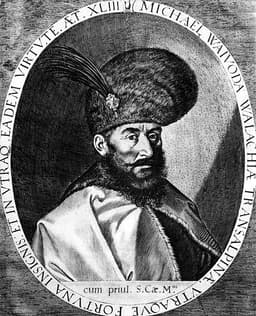
Michael the Brave
Emperor · Modern
54.9Total
Basic Information
Born
1609
1558
Died
1670
1601
Era
Modern
Modern
Nationality
Denmark
Wallachia
Occupation
Emperor
Emperor
Civilization
Western
Western
Score Comparison
Military (10%)
22.6
60.0
Political (20%)
59.3
54.7
Influence (20%)
54.9
54.9
Legacy (20%)
49.2
46.7
Leadership (15%)
80.0
62.2
Strategy (15%)
36.8
60.0
TOTAL
52.9
54.9
Frederick III of Denmark — Complete Timeline
1658 AD
Siege of Copenhagen (1658-1660)War◆ Major
During the Second Northern War, Swedish forces besieged Copenhagen. Frederick III led the city's defense, rallying citizens and soldiers. The successful resistance, aided by Dutch naval relief, saved the Danish monarchy and led to the Treaty of Copenhagen, which established Denmark's modern borders.
SiegeWarNational Defense
Impact: regional
1660 AD
Coup of 1660Political Action◆ Major
After the war, Frederick III staged a bloodless coup, using the Estates' gratitude for his leadership to force through a constitutional change. He abolished the elective monarchy and the Council of the Realm, concentrating power in his own hands and paving the way for the Lex Regia.
CoupConstitutional ChangePower Consolidation
Impact: regional
1665 AD
Establishment of absolute monarchy (Lex Regia)Political Action
Frederick III oversaw the introduction of the Lex Regia (Kongeloven), which formally established absolute hereditary monarchy in Denmark-Norway. This constitution, one of the most absolute in Europe, gave the king unlimited legislative, executive, and judicial power, ending the power of the nobility.
Absolute MonarchyConstitutionPolitical Reform
Impact: regional
Michael the Brave — Complete Timeline
1595 AD
Battle of CălugăreniWar◆ Major
Michael the Brave defeated an Ottoman army at C
BattleOttoman WarsWallachia
Impact: regional
1599 AD
Conquest of TransylvaniaWar◆ Major
Michael the Brave invaded Transylvania and defeated the forces of Andrew B
ConquestTransylvaniaȘelimbăr
Impact: regional
1600 AD
Union of the Three PrincipalitiesPolitical Action
Michael the Brave united Wallachia, Moldavia, and Transylvania under his rule, creating a short-lived union of the three Romanian principalities. This was the first time the regions were unified.
UnificationRomanian PrincipalitiesTransylvania
Impact: regionalconstructive
1601 AD
AssassinationOther◆ Major
Michael the Brave was assassinated by agents of the Habsburg general Giorgio Basta near Turda. His death ended the union of the principalities, which collapsed shortly after.
AssassinationHabsburgsEnd of Union
Impact: regionaltragic
Expert Analysis
Origins
Frederick III of Denmark was born on March 18, 1609, in Haderslev, Denmark, as the second son of King Christian IV and Anne Catherine of Brandenburg. His upbringing was overshadowed by his older brother, the heir apparent, but Frederick received a thorough education in statecraft and military matters. His early years were marked by the Thirty Years' War, which strained Danish resources. In contrast, Michael the Brave (Mihai Viteazul) was born in 1558 in Wallachia, likely in the town of Drăgășani. His father was Pătrașcu the Good, a former prince of Wallachia, but Michael's early life was precarious due to political instability. He rose through military ranks, serving as ban of Oltenia before claiming the throne in 1593. Both men emerged from turbulent periods—Frederick from a declining monarchy, Michael from Ottoman suzerainty.
Rise to Power
Frederick III became king in 1648 after the death of his father, Christian IV. His early reign was dominated by the disastrous Dano-Swedish wars. The Second Northern War (1655–1660) saw Swedish forces invade Denmark, culminating in the Siege of Copenhagen (1658–1660). Frederick's leadership during the siege, where he rallied citizens and soldiers, boosted his popularity. After the war, he exploited the Estates' gratitude to stage a bloodless coup in 1660, abolishing the elective monarchy and establishing absolute rule via the Lex Regia (1665). Michael the Brave's rise was more martial. He became prince of Wallachia in 1593 after a coup supported by the Ottoman Empire. He then sought independence, allying with the Holy Roman Empire and Transylvania. His major turning point was the Battle of Călugăreni (1595), where he defeated a larger Ottoman army, securing his reputation. In 1599, he invaded Transylvania and defeated Andrew Báthory at the Battle of Șelimbăr, adding Transylvania to his domains. In 1600, he conquered Moldavia, achieving a personal union of the three principalities.
Leadership & Governance
Frederick III's leadership style was authoritarian and systematic. He centralized power by abolishing the Council of the Realm and the Estates, implementing the Lex Regia, which declared the king absolute and hereditary. His governance focused on administrative reforms, reducing noble influence, and strengthening the crown. He scored 80.0 in leadership and 59.3 in political skills. In contrast, Michael the Brave's leadership was military-driven and expansionist. He scored 62.2 in leadership and 54.7 in political skills. His governance was less about institutional reform and more about territorial consolidation. He minted coins bearing his title "Prince of Wallachia, Moldavia, and Transylvania" and sought to centralize his rule, but his union was fragile due to ethnic and religious divisions. Frederick's governance created lasting institutions, while Michael's was a personal union that collapsed after his death.
Triumph & Tragedy
Frederick III's greatest triumph was the establishment of absolute monarchy, which lasted until 1848 in Denmark. His successful defense of Copenhagen against the Swedes (scoring 22.6 in military, but effective in siege) was a key victory. His tragedy was the loss of Danish territories: the Treaty of Copenhagen (1660) ceded Skåne, Halland, and Blekinge to Sweden, reducing Denmark's size permanently. Michael the Brave's triumph was the unification of Wallachia, Moldavia, and Transylvania—a feat unmatched until the 20th century. His military victories, including the Battle of Călugăreni (scoring 60.0 in military), showcased tactical skill. His tragedy was his assassination on August 9, 1601, by Habsburg agents near Turda, ending the union. His death was a direct result of his ambition and the shifting alliances of the Long Turkish War.
Character & Destiny
Frederick III was methodical, patient, and politically astute. He waited for the opportune moment to seize absolute power, using the war's aftermath to his advantage. His character was cautious but determined, shaping a destiny of institutional consolidation. Historians assess him as a pragmatic ruler who prioritized stability. Michael the Brave was bold, ambitious, and combative. His character drove him to rapid conquests but also to overreach, alienating allies like the Habsburgs. His destiny was a short, brilliant career ended by betrayal. He scored 60.0 in strategy, reflecting his military acumen but political miscalculation. Frederick's character led to a lasting legacy; Michael's led to a symbolic one.
Legacy
Frederick III's legacy is the absolute monarchy in Denmark-Norway, which influenced governance until the 19th century. The Lex Regia remained in force until 1849, and his administrative reforms centralized the state. His influence score is 54.9, and legacy score 49.2. Michael the Brave's legacy is as a national hero in Romania, symbolizing unity. His union of the principalities inspired later Romanian nationalism and the eventual unification in 1859 and 1918. His influence score is 54.9, legacy 46.7. While Frederick's impact was institutional and long-lasting, Michael's was symbolic and inspirational.
Conclusion
Frederick III of Denmark had a greater impact on governance and state-building than Michael the Brave. Frederick's establishment of absolute monarchy created a durable political system that lasted nearly two centuries, while Michael's union lasted only months. Frederick's total score of 52.9 versus Michael's 54.9 is close, but the longevity of Frederick's reforms outweighs Michael's temporary unification. Michael's legacy is powerful in national memory, but in terms of concrete, lasting change, Frederick's transformation of Danish governance was more significant. Therefore, Frederick III of Denmark had a greater impact on history.
Rankings
🥇
Michael the BraveLeader
Mil: 60.0Pol: 54.7Inf: 54.9
54.9
🥈
Frederick III of Denmark
Mil: 22.6Pol: 59.3Inf: 54.9
52.9
+2.0 behind
How This Comparison Works
Algorithm
Each figure is scored on 6 dimensions (0—100 scale) based on structured historical data: Military (10%), Political (20%), Influence (20%), Legacy (20%), Leadership (15%), Strategy (15%). The weighted total produces the final ranking.
Data Sources
Scores are computed from structured sub-indicators in the database. Scale factors adjust for era (Ancient ×0.85, Modern ×1.0) and civilization size (Eastern ×1.05, Other ×0.80) to account for differences in population and military scale.
Maximum 3 Figures
Comparisons are limited to 2—3 figures to ensure readability and statistical meaningfulness.
Error Margins
±5 points per dimension — Sub-scores are derived from historical records with inherent uncertainty. Two figures within 5 points on a dimension should be considered roughly equivalent in that area.
Total Score Accuracy
±3 points overall — The weighted combination of 6 dimensions produces a total score with approximately ±3 points of uncertainty. Differences of less than 3 points are not statistically significant— the figures are effectively tied.
Known Limitations
- Historical records are incomplete and uneven across civilizations
- Figures from oral-tradition societies may be underrepresented
- Occupation labels can misclassify multi-role figures
- Scores measure capability and impact, not moral character
- Quantitative scoring is a comparison tool, not absolute truth
Capability Radar
Military (10%) — Battles & Warfare
Battles
15
55
Win Rate
10
60
Expansion
10
55
Political (20%) — Governance & Reform
Reform
85
30
Diplomacy
60
50
Economy
50
30
Influence (20%) — Cultural & Global Reach
Cultural
40
40
Global
30
30
Legacy (20%) — Historical Impact
Historical
55
50
Longevity
50
40
Leadership (15%) — Power & Stability
Tenure
70
40
Stability
65
20
Strategy (15%) — Tactics & Innovation
Strategy
15
50
Tactics
10
55
Reform
20
30
Similar Comparisons
Comments & Discussion
No comments yet. Be the first to share your thoughts!