Loading...
Frank-Walter Steinmeier vs Michel Barnier
Frank-Walter Steinmeier leads by 3.8 pts · 2 figures compared
…
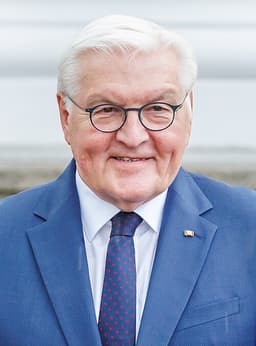
Frank-Walter Steinmeier
Politician · Modern
58.3Total

Michel Barnier
Politician · Modern
54.5Total
Basic Information
Born
1956
1951
Died
—
—
Era
Modern
Modern
Nationality
Germany
France
Occupation
Politician
Politician
Civilization
Western
Western
Score Comparison
Military (10%)
50.0
50.0
Political (20%)
72.0
45.0
Influence (20%)
57.2
60.0
Legacy (20%)
47.5
50.0
Leadership (15%)
80.0
74.0
Strategy (15%)
43.5
41.2
TOTAL
58.3
54.5
Frank-Walter Steinmeier — Complete Timeline
2005 AD
Became Foreign Minister of GermanyPolitical Action◆ Major
Frank-Walter Steinmeier was appointed Federal Minister for Foreign Affairs under Chancellor Angela Merkel. He served in this role until 2009, overseeing German foreign policy during a period of European integration and global challenges.
German PoliticsForeign PolicyMerkel Cabinet
Impact: national
2007 AD
Became Vice Chancellor of GermanyPolitical Action◆ Major
Steinmeier was appointed Vice Chancellor of Germany, serving concurrently as Foreign Minister. This position made him the second-highest-ranking official in the German government.
German PoliticsGovernmentVice Chancellor
Impact: national
2017 AD
Elected President of GermanyPolitical Action◆ Major
Steinmeier was elected as the 12th President of Germany by the Federal Convention. As a largely ceremonial head of state, he has focused on promoting social cohesion and democratic values.
German PresidencyHead of StateElection
Impact: nationalconstructive
2022 AD
Re-elected as President of GermanyPolitical Action◆ Major
Steinmeier was re-elected for a second five-year term as President of Germany. His re-election reflected broad cross-party support for his role as a unifying figure during times of political and social change.
German PresidencyRe-electionPolitical Stability
Impact: nationalconstructive
Michel Barnier — Complete Timeline
2016 AD
Appointed EU Chief Brexit NegotiatorPolitical Action◆ Major
The European Commission appointed Michel Barnier as its chief negotiator for the United Kingdom's withdrawal from the European Union. He led the EU's negotiating team through the Article 50 process.
BrexitEU Negotiations
Impact: global
2020 AD
Negotiated the Brexit Withdrawal AgreementPolitical Action◆ Major
Barnier oversaw the negotiation of the EU-UK Withdrawal Agreement, including the Northern Ireland Protocol. The agreement was ratified and the UK left the EU on January 31, 2020.
BrexitTreatyNorthern Ireland
Impact: globalconstructive
2024 AD
Appointed Prime Minister of FrancePolitical Action◆ Major
President Emmanuel Macron appointed Michel Barnier as Prime Minister following the 2024 legislative elections. Barnier, a conservative, was tasked with forming a government in a hung parliament.
AppointmentGovernment Formation
Impact: national
Expert Analysis
Origins
Frank-Walter Steinmeier was born on January 5, 1956, in Detmold, West Germany, into a Protestant family. His father was a carpenter and his mother a housewife. Steinmeier studied law and political science at the University of Giessen, earning a doctorate in law in 1991. His early career included work as a research assistant and later as a civil servant in the Lower Saxony state chancellery.
Michel Barnier was born on January 9, 1951, in La Tronche, France, near Grenoble. His parents ran a small leather goods business. Barnier studied at the École Supérieure de Commerce de Paris (now ESCP Business School). He entered politics early, serving as a local councillor in Savoie from 1973 onward.
Rise to Power
Steinmeier rose through the ranks of the Social Democratic Party (SPD). In 1998, he became State Secretary in the German Chancellery under Chancellor Gerhard Schröder, handling intelligence coordination. In 2005, he was appointed Foreign Minister under Chancellor Angela Merkel, a role he held until 2009. He also served as Vice Chancellor from 2007 to 2009. After a brief period as opposition leader, he was elected President of Germany in 2017, a largely ceremonial role.
Barnier's rise began in French politics. He served as Minister for the Environment (1993–1995), Minister for European Affairs (1995–1997), and Minister of Foreign Affairs (2004–2005). He also served as a European Commissioner for Internal Market and Services (2010–2014). His most prominent role came in 2016 when he was appointed the European Union's Chief Brexit Negotiator, leading negotiations with the United Kingdom until 2021. In 2024, he was appointed Prime Minister of France by President Macron.
Leadership & Governance
Steinmeier's leadership style is consensual and diplomatic. As President, he has focused on unifying Germany and defending democratic values. His political score of 72.0 reflects his ability to navigate coalition politics. He has been criticized for lacking a strong strategic vision, with a strategy score of 43.5. In contrast, Barnier, with a political score of 45.0, is known for his meticulous, detail-oriented approach to negotiation. His leadership score of 74.0 indicates his ability to manage complex teams, but his strategy score of 41.2 suggests rigidity. As Prime Minister, Barnier faced a fragmented parliament, limiting his effectiveness.
Triumph & Tragedy
Steinmeier's greatest success is his re-election as President in 2022 with broad cross-party support, symbolizing stability. His major failure was his inability to prevent the rise of far-right populism in Germany, though his role is largely symbolic. Barnier's triumph is the Brexit Withdrawal Agreement, which ensured an orderly UK exit and protected EU interests. His tragedy was the political fallout: his negotiation style was criticized by both hardliners and moderates, and his brief tenure as Prime Minister ended in a no-confidence vote in December 2024.
Character & Destiny
Steinmeier is seen as a pragmatic, cautious figure who values consensus. His character shaped his rise as a behind-the-scenes operator, but his presidency has been marked by moral clarity on issues like migration and climate change. Barnier is known for his tenacity and deep knowledge of EU institutions. His character made him a formidable negotiator but also inflexible, limiting his political appeal. Historical assessments often note Steinmeier's steady hand during crises, while Barnier is remembered for his technical expertise but also for polarizing public opinion.
Legacy
Steinmeier's legacy is tied to his role as a unifying figure in German politics. He has strengthened the moral authority of the presidency, scoring 47.5 in legacy. Barnier's legacy is more tangible: the Brexit process he managed fundamentally reshaped EU-UK relations. His influence score of 60.0 reflects his impact on European integration. However, his legacy is also contested due to the divisive nature of Brexit. Both men have contributed to European stability, but in different spheres.
Conclusion
Frank-Walter Steinmeier has had a greater overall impact than Michel Barnier, as reflected in his higher total score of 58.3 versus Barnier's 54.5. Steinmeier's role as a moral compass in German democracy, though largely ceremonial, has provided stability in turbulent times. Barnier's technical achievements are significant but marred by political failure. Steinmeier's ability to maintain cross-party support and his influence on German political culture outweigh Barnier's narrow but impactful negotiation role. Therefore, Steinmeier emerges as the more effective leader in terms of lasting political influence.
Rankings
🥇
Frank-Walter SteinmeierLeader
Mil: 50.0Pol: 72.0Inf: 57.2
58.3
🥈
Michel Barnier
Mil: 50.0Pol: 45.0Inf: 60.0
54.5
+3.8 behind
How This Comparison Works
Algorithm
Each figure is scored on 6 dimensions (0—100 scale) based on structured historical data: Military (10%), Political (20%), Influence (20%), Legacy (20%), Leadership (15%), Strategy (15%). The weighted total produces the final ranking.
Data Sources
Scores are computed from structured sub-indicators in the database. Scale factors adjust for era (Ancient ×0.85, Modern ×1.0) and civilization size (Eastern ×1.05, Other ×0.80) to account for differences in population and military scale.
Maximum 3 Figures
Comparisons are limited to 2—3 figures to ensure readability and statistical meaningfulness.
Error Margins
±5 points per dimension — Sub-scores are derived from historical records with inherent uncertainty. Two figures within 5 points on a dimension should be considered roughly equivalent in that area.
Total Score Accuracy
±3 points overall — The weighted combination of 6 dimensions produces a total score with approximately ±3 points of uncertainty. Differences of less than 3 points are not statistically significant— the figures are effectively tied.
Known Limitations
- Historical records are incomplete and uneven across civilizations
- Figures from oral-tradition societies may be underrepresented
- Occupation labels can misclassify multi-role figures
- Scores measure capability and impact, not moral character
- Quantitative scoring is a comparison tool, not absolute truth
Capability Radar
Military (10%) — Battles & Warfare
Battles
31
28
Win Rate
31
33
Expansion
33
32
Political (20%) — Governance & Reform
Reform
45
55
Diplomacy
75
75
Economy
50
50
Influence (20%) — Cultural & Global Reach
Cultural
30
30
Global
45
60
Legacy (20%) — Historical Impact
Historical
40
55
Longevity
35
40
Leadership (15%) — Power & Stability
Tenure
65
40
Stability
70
45
Strategy (15%) — Tactics & Innovation
Strategy
40
36
Tactics
43
41
Reform
43
42
Similar Comparisons
Comments & Discussion
No comments yet. Be the first to share your thoughts!