Loading...
Frank-Walter Steinmeier vs Josep Borrell
Frank-Walter Steinmeier leads by 3.6 pts · 2 figures compared
…
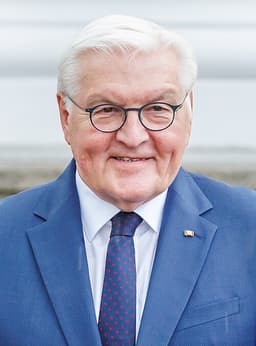
Frank-Walter Steinmeier
Politician · Modern
58.3Total

Josep Borrell
Politician · Modern
54.7Total
Basic Information
Born
1956
1947
Died
—
—
Era
Modern
Modern
Nationality
Germany
Spain
Occupation
Politician
Politician
Civilization
Western
Western
Score Comparison
Military (10%)
50.0
49.7
Political (20%)
72.0
68.0
Influence (20%)
57.2
55.7
Legacy (20%)
47.5
42.5
Leadership (15%)
80.0
72.0
Strategy (15%)
43.5
41.4
TOTAL
58.3
54.7
Frank-Walter Steinmeier — Complete Timeline
2005 AD
Became Foreign Minister of GermanyPolitical Action◆ Major
Frank-Walter Steinmeier was appointed Federal Minister for Foreign Affairs under Chancellor Angela Merkel. He served in this role until 2009, overseeing German foreign policy during a period of European integration and global challenges.
German PoliticsForeign PolicyMerkel Cabinet
Impact: national
2007 AD
Became Vice Chancellor of GermanyPolitical Action◆ Major
Steinmeier was appointed Vice Chancellor of Germany, serving concurrently as Foreign Minister. This position made him the second-highest-ranking official in the German government.
German PoliticsGovernmentVice Chancellor
Impact: national
2017 AD
Elected President of GermanyPolitical Action◆ Major
Steinmeier was elected as the 12th President of Germany by the Federal Convention. As a largely ceremonial head of state, he has focused on promoting social cohesion and democratic values.
German PresidencyHead of StateElection
Impact: nationalconstructive
2022 AD
Re-elected as President of GermanyPolitical Action◆ Major
Steinmeier was re-elected for a second five-year term as President of Germany. His re-election reflected broad cross-party support for his role as a unifying figure during times of political and social change.
German PresidencyRe-electionPolitical Stability
Impact: nationalconstructive
Josep Borrell — Complete Timeline
2019 AD
Appointed EU High Representative for Foreign AffairsPolitical Action◆ Major
Josep Borrell became the EU High Representative for Foreign Affairs and Security Policy, succeeding Federica Mogherini. He also served as Vice-President of the European Commission, responsible for coordinating EU foreign policy.
EU Foreign PolicyHigh RepresentativeDiplomacy
Impact: regionalconstructive
2020 AD
Negotiated Iran Nuclear Deal (JCPOA) StancePolitical Action◆ Major
Borrell served as coordinator of the Joint Comprehensive Plan of Action (JCPOA) talks, attempting to revive the Iran nuclear deal after US withdrawal. He facilitated negotiations between Iran and remaining parties, though talks stalled by 2023.
Iran Nuclear DealJCPOADiplomacy
Impact: global
2021 AD
Visited Afghanistan After Taliban TakeoverPolitical Action
Borrell visited Doha to engage with Taliban representatives after the fall of Kabul, focusing on safe passage for EU citizens and Afghan allies. The visit was criticized by some EU member states for legitimizing the Taliban.
AfghanistanTalibanEU Diplomacy
Impact: regional
2022 AD
Proposed EU Strategic Compass for SecurityReform◆ Major
Borrell presented the EU Strategic Compass, a defense strategy outlining threats and capabilities. The plan included a rapid deployment force, cyber defense, and increased military spending, aiming to strengthen EU autonomy in security.
EU DefenseStrategic CompassSecurity
Impact: regionalconstructive
Led EU Response to Russia-Ukraine WarPolitical Action◆ Major
Borrell coordinated EU sanctions against Russia and military aid to Ukraine following the 2022 invasion. He pushed for arms deliveries and trained Ukrainian troops, while also managing EU diplomatic efforts to isolate Russia internationally.
Russia-Ukraine WarSanctionsEU Foreign Policy
Impact: global
Expert Analysis
Origins
Frank-Walter Steinmeier was born on January 5, 1956, in Detmold, West Germany. His father was a carpenter, and his mother a housewife. He studied law and political science at the University of Giessen, earning a doctorate in 1991. His early career included working as a research assistant and later as a civil servant in the Lower Saxony state chancellery under future Chancellor Gerhard Schröder.
Josep Borrell Fontelles was born on April 24, 1947, in La Pobla de Segur, Spain. His father was a baker, and his mother a homemaker. He studied industrial engineering at the Technical University of Madrid and later earned a PhD in economics from the Complutense University of Madrid. He also studied at Stanford University. His early career included teaching mathematics and working as an economist before entering politics as a member of the Spanish Socialist Workers' Party (PSOE).
Rise to Power
Steinmeier rose to prominence as a key aide to Gerhard Schröder, becoming head of the Chancellery in 1999. He was appointed Federal Minister for Foreign Affairs in 2005 under Chancellor Angela Merkel, a position he held until 2009. He also served as Vice Chancellor from 2007 to 2009. After a brief stint as leader of the SPD parliamentary group, he was elected President of Germany in 2017 and re-elected in 2022. His rise was marked by loyalty to Schröder and later by his steady, consensus-building style.
Borrell entered national politics as a member of the Spanish Congress of Deputies in 1986. He served as Minister of Public Works and Transport (1991-1996) and later as Minister of Infrastructure and Environment (2004-2007). He was President of the European Parliament from 2004 to 2007. In 2019, he was appointed EU High Representative for Foreign Affairs and Security Policy, and Vice-President of the European Commission. His rise was driven by his expertise in economics and his strong Europeanist stance.
Leadership & Governance
Steinmeier's leadership style is characterized by moderation, diplomacy, and a focus on unity. As President, he has emphasized dialogue and reconciliation, often acting as a moral authority. His political score of 72.0 reflects his ability to navigate coalition governments and maintain cross-party support. However, his strategic score of 43.5 suggests a limited role in shaping policy, consistent with the ceremonial nature of the presidency.
Borrell's leadership is more activist and confrontational. As EU High Representative, he has pushed for a stronger EU foreign policy, particularly in response to the Ukraine war. His political score of 68.0 reflects his influence in European politics, but his strategy score of 41.4 indicates challenges in coordinating the 27 member states. He has been criticized for some diplomatic missteps, such as his remarks on the US-China competition.
Triumph & Tragedy
Steinmeier's greatest success was his re-election as President in 2022 with broad support, a testament to his role as a unifying figure. He also played a key role in the German government's response to the COVID-19 pandemic, promoting social cohesion. However, his time as Foreign Minister saw limited breakthroughs in foreign policy, and his legacy is constrained by the largely symbolic powers of the presidency.
Borrell's major achievement is coordinating the EU's response to the Russia-Ukraine war, including sanctions and military aid. He also advanced the EU Strategic Compass, a defense strategy. However, his failure to revive the Iran nuclear deal (JCPOA) and the chaotic withdrawal from Afghanistan highlighted the limits of EU foreign policy. His influence score of 55.7 reflects a mixed record.
Character & Destiny
Steinmeier is known for his calm, reserved demeanor and his ability to build consensus. His character has made him a trusted figure in German politics, but also a cautious one, avoiding bold initiatives. This has shaped his destiny as a respected but not transformative leader.
Borrell is more outspoken and often polarizing. His direct style has energized EU foreign policy but also led to controversies. His character has driven him to push for a more assertive EU role, but the structural constraints of the EU's foreign policy machinery have limited his impact.
Legacy
Steinmeier's legacy will be as a stabilizing force in German politics during turbulent times. He has upheld the office's dignity and promoted democratic values. However, his impact on policy is minimal, and he is unlikely to be remembered as a major historical figure.
Borrell's legacy is tied to the EU's response to the Ukraine war and the push for a more integrated European defense. He has raised the profile of EU foreign policy, but his legacy is still unfolding. His total score of 54.7 reflects a politician who has been influential but not transformative.
Conclusion
Frank-Walter Steinmeier scores higher overall (58.3 vs. 54.7), with a significant edge in leadership (80.0 vs. 72.0). His role as a unifying figure in Germany's political system gives him a more solid, if less dramatic, impact. Borrell, while influential in EU foreign policy, has faced greater structural obstacles and mixed results. Steinmeier's ability to command cross-party respect and his success in a ceremonial role with limited power demonstrate greater political skill. Therefore, Steinmeier has had a greater impact on his nation's stability and democratic resilience.
Rankings
🥇
Frank-Walter SteinmeierLeader
Mil: 50.0Pol: 72.0Inf: 57.2
58.3
🥈
Josep Borrell
Mil: 49.7Pol: 68.0Inf: 55.7
54.7
+3.6 behind
How This Comparison Works
Algorithm
Each figure is scored on 6 dimensions (0—100 scale) based on structured historical data: Military (10%), Political (20%), Influence (20%), Legacy (20%), Leadership (15%), Strategy (15%). The weighted total produces the final ranking.
Data Sources
Scores are computed from structured sub-indicators in the database. Scale factors adjust for era (Ancient ×0.85, Modern ×1.0) and civilization size (Eastern ×1.05, Other ×0.80) to account for differences in population and military scale.
Maximum 3 Figures
Comparisons are limited to 2—3 figures to ensure readability and statistical meaningfulness.
Error Margins
±5 points per dimension — Sub-scores are derived from historical records with inherent uncertainty. Two figures within 5 points on a dimension should be considered roughly equivalent in that area.
Total Score Accuracy
±3 points overall — The weighted combination of 6 dimensions produces a total score with approximately ±3 points of uncertainty. Differences of less than 3 points are not statistically significant— the figures are effectively tied.
Known Limitations
- Historical records are incomplete and uneven across civilizations
- Figures from oral-tradition societies may be underrepresented
- Occupation labels can misclassify multi-role figures
- Scores measure capability and impact, not moral character
- Quantitative scoring is a comparison tool, not absolute truth
Capability Radar
Military (10%) — Battles & Warfare
Battles
31
31
Win Rate
31
29
Expansion
33
36
Political (20%) — Governance & Reform
Reform
45
45
Diplomacy
75
65
Economy
50
40
Influence (20%) — Cultural & Global Reach
Cultural
30
20
Global
45
55
Legacy (20%) — Historical Impact
Historical
40
30
Longevity
35
25
Leadership (15%) — Power & Stability
Tenure
65
60
Stability
70
50
Strategy (15%) — Tactics & Innovation
Strategy
40
36
Tactics
43
40
Reform
43
43
Similar Comparisons
Comments & Discussion
No comments yet. Be the first to share your thoughts!