Loading...
Francois de Guise vs Julius Caesar
Julius Caesar leads by 22.4 pts · 2 figures compared
…
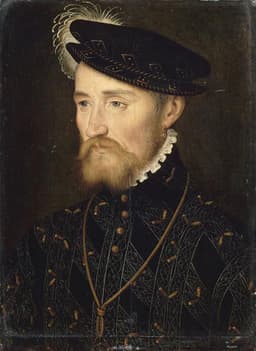
Francois de Guise
General · Modern
60.4Total

Julius Caesar
General · Ancient
82.8Total
Basic Information
Born
1519
-100
Died
1563
-44
Era
Modern
Ancient
Nationality
France
Roman Republic
Occupation
General
General
Civilization
Western
Western
Score Comparison
Military (10%)
70.3
88.0
Political (20%)
68.0
78.0
Influence (20%)
55.0
85.0
Legacy (20%)
52.0
82.0
Leadership (15%)
70.0
80.0
Strategy (15%)
58.8
85.0
TOTAL
60.4
82.8
Francois de Guise — Complete Timeline
1552 AD
Defense of MetzWar◆ Major
Francois de Guise successfully defended the city of Metz against the forces of Emperor Charles V. His military leadership repelled the imperial siege, securing the city for France and enhancing his reputation as a general.
SiegeHabsburg-Valois WarsMilitary
Impact: regional
1558 AD
Capture of CalaisWar◆ Major
Francois de Guise led the French army that captured Calais from the English. This victory ended 200 years of English rule in Calais and was a major triumph for France in the Italian Wars.
BattleCalaisItalian Wars
Impact: regional
1562 AD
Leadership of the Catholic LeaguePolitical Action◆ Major
Francois de Guise became the military leader of the Catholic League during the early French Wars of Religion. He led Catholic forces against the Huguenots, including the massacre of Huguenots at Wassy in 1562.
Catholic LeagueWars of ReligionMilitary
Impact: nationaldestructive
1563 AD
Assassination of Francois de GuisePolitical Action◆ Major
Francois de Guise was assassinated by a Huguenot nobleman, Jean de Poltrot, during the Siege of Orleans. His death escalated the French Wars of Religion and deepened the conflict between Catholics and Protestants.
AssassinationWars of ReligionCatholic League
Impact: nationaltragic
Julius Caesar — Complete Timeline
58 BC
Gallic WarsWar◆ Major
Caesar, as proconsul of Gaul, launched a series of campaigns that conquered all of Gaul (modern France, Belgium, and parts of Switzerland). He fought numerous battles, including against the Helvetii, the Belgae, and the Gallic chieftain Vercingetorix. The wars brought immense wealth and a loyal army to Caesar.
Gallic WarsConquestRoman Expansion
Impact: regional
49 BC
Crossing the RubiconPolitical Action◆ Major
Caesar led Legio XIII across the Rubicon River into Italy, defying the Roman Senate's order to disband his army. This act triggered a civil war against Pompey and the Optimates, ultimately leading to Caesar's dictatorship and the end of the Roman Republic.
Roman Civil WarEnd of RepublicPower Struggle
Impact: global
48 BC
Battle of PharsalusWar◆ Major
Caesar's outnumbered army defeated the larger forces of Pompey the Great at Pharsalus in Greece. Caesar's tactical use of a reserve line to counter Pompey's cavalry charge proved decisive. Pompey fled to Egypt, where he was assassinated, leaving Caesar as the undisputed master of the Roman world.
Roman Civil WarBattleDecisive Victory
Impact: regional
44 BC
Appointment as Dictator for LifePolitical Action◆ Major
The Roman Senate appointed Caesar dictator perpetuo (dictator for life), granting him unprecedented personal power. This move concentrated military, legislative, and judicial authority in one person, effectively ending the Roman Republic's traditional system of checks and balances and alarming many senators.
DictatorshipEnd of RepublicPower Consolidation
Impact: regionaldestructive
Assassination on the Ides of MarchPolitical Action◆ Major
A group of Roman senators, led by Marcus Junius Brutus and Gaius Cassius Longinus, stabbed Caesar to death at a meeting of the Senate in the Theatre of Pompey. The assassination was intended to restore the Republic, but instead triggered another civil war that led to the rise of the Roman Empire.
AssassinationRoman PoliticsEnd of Republic
Impact: globaldestructive
Expert Analysis
francois-de-guise-vs-julius-caesar
# The Rubicon and the Cross: Caesar and Guise, Two Visions of Power
On the Ides of March, 44 BCE, Julius Caesar fell beneath twenty-three dagger thrusts in the Pompeian Theater, his blood pooling on the marble floor as senators scattered. Fourteen hundred miles and sixteen centuries away, on February 18, 1563, François de Guise slumped in his saddle outside Orléans, a pistol ball lodged in his shoulder from a Huguenot assassin. Both men died by violence, both were generals of extraordinary skill, and both lived at moments when their civilizations trembled on the edge of transformation. Yet one shaped the world for two millennia, while the other is remembered only by specialists. Why?
Origins
Caesar was born into the patrician Julian clan, but his family had fallen from political prominence. He grew up in a Rome that was already an empire in all but name—a republic buckling under the weight of its conquests, where ambitious generals could command personal armies and the Senate struggled to maintain control. His uncle by marriage, Gaius Marius, had reformed the army and waged civil war; his father-in-law, Cinna, had been a populist leader. Caesar learned early that power flowed not from tradition but from force, charisma, and the loyalty of soldiers.
François de Guise was born in 1519 into the House of Guise, a cadet branch of the French royal family that had risen to prominence through marriage and military service. His father, Claude, was the first Duke of Guise; his mother, Antoinette de Bourbon, connected him to the French crown. The Guises were the most powerful Catholic family in France, and François inherited not just their ambition but their cause. He grew up in a France torn between Reformation and Counter-Reformation, where religious loyalty was becoming the defining question of political life.
The difference in their origins was subtle but crucial: Caesar’s world was one of secular ambition, where gods were tools and the state was the prize. Guise’s world was one of holy war, where salvation and power were inextricably mixed.
Rise to Power
Caesar’s path was slow and strategic. He served as a military tribune, then quaestor in Spain, where he reportedly wept before a statue of Alexander the Great, lamenting that he had achieved nothing by his age. He climbed the cursus honorum—the ladder of Roman offices—with careful calculation, forming the First Triumvirate with Pompey and Crassus in 60 BCE. His appointment as governor of Gaul in 58 BCE gave him the command he needed: nine years of brutal conquest that made him fabulously wealthy, gave him a veteran army fanatically loyal to him, and established his reputation as one of history’s greatest generals. When the Senate ordered him to disband his army, he crossed the Rubicon River in 49 BCE, triggering a civil war that ended with him as dictator for life.
Guise’s rise was faster and more direct. He was only thirty-three when he defended Metz against the forces of Emperor Charles V in 1552, a victory that made him the hero of Catholic France. In 1558, he captured Calais from the English, ending two centuries of English rule on the continent—a feat that Henry II of France called “the greatest achievement of our reign.” When the French Wars of Religion erupted in 1562, Guise became the military leader of the Catholic League, the faction determined to crush Protestantism. His power came not from a slow accumulation of offices but from the desperate need of a monarchy too weak to defend itself.
Leadership and Governance
Caesar governed as a reformer. As dictator, he overhauled the Roman calendar, expanded the Senate to include provincials, granted citizenship to Gauls, and initiated public works projects that employed the poor. He was merciful to his defeated enemies—Pompey’s supporters were pardoned, not proscribed—but his clemency was a political tool, not a virtue. His military genius lay in speed and logistics: he once marched his army forty miles in a single day, and his siege of Alesia remains a masterpiece of military engineering. His leadership was personal; he fought alongside his men, shared their hardships, and called them “fellow soldiers,” not “men.”
Guise’s leadership was narrower. He was a brilliant tactician—his defense of Metz against overwhelming odds demonstrated extraordinary skill—but his vision was limited to military victory. He had no interest in reforming France or reconciling its religious divisions. When he led the Catholic League, he did so with ruthless efficiency: the Massacre of Vassy in 1562, which killed dozens of Huguenot worshippers, was carried out by his men. He saw the Protestants as enemies to be exterminated, not citizens to be integrated. His political wisdom was negligible; he never sought to govern France, only to defend the Catholic faith by the sword.
Triumph and Tragedy
Caesar’s triumph was his conquest of Gaul and his defeat of Pompey, but his tragedy was his assassination. He had centralized power so completely that his death left a vacuum that could only be filled by another strongman—his adopted heir, Octavian, who became Augustus and founded the Roman Empire. Caesar’s tragedy was that he destroyed the Republic he claimed to save, but his triumph was that he made the empire inevitable.
Guise’s triumph was the capture of Calais, a victory that restored French pride and ended a humiliation that had lasted since the Hundred Years’ War. His tragedy was his assassination, which escalated the Wars of Religion into a cycle of revenge that would last for decades. His death at the hands of a Huguenot nobleman confirmed the Catholics’ belief that Protestants were traitors, and the Protestants’ belief that the Guises were tyrants. Unlike Caesar, Guise left no successor; his brother Charles took over the League, but the family’s power never recovered.
Character and Destiny
Caesar was audacious, intelligent, and utterly ruthless when necessary. He gambled constantly—crossing the Rubicon, fighting at Pharsalus against superior numbers, walking into the Senate unarmed—and he usually won. His personality was magnetic; even his enemies admired him. But his arrogance blinded him: he ignored warnings of the conspiracy against him, refused a bodyguard, and believed his clemency had disarmed his opponents. It hadn’t.
Guise was brave, devout, and inflexible. He fought for a cause, not for himself, and his religious conviction gave him a certainty that Caesar never possessed. But that same certainty made him incapable of compromise. He could not imagine a France where Catholics and Protestants coexisted, and so he fought to annihilate the other side. His personality was suited to war, not peace.
Legacy
Caesar’s legacy is immeasurable. His name became synonymous with imperial power—Kaiser, Tsar, Caesar—and his writings, the *Commentaries on the Gallic War*, are still studied as models of military prose. He transformed Rome from a republic into an empire, and that empire shaped Europe, the Middle East, and North Africa for centuries. His reforms, from the calendar to citizenship, endured long after his death.
Guise’s legacy is local and contested. He is remembered as a hero of the Counter-Reformation, a defender of the Catholic faith, but also as a fanatic who plunged France into civil war. His capture of Calais is a footnote in English history, a triumph in French. The Catholic League he led eventually collapsed, and France’s religious wars ended only when Henry IV converted to Catholicism and issued the Edict of Nantes. Guise’s vision of a purely Catholic France was ultimately defeated.
Conclusion
Standing before the statue of Alexander, Caesar wept because he had achieved nothing. François de Guise never wept; he was too certain of his cause. Caesar’s ambition was personal and limitless; Guise’s was religious and bounded. One built an empire that outlasted him; the other led a faction that died with him. The difference lies not in their military skill—both were superb commanders—but in their vision. Caesar saw a world he could reshape; Guise saw a world he could only defend. And in history, as in life, the builders outlast the defenders.
Rankings
🥇
Julius CaesarLeader
Mil: 88.0Pol: 78.0Inf: 85.0
82.8
🥈
Francois de Guise
Mil: 70.3Pol: 68.0Inf: 55.0
60.4
+22.4 behind
How This Comparison Works
Algorithm
Each figure is scored on 6 dimensions (0—100 scale) based on structured historical data: Military (10%), Political (20%), Influence (20%), Legacy (20%), Leadership (15%), Strategy (15%). The weighted total produces the final ranking.
Data Sources
Scores are computed from structured sub-indicators in the database. Scale factors adjust for era (Ancient ×0.85, Modern ×1.0) and civilization size (Eastern ×1.05, Other ×0.80) to account for differences in population and military scale.
Maximum 3 Figures
Comparisons are limited to 2—3 figures to ensure readability and statistical meaningfulness.
Error Margins
±5 points per dimension — Sub-scores are derived from historical records with inherent uncertainty. Two figures within 5 points on a dimension should be considered roughly equivalent in that area.
Total Score Accuracy
±3 points overall — The weighted combination of 6 dimensions produces a total score with approximately ±3 points of uncertainty. Differences of less than 3 points are not statistically significant— the figures are effectively tied.
Known Limitations
- Historical records are incomplete and uneven across civilizations
- Figures from oral-tradition societies may be underrepresented
- Occupation labels can misclassify multi-role figures
- Scores measure capability and impact, not moral character
- Quantitative scoring is a comparison tool, not absolute truth
Capability Radar
Military (10%) — Battles & Warfare
Battles
72
95
Win Rate
75
92
Expansion
60
97
Political (20%) — Governance & Reform
Reform
40
90
Diplomacy
60
85
Economy
45
82
Influence (20%) — Cultural & Global Reach
Cultural
55
88
Global
50
94
Legacy (20%) — Historical Impact
Historical
65
95
Longevity
55
96
Leadership (15%) — Power & Stability
Tenure
65
75
Stability
50
60
Strategy (15%) — Tactics & Innovation
Strategy
70
94
Tactics
78
96
Reform
55
88
Similar Comparisons
Comments & Discussion
RubiconRevenant6/17/2026
Calling Caesar a general of "extraordinary skill" sells him short—he was a logistics genius who turned Gaul into Rome’s breadbasket before crossing the Rubicon. Guise, meanwhile, got lucky at Metz in 1552 when the Habsburgs botched their siege. Caesar wins wars; Guise won skirmishes. One rewrote history, the other’s a footnote because he never grasped that true power demands total political overhaul, not just battlefield bravado.
断戟之眼6/17/2026
拿吉斯跟凯撒比,真是抬举了吉斯。凯撒在高卢之战中写了《高卢战记》给后世当兵法教材,吉斯呢?1563年奥尔良那枪打得稀里糊涂,死得窝囊。你说他战术厉害,可他连法国宗教战争的烂摊子都没收拾干净。凯撒把罗马从共和国扭成帝国,吉斯连教会都压不住,这差距不是一星半点。
DataScourge6/17/2026
Ancient vs. early modern is an apples-to-oranges mess. Caesar commanded maybe 50,000 legionaries at Alesia—that’s a crowd by Roman standards. Guise fought with arquebusiers and cannon against 16th-century fortifications; his Siege of Calais in 1558 involved 27,000 men max. Different eras, different tech, different scales. Comparing their "skill" without adjusting for military evolution is lazy history. Stop romanticizing the Rubicon and check the numbers.
狮心统计6/17/2026
你拿2000年前的凯撒跟500年前的吉斯比军事能力?瞎比。凯撒的兵靠短剑和盾牌在步兵阵里砍杀,吉斯那会儿火绳枪和重炮都普及了。吉斯在1558年攻占加来,用的炮兵规模能让凯撒目瞪口呆。你要这么比,凯撒在阿尔卑斯山也得被冻死。技术进步改游戏规则,别拿战术说事了。
PatricianGhost6/17/2026
Caesar’s death was a political statement—the Senate’s last gasp—while Guise’s was sectarian chaos. Guise led a Catholic faction in France’s Wars of Religion, a messy grudge match with Huguenots. Caesar unified Rome’s civil war aftermath under a dictator’s smile. The fundamental difference: Guise tried to preserve a divided kingdom, Caesar built a new world order. One’s a historical echo, the other’s an echo that became a revolution.
铁血残碑6/17/2026
凯撒死的是共和制的葬礼,跟吉斯那宗教暗杀完全不同。吉斯在1562年巴黎拿的是天主教大旗,可法国宗教战争纯粹是贵族瞎搅合,没凯撒那种横扫天下的格局。凯