Loading...
Ferdinand I of Aragon vs Richard II of England
Ferdinand I of Aragon leads by 12.0 pts · 2 figures compared
…
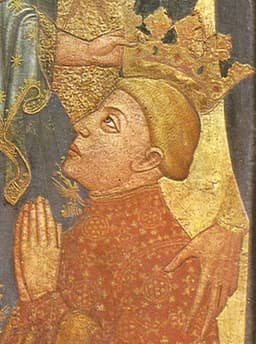
Ferdinand I of Aragon
Emperor · Medieval
54.8Total
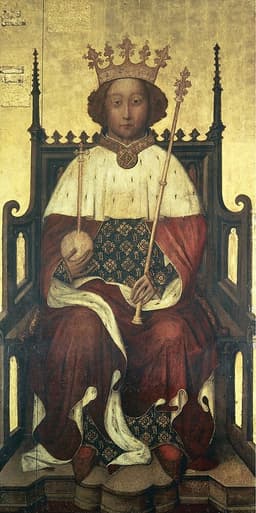
Richard II of England
Emperor · Medieval
42.8Total
Basic Information
Born
1380
1367
Died
1416
1400
Era
Medieval
Medieval
Nationality
Aragon
England
Occupation
Emperor
Emperor
Civilization
Western
Western
Score Comparison
Military (10%)
40.0
21.2
Political (20%)
68.0
35.1
Influence (20%)
55.7
51.8
Legacy (20%)
45.0
45.0
Leadership (15%)
74.0
48.4
Strategy (15%)
43.3
39.6
TOTAL
54.8
42.8
Ferdinand I of Aragon — Complete Timeline
1412 AD
Compromise of CaspePolitical Action
Ferdinand I was elected King of Aragon by the Compromise of Caspe, a commission of nine representatives from Aragon, Catalonia, and Valencia. This resolved the succession crisis following the death of Martin I without a direct heir, bringing the Trastamara dynasty to the Aragonese throne.
Succession crisisTrastamara dynasty
Impact: regionalconstructive
1414 AD
Conquest of SardiniaWar◆ Major
Ferdinand I launched a military campaign to subdue the rebellious Sardinian nobles who had resisted Aragonese rule. The campaign successfully reasserted Aragonese control over the island, consolidating the Crown of Aragon's Mediterranean possessions.
Mediterranean expansionSardinia
Impact: regional
1415 AD
Reform of the Aragonese administrationReform
Ferdinand I implemented administrative reforms in the Crown of Aragon, including the reorganization of the royal council and the standardization of tax collection. These reforms strengthened royal authority and improved the efficiency of governance across the diverse territories of Aragon.
Administrative reformRoyal authority
Impact: nationalconstructive
Richard II of England — Complete Timeline
1381 AD
Peasants' RevoltPolitical Action◆ Major
Richard II faced the Peasants' Revolt, a major uprising led by Wat Tyler. The rebels marched on London, demanding an end to serfdom and poll taxes. Richard met them at Smithfield, where Tyler was killed, and the revolt was suppressed.
RevoltPeasantsWat Tyler
Impact: nationaldestructive
1388 AD
Merciless ParliamentPolitical Action◆ Major
The Lords Appellant, a group of nobles, took control of the government through the Merciless Parliament. They executed or exiled Richard's favorites, severely limiting his power and humiliating the king.
ParliamentLords AppellantPurge
Impact: nationaldestructive
1399 AD
Deposition by Henry BolingbrokePolitical Action◆ Major
Richard II was deposed by his cousin Henry Bolingbroke, who returned from exile and seized the throne. Richard was imprisoned and forced to abdicate, ending his reign and beginning the Lancastrian dynasty.
DepositionUsurpationLancaster
Impact: nationaltragic
1400 AD
Death at Pontefract CastleOther◆ Major
Richard II died at Pontefract Castle, likely starved to death on orders of Henry IV. His death ended the Plantagenet line of direct succession and led to the Wars of the Roses.
DeathImprisonment
Impact: nationaltragic
Expert Analysis
Origins
Ferdinand I of Aragon was born in 1380 as Ferdinand of Trastamara, the son of King John I of Castile and Eleanor of Aragon. He grew up in the Castilian court, receiving education in governance and military tactics. His marriage to Eleanor of Alburquerque strengthened his ties to the nobility. Richard II of England was born in 1367 in Bordeaux, the son of Edward the Black Prince and Joan of Kent. He became heir to the throne at age nine after his father's death, and was raised under the regency of his uncle John of Gaunt. Richard's early life was marked by the influence of his mother and tutors, who instilled a belief in the divine right of kings.
Rise to Power
Ferdinand I rose to power through the Compromise of Caspe in 1412, a commission of nine representatives from Aragon, Catalonia, and Valencia that elected him king after the death of Martin I without direct heir. His claim was based on his maternal lineage from the House of Barcelona. Richard II ascended the throne at age ten in 1377, following the death of his grandfather Edward III. His early reign was controlled by a series of regency councils dominated by his uncles, particularly John of Gaunt. Richard's personal rule began in 1389, but he faced challenges from powerful nobles.
Leadership & Governance
Ferdinand I scored 74.0 in leadership, reflecting his ability to unify the diverse realms of the Crown of Aragon. He implemented administrative reforms, including reorganizing the royal council and standardizing tax collection, which improved efficiency. He also strengthened the monarchy's authority over the nobility. Richard II scored 48.4 in leadership, hindered by his autocratic tendencies and favoritism toward a small group of courtiers. His governance style alienated the nobility, leading to the Merciless Parliament of 1388, where the Lords Appellant executed or exiled his favorites. Richard later sought revenge, exiling and executing his opponents, which ultimately led to his downfall.
Triumph & Tragedy
Ferdinand I's greatest success was the Compromise of Caspe, which peacefully resolved a succession crisis and expanded Aragonese influence. He also launched a successful campaign to subdue rebellious Sardinian nobles, reasserting Aragonese control. However, his military score of 40.0 reflects limited battlefield achievements; his reign was more diplomatic than martial. His tragedy was dying in 1416 before fully consolidating his reforms. Richard II's triumph was his handling of the Peasants' Revolt in 1381; at age 14, he met the rebels and promised concessions, then later suppressed the uprising after the death of Wat Tyler. But his tragedy was his deposition in 1399 by Henry Bolingbroke, leading to his death at Pontefract Castle, likely starved. His total score of 42.8 reflects his political failures.
Character & Destiny
Ferdinand I was pragmatic and diplomatic, using negotiation to secure his throne. His political score of 68.0 indicates skillful maneuvering among competing factions. He was cautious, avoiding unnecessary conflicts. In contrast, Richard II was impulsive and vengeful, with a political score of 35.1. He believed in absolute monarchy, which clashed with England's tradition of noble power. His character led him to alienate key allies, including his cousin Henry Bolingbroke, whom he exiled and then disinherited. This directly caused Bolingbroke's invasion and Richard's deposition. Richard's destiny was sealed by his inability to compromise.
Legacy
Ferdinand I's legacy is as a founder of the Trastamara dynasty in Aragon, which later united with Castile through his grandson Ferdinand II of Aragon. His administrative reforms laid groundwork for a more centralized state. His score of 45.0 in legacy reflects modest but enduring impact. Richard II's legacy is more dramatic: his deposition led to the Wars of the Roses, as his usurpation by the Lancastrian Henry IV created a precedent for contested succession. His death ended the direct Plantagenet line. However, his legacy score is also 45.0, as his reign is often seen as a cautionary tale of royal overreach.
Conclusion
Ferdinand I of Aragon, with a total score of 54.8, had a more effective reign than Richard II (42.8). Ferdinand's diplomatic skills and administrative reforms strengthened the Crown of Aragon and set the stage for future unification with Castile. Richard's reign, despite a promising start, ended in failure due to his autocratic rule and political miscalculations. While Richard's deposition had major historical consequences, Ferdinand's positive contributions to state-building give him greater impact as a ruler.
Rankings
🥇
Ferdinand I of AragonLeader
Mil: 40.0Pol: 68.0Inf: 55.7
54.8
🥈
Richard II of England
Mil: 21.2Pol: 35.1Inf: 51.8
42.8
+12.0 behind
How This Comparison Works
Algorithm
Each figure is scored on 6 dimensions (0—100 scale) based on structured historical data: Military (10%), Political (20%), Influence (20%), Legacy (20%), Leadership (15%), Strategy (15%). The weighted total produces the final ranking.
Data Sources
Scores are computed from structured sub-indicators in the database. Scale factors adjust for era (Ancient ×0.85, Modern ×1.0) and civilization size (Eastern ×1.05, Other ×0.80) to account for differences in population and military scale.
Maximum 3 Figures
Comparisons are limited to 2—3 figures to ensure readability and statistical meaningfulness.
Error Margins
±5 points per dimension — Sub-scores are derived from historical records with inherent uncertainty. Two figures within 5 points on a dimension should be considered roughly equivalent in that area.
Total Score Accuracy
±3 points overall — The weighted combination of 6 dimensions produces a total score with approximately ±3 points of uncertainty. Differences of less than 3 points are not statistically significant— the figures are effectively tied.
Known Limitations
- Historical records are incomplete and uneven across civilizations
- Figures from oral-tradition societies may be underrepresented
- Occupation labels can misclassify multi-role figures
- Scores measure capability and impact, not moral character
- Quantitative scoring is a comparison tool, not absolute truth
Capability Radar
Military (10%) — Battles & Warfare
Battles
40
15
Win Rate
45
10
Expansion
50
5
Political (20%) — Governance & Reform
Reform
45
35
Diplomacy
60
30
Economy
50
25
Influence (20%) — Cultural & Global Reach
Cultural
35
30
Global
30
20
Legacy (20%) — Historical Impact
Historical
40
40
Longevity
30
30
Leadership (15%) — Power & Stability
Tenure
55
40
Stability
50
20
Strategy (15%) — Tactics & Innovation
Strategy
40
10
Tactics
35
10
Reform
30
5
Similar Comparisons
Comments & Discussion
No comments yet. Be the first to share your thoughts!