Loading...
Ashina Funian vs Richard II of England
Richard II of England leads by 3.4 pts · 2 figures compared
…

Ashina Funian
Emperor · Medieval
39.4Total
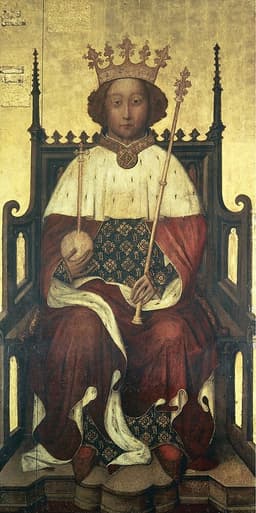
Richard II of England
Emperor · Medieval
42.8Total
Basic Information
Born
670
1367
Died
690
1400
Era
Medieval
Medieval
Nationality
Eastern Turkic Khaganate
England
Occupation
Emperor
Emperor
Civilization
Eastern
Western
Score Comparison
Military (10%)
20.0
21.2
Political (20%)
35.0
35.1
Influence (20%)
45.5
51.8
Legacy (20%)
35.0
45.0
Leadership (15%)
49.9
48.4
Strategy (15%)
45.0
39.6
TOTAL
39.4
42.8
Ashina Funian — Complete Timeline
679 AD
Proclaimed himself khagan of the Eastern Turkic KhaganatePolitical Action◆ Major
Ashina Funian declared himself khagan of the Eastern Turkic Khaganate during a period of Tang Chinese domination over the Turkic tribes. His claim to the throne was part of a broader Turkic resistance movement against Tang control, challenging the authority of the Tang-protected khagans.
Khaganate ClaimTurkic ResistanceTang Dynasty
Impact: regional
680 AD
Rebellion against Tang China suppressedWar◆ Major
Ashina Funian's rebellion against Tang Chinese authority was defeated by Tang forces. The suppression of his uprising reaffirmed Tang control over the Eastern Turkic Khaganate. Funian was captured or killed during the campaign, ending his brief claim to the khaganate.
Military DefeatTang SuppressionFailed Rebellion
Impact: regionaldestructive
Richard II of England — Complete Timeline
1381 AD
Peasants' RevoltPolitical Action◆ Major
Richard II faced the Peasants' Revolt, a major uprising led by Wat Tyler. The rebels marched on London, demanding an end to serfdom and poll taxes. Richard met them at Smithfield, where Tyler was killed, and the revolt was suppressed.
RevoltPeasantsWat Tyler
Impact: nationaldestructive
1388 AD
Merciless ParliamentPolitical Action◆ Major
The Lords Appellant, a group of nobles, took control of the government through the Merciless Parliament. They executed or exiled Richard's favorites, severely limiting his power and humiliating the king.
ParliamentLords AppellantPurge
Impact: nationaldestructive
1399 AD
Deposition by Henry BolingbrokePolitical Action◆ Major
Richard II was deposed by his cousin Henry Bolingbroke, who returned from exile and seized the throne. Richard was imprisoned and forced to abdicate, ending his reign and beginning the Lancastrian dynasty.
DepositionUsurpationLancaster
Impact: nationaltragic
1400 AD
Death at Pontefract CastleOther◆ Major
Richard II died at Pontefract Castle, likely starved to death on orders of Henry IV. His death ended the Plantagenet line of direct succession and led to the Wars of the Roses.
DeathImprisonment
Impact: nationaltragic
Expert Analysis
Origins
Ashina Funian was born into the Ashina clan, the ruling dynasty of the Eastern Turkic Khaganate, around the early 680s. His exact birth year is unknown, but he emerged as a figure during the period of Tang Chinese domination over the Turkic tribes (the Protectorate General to Pacify the North). His family background positioned him as a potential leader of Turkic resistance, but little is recorded about his early life or education.
Richard II of England was born on January 6, 1367, in Bordeaux, Aquitaine, to Edward the Black Prince and Joan of Kent. As a grandson of King Edward III, he was groomed for royalty from birth. He received a refined education typical of medieval princes, including Latin, French, and chivalric training. His father died in 1376, and when Edward III died in 1377, Richard became king at age ten.
Rise to Power
Ashina Funian proclaimed himself khagan of the Eastern Turkic Khaganate around 679, during a period of Tang Chinese control. The Tang had established the Protectorate General to Pacify the North in 647, directly ruling former Turkic territories. Funian's claim was a direct challenge to Tang authority, but he lacked broad support among the Turkic tribes, many of whom were integrated into Tang military and administrative systems. His rebellion was quickly suppressed by Tang forces under Pei Xingjian in 680. The suppression reaffirmed Tang control, and Funian was captured and executed.
Richard II ascended the throne on June 22, 1377, at age ten, under a regency council. His early reign was dominated by his uncles, John of Gaunt and Thomas of Woodstock, and the ongoing Hundred Years' War. In 1381, the Peasants' Revolt erupted, led by Wat Tyler. Richard, then fourteen, famously confronted the rebels at Smithfield, defusing the situation by promising concessions, though the promises were later revoked. This event boosted his prestige temporarily. However, as he grew older, he sought to assert personal rule, clashing with the nobility.
Leadership & Governance
Ashina Funian's leadership was characterized by a traditional claim to khaganate based on lineage, but he lacked the political and military infrastructure to sustain a rebellion. His governance approach was reactive rather than strategic; he declared himself khagan but failed to consolidate support among Turkic elites or secure alliances with neighboring powers. His rebellion scored only 20.0 in military and 35.0 in political metrics, reflecting his inability to challenge Tang dominance effectively.
Richard II's leadership style was autocratic and increasingly arbitrary. After the Peasants' Revolt, he sought to centralize power, bypassing Parliament and relying on a small circle of favorites. He promoted peace with France, marrying Isabella of Valois in 1396, which alienated nobles who favored war. His governance approach included heavy taxation and the use of blank charters to raise funds, leading to widespread resentment. The Merciless Parliament of 1388, where the Lords Appellant executed or exiled his favorites, demonstrated his political vulnerability. His political score of 35.1 reflects his inability to maintain stable rule.
Triumph & Tragedy
Ashina Funian's greatest triumph was asserting his claim as khagan, symbolizing Turkic resistance against Chinese domination. However, his rebellion was a failure: it was suppressed within a year, and he was executed. His legacy is minimal, as the Eastern Turkic Khaganate remained under Tang control until the rise of Ilterish Qaghan, who successfully revived Turkic power in 682. Funian's tragedy was that his premature uprising likely hindered later efforts by providing the Tang with a pretext for tighter control.
Richard II's greatest triumph was his handling of the Peasants' Revolt at age fourteen, where his courage and quick thinking prevented a massacre. However, his later reign was marked by tragedy: his deposition by Henry Bolingbroke in 1399 and his death at Pontefract Castle in 1400, likely starved to death. He failed to produce an heir, and his deposition led to the Wars of the Roses. His legacy score of 45.0 reflects his role in triggering the dynastic conflict that followed.
Character & Destiny
Ashina Funian appears to have been ambitious but reckless, overestimating his support and underestimating Tang power. His decision to rebel without securing alliances or building a strong base suggests poor strategic judgment (strategy score: 45.0). His character was likely shaped by pride in his Ashina lineage, but he lacked the pragmatism of later khans like Ilterish.
Richard II was intelligent and cultured but increasingly paranoid and vindictive. After the Peasants' Revolt, he developed a belief in divine right, leading him to rule arbitrarily. His exile of Henry Bolingbroke and seizure of Lancaster lands provoked Bolingbroke's return and rebellion. His character flaws—arrogance, poor counsel, and inability to compromise—directly led to his deposition. Historians note his political score of 35.1 reflects his failure to navigate the complex feudal politics of England.
Legacy
Ashina Funian's legacy is negligible; he is a footnote in Turkic history, remembered only as a failed pretender. His rebellion did not alter the course of Tang-Turkic relations, and the eventual Turkic revival was led by others. His total score of 39.4 reflects his limited impact.
Richard II's legacy is more significant. His deposition established a precedent for the removal of an anointed king, weakening the monarchy and contributing to the Wars of the Roses. The Lancastrian claim to the throne began with Henry IV's usurpation. Culturally, Richard was a patron of arts, commissioning the Wilton Diptych and promoting the English language in court. His influence score of 51.8 reflects his role in shaping English political and cultural history.
Conclusion
Richard II had a greater impact than Ashina Funian, as reflected in his higher total score (42.8 vs 39.4). While both failed in their immediate objectives, Richard's reign and deposition had lasting consequences for English governance and dynastic succession, triggering the Wars of the Roses. Ashina Funian's rebellion was a minor episode in Turkic subjugation under Tang China, with no enduring effect. Richard's legacy, though negative, is far more consequential in world history.
Rankings
🥇
Richard II of EnglandLeader
Mil: 21.2Pol: 35.1Inf: 51.8
42.8
🥈
Ashina Funian
Mil: 20.0Pol: 35.0Inf: 45.5
39.4
+3.4 behind
How This Comparison Works
Algorithm
Each figure is scored on 6 dimensions (0—100 scale) based on structured historical data: Military (10%), Political (20%), Influence (20%), Legacy (20%), Leadership (15%), Strategy (15%). The weighted total produces the final ranking.
Data Sources
Scores are computed from structured sub-indicators in the database. Scale factors adjust for era (Ancient ×0.85, Modern ×1.0) and civilization size (Eastern ×1.05, Other ×0.80) to account for differences in population and military scale.
Maximum 3 Figures
Comparisons are limited to 2—3 figures to ensure readability and statistical meaningfulness.
Error Margins
±5 points per dimension — Sub-scores are derived from historical records with inherent uncertainty. Two figures within 5 points on a dimension should be considered roughly equivalent in that area.
Total Score Accuracy
±3 points overall — The weighted combination of 6 dimensions produces a total score with approximately ±3 points of uncertainty. Differences of less than 3 points are not statistically significant— the figures are effectively tied.
Known Limitations
- Historical records are incomplete and uneven across civilizations
- Figures from oral-tradition societies may be underrepresented
- Occupation labels can misclassify multi-role figures
- Scores measure capability and impact, not moral character
- Quantitative scoring is a comparison tool, not absolute truth
Capability Radar
Military (10%) — Battles & Warfare
Battles
5
15
Win Rate
5
10
Expansion
5
5
Political (20%) — Governance & Reform
Reform
5
35
Diplomacy
10
30
Economy
5
25
Influence (20%) — Cultural & Global Reach
Cultural
5
30
Global
5
20
Legacy (20%) — Historical Impact
Historical
5
40
Longevity
5
30
Leadership (15%) — Power & Stability
Tenure
10
40
Stability
5
20
Strategy (15%) — Tactics & Innovation
Strategy
5
10
Tactics
5
10
Reform
5
5
Similar Comparisons
Comments & Discussion
No comments yet. Be the first to share your thoughts!