Loading...
Ferdinand Foch vs Julius Caesar
Julius Caesar leads by 12.0 pts · 2 figures compared
…
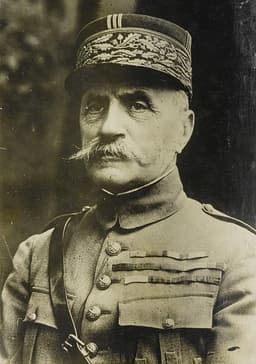
Ferdinand Foch
General · Modern
70.8Total

Julius Caesar
General · Ancient
82.8Total
Basic Information
Born
1851
-100
Died
1929
-44
Era
Modern
Ancient
Nationality
France
Roman Republic
Occupation
General
General
Civilization
Western
Western
Score Comparison
Military (10%)
78.0
88.0
Political (20%)
72.0
78.0
Influence (20%)
75.0
85.0
Legacy (20%)
65.0
82.0
Leadership (15%)
68.0
80.0
Strategy (15%)
70.0
85.0
TOTAL
70.8
82.8
Ferdinand Foch — Complete Timeline
1914 AD
First Battle of the MarneWar
As commander of the French Ninth Army, Foch's forces held the line and counterattacked at the First Battle of the Marne, helping to halt the German advance on Paris. This battle saved France from early defeat.
World War IWestern FrontDefense
Impact: global
1918 AD
Hundred Days OffensiveWar
Foch planned and directed the Allied Hundred Days Offensive, a series of coordinated attacks that broke the German lines and forced the German army to retreat. The offensive led directly to the Armistice.
World War IWestern FrontOffensive
Impact: global
Appointed Allied Supreme CommanderPolitical Action◆ Major
Foch was appointed Supreme Commander of the Allied Armies on the Western Front, coordinating the forces of France, Britain, the United States, and other allies. This unified command was crucial for the final Allied offensives.
World War ICommandAllied Unity
Impact: globalconstructive
Accepted the German ArmisticePolitical Action
Foch, as Allied Supreme Commander, accepted the German armistice delegation in a railway carriage at Compi
World War IArmisticePeace
Impact: global
Julius Caesar — Complete Timeline
58 BC
Gallic WarsWar◆ Major
Caesar, as proconsul of Gaul, launched a series of campaigns that conquered all of Gaul (modern France, Belgium, and parts of Switzerland). He fought numerous battles, including against the Helvetii, the Belgae, and the Gallic chieftain Vercingetorix. The wars brought immense wealth and a loyal army to Caesar.
Gallic WarsConquestRoman Expansion
Impact: regional
49 BC
Crossing the RubiconPolitical Action◆ Major
Caesar led Legio XIII across the Rubicon River into Italy, defying the Roman Senate's order to disband his army. This act triggered a civil war against Pompey and the Optimates, ultimately leading to Caesar's dictatorship and the end of the Roman Republic.
Roman Civil WarEnd of RepublicPower Struggle
Impact: global
48 BC
Battle of PharsalusWar◆ Major
Caesar's outnumbered army defeated the larger forces of Pompey the Great at Pharsalus in Greece. Caesar's tactical use of a reserve line to counter Pompey's cavalry charge proved decisive. Pompey fled to Egypt, where he was assassinated, leaving Caesar as the undisputed master of the Roman world.
Roman Civil WarBattleDecisive Victory
Impact: regional
44 BC
Appointment as Dictator for LifePolitical Action◆ Major
The Roman Senate appointed Caesar dictator perpetuo (dictator for life), granting him unprecedented personal power. This move concentrated military, legislative, and judicial authority in one person, effectively ending the Roman Republic's traditional system of checks and balances and alarming many senators.
DictatorshipEnd of RepublicPower Consolidation
Impact: regionaldestructive
Assassination on the Ides of MarchPolitical Action◆ Major
A group of Roman senators, led by Marcus Junius Brutus and Gaius Cassius Longinus, stabbed Caesar to death at a meeting of the Senate in the Theatre of Pompey. The assassination was intended to restore the Republic, but instead triggered another civil war that led to the rise of the Roman Empire.
AssassinationRoman PoliticsEnd of Republic
Impact: globaldestructive
Expert Analysis
Origins
Ferdinand Foch was born on October 2, 1851, in Tarbes, France, into a devout Catholic family. His father, a civil servant, encouraged his education. Foch attended the prestigious École Polytechnique and later the École de Guerre, where he became a professor of military history and strategy. His early experiences in the Franco-Prussian War (1870-1871) as a soldier left a deep impression, fueling his determination to understand the principles of war.
Julius Caesar was born on July 12, 100 BCE, into the patrician Julian family in Rome. His family claimed descent from the goddess Venus, but they were not wealthy. Caesar received a rhetorical education typical of the Roman elite. His early life was marked by political turmoil: he served in the military in Asia Minor and was captured by pirates. His uncle Marius and father-in-law Cinna were prominent populares, exposing Caesar to populist politics.
Rise to Power
Foch's rise came through academic and military merit. In 1908, he was appointed director of the École de Guerre, where he developed his offensive doctrine. During World War I, he commanded the French Ninth Army at the First Battle of the Marne (September 1914), where his forces held the line against German attacks. This success led to his appointment as commander of Army Group North in 1915. In 1917, with the Allies struggling, Foch was named Chief of the General Staff. His decisive moment came in March 1918, when he was appointed Supreme Allied Commander, coordinating the French, British, American, and Belgian armies. Foch's strategic planning for the Hundred Days Offensive (August-November 1918) broke the German army and forced the armistice.
Caesar's rise was a blend of military conquest and political maneuvering. He served as governor of Hispania Ulterior (61-60 BCE) and then formed the First Triumvirate with Pompey and Crassus in 60 BCE. As proconsul of Gaul (58-50 BCE), he conquered the entire region, defeating Gallic tribes and even invading Britain. His military successes and loyal army gave him immense power. In 49 BCE, the Senate ordered him to disband his army, but he crossed the Rubicon River, triggering a civil war. He defeated Pompey at Pharsalus (48 BCE) and later secured control over the Roman world, becoming dictator first for ten years and then for life in 44 BCE.
Leadership & Governance
Foch's leadership was characterized by coordination and strategic vision. As Supreme Allied Commander, he unified disparate national armies under a single command structure. He emphasized offensive action and unity of effort, famously stating, "My center is giving way, my right is in retreat; situation excellent. I shall attack." His governance was limited to military matters; he did not hold political office. Foch's approach was methodical: he planned the Hundred Days Offensive as a series of coordinated blows along the Western Front, using tanks, infantry, and air power to exploit weaknesses.
Caesar wielded absolute power as dictator. He enacted reforms that centralized authority and addressed social and economic issues: he reorganized the calendar (Julian calendar), granted citizenship to provincials, initiated public works, and reformed debt laws. His governance style was autocratic but pragmatic, often pardoning former enemies. However, his accumulation of power and disregard for republican traditions alienated many senators. He appointed loyalists to key positions and reduced the Senate's role, concentrating military and political control in his hands.
Triumph & Tragedy
Foch's greatest triumph was the successful coordination of the Hundred Days Offensive, which broke the German army and ended World War I. He also accepted the German armistice in the Compiègne forest on November 11, 1918. However, his tragedy was that he foresaw the Versailles Treaty as too lenient; he famously said, "This is not a peace. It is an armistice for twenty years." His warnings were ignored, and his post-war influence waned. Foch also failed to prevent the rise of German militarism, as his proposal to permanently occupy the Rhineland was rejected.
Caesar's triumphs include the conquest of Gaul, which expanded Roman territory and brought immense wealth. His victory in the civil war established him as the sole ruler of Rome. He introduced reforms that stabilized the Republic for a time. However, his tragedy was his assassination on the Ides of March (44 BCE) by senators who feared his monarchy. His death plunged Rome into another civil war, ultimately leading to the end of the Republic and the rise of the Empire. Caesar's failure to secure a peaceful transition of power and his underestimation of republican sentiment cost him his life.
Character & Destiny
Foch was disciplined, devout, and intellectually rigorous. He believed in the moral force of the offensive and was known for his calm under pressure. His character was shaped by his Catholic faith and his studies of military theory. He was respected but not loved; his aloofness and rigidity sometimes strained relationships with allies. His destiny was to be the architect of Allied victory, but his post-war marginalization reflected the fickleness of political gratitude.
Caesar was ambitious, charismatic, and ruthless. He combined military genius with political acumen, often using clemency to win over enemies. His character was marked by a relentless drive for personal power, which he pursued with calculated risk-taking. He was also a skilled writer, whose Commentaries shaped his own legacy. His destiny was to transform the Roman Republic, but his autocracy led to his murder. Caesar's character—his ambition and disregard for norms—both elevated him and sealed his fate.
Legacy
Foch's legacy is tied to World War I. He is remembered as the Supreme Commander who secured Allied victory. His concept of unified command influenced NATO and modern coalition warfare. However, his military doctrines were quickly overshadowed by the next war. In France, he is honored with a tomb at Les Invalides and numerous statues. His score of 70.8 reflects his significant but limited impact; his influence is confined to a specific conflict and did not reshape global politics permanently.
Caesar's legacy is immense. He transformed Rome from a republic into an empire, setting a precedent for autocratic rule that lasted centuries. His name became synonymous with imperial authority (Kaiser, Tsar). His military campaigns are studied for their tactical brilliance, and his writings remain classics. The Julian calendar, with modifications, is still used today. Caesar's assassination sparked the end of the Republic, and his adopted heir Octavian became the first emperor. Caesar's score of 82.8 underscores his enduring impact on Western civilization, spanning military, political, and cultural spheres.
Conclusion
Julius Caesar had a greater impact than Ferdinand Foch, as evidenced by his higher total score (82.8 vs 70.8). While Foch's coordination of Allied forces in World War I was a crucial military achievement, his influence was largely confined to the war and its immediate aftermath. Caesar's conquests and political reforms fundamentally altered the course of Roman history and, through the Roman Empire, shaped the development of Europe. Caesar's military score of 88.0 and legacy score of 82.0 far exceed Foch's 78.0 and 65.0, respectively. Foch's warning about the Versailles Treaty proved prescient, but he failed to alter the peace settlement. Caesar, by contrast, permanently destroyed the Roman Republic and established a model of dictatorship that echoed for millennia. Thus, Caesar stands as the more consequential figure in history.
Rankings
🥇
Julius CaesarLeader
Mil: 88.0Pol: 78.0Inf: 85.0
82.8
🥈
Ferdinand Foch
Mil: 78.0Pol: 72.0Inf: 75.0
70.8
+12.0 behind
How This Comparison Works
Algorithm
Each figure is scored on 6 dimensions (0—100 scale) based on structured historical data: Military (10%), Political (20%), Influence (20%), Legacy (20%), Leadership (15%), Strategy (15%). The weighted total produces the final ranking.
Data Sources
Scores are computed from structured sub-indicators in the database. Scale factors adjust for era (Ancient ×0.85, Modern ×1.0) and civilization size (Eastern ×1.05, Other ×0.80) to account for differences in population and military scale.
Maximum 3 Figures
Comparisons are limited to 2—3 figures to ensure readability and statistical meaningfulness.
Error Margins
±5 points per dimension — Sub-scores are derived from historical records with inherent uncertainty. Two figures within 5 points on a dimension should be considered roughly equivalent in that area.
Total Score Accuracy
±3 points overall — The weighted combination of 6 dimensions produces a total score with approximately ±3 points of uncertainty. Differences of less than 3 points are not statistically significant— the figures are effectively tied.
Known Limitations
- Historical records are incomplete and uneven across civilizations
- Figures from oral-tradition societies may be underrepresented
- Occupation labels can misclassify multi-role figures
- Scores measure capability and impact, not moral character
- Quantitative scoring is a comparison tool, not absolute truth
Capability Radar
Military (10%) — Battles & Warfare
Battles
85
95
Win Rate
80
92
Expansion
60
97
Political (20%) — Governance & Reform
Reform
50
90
Diplomacy
85
85
Economy
40
82
Influence (20%) — Cultural & Global Reach
Cultural
60
88
Global
80
94
Legacy (20%) — Historical Impact
Historical
85
95
Longevity
70
96
Leadership (15%) — Power & Stability
Tenure
65
75
Stability
55
60
Strategy (15%) — Tactics & Innovation
Strategy
90
94
Tactics
75
96
Reform
70
88
Similar Comparisons
Comments & Discussion
No comments yet. Be the first to share your thoughts!