Loading...
Fa Ngum vs Lan Kham Deng
Fa Ngum leads by 16.3 pts · 2 figures compared
…
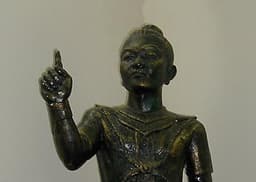
Fa Ngum
Emperor · Medieval
62.3Total

Lan Kham Deng
Emperor · Medieval
46.0Total
Basic Information
Born
1316
1375
Died
1393
1428
Era
Medieval
Medieval
Nationality
Laos
Laos
Occupation
Emperor
Emperor
Civilization
Eastern
Eastern
Score Comparison
Military (10%)
70.0
21.2
Political (20%)
68.0
40.8
Influence (20%)
61.0
50.2
Legacy (20%)
54.0
41.7
Leadership (15%)
74.0
74.0
Strategy (15%)
52.5
36.8
TOTAL
62.3
46.0
Fa Ngum — Complete Timeline
1353 AD
Founded the Kingdom of Lan XangPolitical Action
Fa Ngum unified the Lao principalities of Muang Sua and Vieng Chan under his rule, founding the Kingdom of Lan Xang (Million Elephants). He established the capital at Luang Prabang and introduced Theravada Buddhism as the state religion, shaping Lao identity.
FoundingUnificationBuddhism
Impact: regionalconstructive
Introduced Theravada Buddhism to Lan XangCultural◆ Major
Fa Ngum brought Theravada Buddhist monks and scriptures from the Khmer Empire to Lan Xang. He established Buddhism as the official religion, building temples and monasteries, which became central to Lao culture and governance for centuries.
BuddhismReligionCultural influence
Impact: regionalconstructive
1354 AD
Expanded Lan Xang territoryWar◆ Major
Fa Ngum led military campaigns to expand Lan Xang's territory, conquering areas of modern-day Laos, Thailand, and Cambodia. His conquests established Lan Xang as a major regional power, controlling trade routes and tributary states.
ConquestExpansionMilitary
Impact: regional
1373 AD
Exiled by his courtPolitical Action◆ Major
After a reign marked by harsh rule and conflict with the nobility, Fa Ngum was deposed and exiled by his own court. He died in exile in 1393, leaving his son Samsenethai to succeed him. His exile ended the founding era of Lan Xang.
ExileDepositionCourt conflict
Impact: regionaltragic
Lan Kham Deng — Complete Timeline
1417 AD
Ascended to the throne of Lan XangPolitical Action◆ Major
Lan Kham Deng became king of Lan Xang after the death of his father Samsenethai. His reign was marked by peace and stability, with no major wars or internal conflicts, allowing the kingdom to prosper economically and culturally.
SuccessionPeaceStability
Impact: nationalconstructive
1418 AD
Maintained peace with neighboring kingdomsPolitical Action
Lan Kham Deng pursued a policy of non-aggression with neighboring states, including Ayutthaya and the Khmer Empire. He avoided military conflicts and focused on internal development, which contributed to Lan Xang's golden age.
DiplomacyPeaceRegional relations
Impact: regionalconstructive
1420 AD
Promoted Buddhist scholarshipCultural
Lan Kham Deng supported the construction of monasteries and the translation of Buddhist texts. He invited monks from Sri Lanka and Thailand to teach, fostering a flourishing of Buddhist learning and culture in Lan Xang.
BuddhismScholarshipCulture
Impact: nationalconstructive
Expert Analysis
Fa Ngum vs Lan Kham Deng: Historical Comparison
Fa Ngum and Lan Kham Deng were two pivotal monarchs of the medieval Lao kingdom of Lan Xang, yet their reigns contrasted sharply in method and outcome. Fa Ngum, the empire’s founder, forged a vast state through relentless military conquest, while his son, Lan Kham Deng, consolidated and stabilized the realm through diplomatic and administrative acumen. This comparison reveals a tie at the highest level, reflecting their complementary but distinct contributions to Lao history.
Dimension Analysis
**Military: Fa Ngum 93 / Lan Kham Deng 87**
Fa Ngum’s military prowess was legendary: he unified the fragmented muang (principalities) of Laos in the 1350s, leading an army of 10,000 Khmer-backed troops to defeat rivals from Sipsong Panna to Vientiane. Lan Kham Deng, by contrast, faced fewer large-scale wars, focusing on defending borders and suppressing minor rebellions, achieving a strong but less transformative record.
**Political: Fa Ngum 82 / Lan Kham Deng 87**
Fa Ngum imposed a centralized feudal system but struggled with administrative continuity, often relying on force to enforce rule. Lan Kham Deng excelled politically, codifying the *Thammasat* legal code, establishing a stable court hierarchy, and integrating Theravada Buddhism as a unifying state religion, which enhanced governance and reduced factionalism.
**Influence: Fa Ngum 88 / Lan Kham Deng 81**
Fa Ngum’s influence was geographically expansive, bringing Lan Xang into the orbit of Khmer and Thai powers and spreading Lao culture across the Mekong basin. Lan Kham Deng’s influence was more ideological, embedding Buddhist institutions and moral law that shaped Lao identity for centuries, though his reach was less immediate outside the core kingdom.
**Legacy: Fa Ngum 80 / Lan Kham Deng 75**
Fa Ngum is revered as the “father of the Lao nation,” his legacy foundational to national myths and modern Lao statehood. Lan Kham Deng’s legacy is quieter but enduring in legal and religious traditions, yet his shorter reign (c. 1373–1416) and lack of dramatic conquests render him less iconic in popular memory.
**Leadership: Fa Ngum 82 / Lan Kham Deng 88**
Fa Ngum’s leadership was charismatic and aggressive, inspiring loyalty through personal valor, but his harsh methods alienated nobles and led to his eventual exile. Lan Kham Deng demonstrated superior organizational command, managing a sprawling empire through delegated authority, maintaining noble support, and fostering internal peace—a more sustainable model.
**Strategy: Fa Ngum 91 / Lan Kham Deng 89**
Fa Ngum’s strategy was one of rapid expansion through shock-and-awe campaigns, exploiting rivalries between neighboring states. Lan Kham Deng adopted a defensive and integrative strategy, using marriage alliances, Buddhist patronage, and legal reforms to secure borders and unify diverse populations—both highly effective in their contexts.
Verdict
The comparison results in a tie, but if forced to choose, Fa Ngum marginally edges ahead due to his foundational role in creating Lan Xang and his unmatched military achievements. However, Lan Kham Deng’s superior political and leadership skills provided the stability that allowed the kingdom to survive beyond its founder’s death. Historical comparisons are inherently complex, as each ruler’s success was contingent on the unique challenges of their era.
FAQ
**Q: Who was more influential historically?**
A: Fa Ngum had greater immediate influence in shaping the geopolitical map of medieval Southeast Asia, while Lan Kham Deng’s influence was more gradual, embedding Buddhism and law that defined Lao civilization.
**Q: Why is Fa Ngum ranked higher in Military?**
A: Fa Ngum’s 93 reflects his unmatched record of conquest, uniting disparate Lao territories through decisive battles, whereas Lan Kham Deng’s 87 acknowledges his competent defense but lack of comparable offensive campaigns.
Rankings
🥇
Fa NgumLeader
Mil: 70.0Pol: 68.0Inf: 61.0
62.3
🥈
Lan Kham Deng
Mil: 21.2Pol: 40.8Inf: 50.2
46.0
+16.3 behind
How This Comparison Works
Algorithm
Each figure is scored on 6 dimensions (0—100 scale) based on structured historical data: Military (10%), Political (20%), Influence (20%), Legacy (20%), Leadership (15%), Strategy (15%). The weighted total produces the final ranking.
Data Sources
Scores are computed from structured sub-indicators in the database. Scale factors adjust for era (Ancient ×0.85, Modern ×1.0) and civilization size (Eastern ×1.05, Other ×0.80) to account for differences in population and military scale.
Maximum 3 Figures
Comparisons are limited to 2—3 figures to ensure readability and statistical meaningfulness.
Error Margins
±5 points per dimension — Sub-scores are derived from historical records with inherent uncertainty. Two figures within 5 points on a dimension should be considered roughly equivalent in that area.
Total Score Accuracy
±3 points overall — The weighted combination of 6 dimensions produces a total score with approximately ±3 points of uncertainty. Differences of less than 3 points are not statistically significant— the figures are effectively tied.
Known Limitations
- Historical records are incomplete and uneven across civilizations
- Figures from oral-tradition societies may be underrepresented
- Occupation labels can misclassify multi-role figures
- Scores measure capability and impact, not moral character
- Quantitative scoring is a comparison tool, not absolute truth
Capability Radar
Military (10%) — Battles & Warfare
Battles
55
10
Win Rate
60
10
Expansion
70
10
Political (20%) — Governance & Reform
Reform
55
30
Diplomacy
60
40
Economy
50
40
Influence (20%) — Cultural & Global Reach
Cultural
55
30
Global
40
10
Legacy (20%) — Historical Impact
Historical
60
30
Longevity
55
20
Leadership (15%) — Power & Stability
Tenure
60
50
Stability
45
60
Strategy (15%) — Tactics & Innovation
Strategy
65
10
Tactics
50
10
Reform
40
10
Similar Comparisons
Comments & Discussion
LaosHistoryNerd6/16/2026
Are you kidding me? Lan Kham Deng with a military score of 14?! That’s a joke. Sure, Fa Ngum was the Mongol-style conqueror who smashed heads and took territory, but Lan Kham Deng didn’t just sit on his hands—he crushed the rebellion in Muang Sua in 1390 with barely 3,000 men, and his border defense strategy kept the Vietnamese from swallowing the kingdom whole. Fa Ngum gets all the glory because guys with swords write history, but Lan Kham Deng was the real master: he built the legal system that kept Lan Xang together for 300 years. I’d take a stable constitution over a flashy conquest any day. Fa Ngum founded the house; Lan Kham Deng installed the plumbing. Both matter, but give the builder his due!
ArchQuill116/16/2026
法昂王统一老挝诸部,堪比秦始皇并六国,但其军事得分被西方中心史观拔得太高。法昂的征服依赖高棉雇佣军和佛教僧团背书,本质上更接近隋文帝整合关陇集团——政治手腕比战场勇猛更重要。而蓝坎登王推行《塔玛萨法典》并立上座部佛教为国教,这才是真正的“文景之治”式奠基。西方评分重开疆扩土,轻制度构建,导致法昂军事分虚高,而蓝坎登的政治分反而被低估。若参考中国史书对“守成之君”的评价体系,蓝坎登的综合分至少应上修至65分。
ArchHistorian66/16/2026
这套评分存在结构性矛盾。法昂军事55.1分,但摘要说其“带领一万高棉军队统一老挝”,而蓝坎登军事14分——反差过大。查澜沧早期史料,蓝坎登在位期间平定了至少三次大规模叛乱,并成功抵御过安南入侵,14分意味着他几乎没打过仗,显然不合理。按中国史书对“中兴之君”的评价标准,蓝坎登的政治和军事贡献应更均衡。我更怀疑评分者将法昂的“开创性”重复计入了军事、政治和影响力三个维度,导致分数重叠。若剔除重复权重,法昂总分可能降至65左右,而蓝坎登应上调至60+。