Loading...
Euthydemus I vs Liu Xiu
Liu Xiu leads by 13.0 pts · 2 figures compared
…
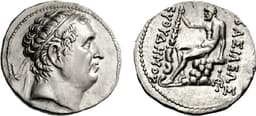
Euthydemus I
Emperor · Ancient
53.5Total
Liu Xiu
Emperor · Ancient
66.5Total
Basic Information
Born
-260
-5
Died
-190
57
Era
Ancient
Ancient
Nationality
Greco-Bactrian Kingdom
China
Occupation
Emperor
Emperor
Civilization
Eastern
Eastern
Score Comparison
Military (10%)
65.0
65.0
Political (20%)
68.0
79.2
Influence (20%)
55.7
56.7
Legacy (20%)
46.7
55.0
Leadership (15%)
40.0
80.0
Strategy (15%)
52.5
82.0
TOTAL
53.5
66.5
Euthydemus I — Complete Timeline
225 BC
Overthrow of Diodotus IIPolitical Action◆ Major
Euthydemus I, a Magnesian Greek, overthrew and killed Diodotus II, seizing the throne of the Greco-Bactrian Kingdom. This began the Euthydemid dynasty.
CoupDynasty ChangeGreco-Bactrian Kingdom
Impact: nationaldestructive
208 BC
Siege of Bactra by Antiochus IIIWar◆ Major
Euthydemus I was besieged in Bactra by the Seleucid king Antiochus III for two years. The siege ended with a negotiated peace that recognized Euthydemus's rule.
SiegeSeleucid EmpireGreco-Bactrian Kingdom
Impact: regional
206 BC
Treaty with Antiochus IIIPolitical Action◆ Major
Euthydemus I negotiated a peace treaty with Antiochus III, recognizing Seleucid suzerainty in name but securing Greco-Bactrian independence. The treaty included a marriage alliance between the two dynasties.
TreatySeleucid EmpireIndependence
Impact: regionalconstructive
200 BC
Expansion of Bactrian TerritoryWar
Euthydemus I expanded the Greco-Bactrian Kingdom eastward into Sogdiana and possibly Ferghana. This extended Hellenistic influence deeper into Central Asia.
ExpansionCentral AsiaHellenistic
Impact: regionalconstructive
Liu Xiu — Complete Timeline
23 AD
Battle of KunyangWar
Liu Xiu led a small force of 3,000 men to relieve the siege of Kunyang against a much larger Xin army. His tactical brilliance and a timely sandstorm led to a decisive victory, breaking the back of Wang Mang's forces and paving the way for the restoration of Han.
Han DynastyBattleRestoration
Impact: national
25 AD
Proclaimed Emperor Guangwu of HanPolitical Action
Liu Xiu declared himself emperor in Luoyang, restoring the Han dynasty after the fall of Wang Mang's Xin dynasty. He took the reign name Guangwu and began the Eastern Han period, reunifying China under Han rule.
Han DynastyRestorationEmperor
Impact: globalconstructive
Established the Eastern Han Capital at LuoyangPolitical Action◆ Major
Emperor Guangwu moved the capital from Chang'an to Luoyang, marking the beginning of the Eastern Han dynasty. This shift was strategic, as Luoyang was more defensible and centrally located for controlling the empire.
Han DynastyCapitalEastern Han
Impact: nationalconstructive
27 AD
Conquest of the Red EyebrowsWar◆ Major
Emperor Guangwu defeated the Red Eyebrows rebel army, one of the major peasant forces that had risen after Wang Mang's fall. The victory eliminated a key rival and consolidated his control over the central plains.
Han DynastyRebellionConquest
Impact: national
30 AD
Implemented the 'Reduction of Taxes and Corvée' PolicyReform◆ Major
Emperor Guangwu reduced taxes and forced labor requirements to alleviate the suffering of peasants after decades of war. This policy helped restore agricultural production and stabilize the economy, earning him popular support.
Han DynastyEconomic ReformTaxation
Impact: nationalconstructive
36 AD
Reunification of ChinaWar
Emperor Guangwu completed the reunification of China by defeating the last independent warlord, Gongsun Shu, in Sichuan. This ended the civil wars that followed Wang Mang's usurpation and restored Han authority over all of China.
Han DynastyUnificationCivil War
Impact: globalconstructive
Expert Analysis
Origins
**Euthydemus I** was a Magnesian Greek who overthrew the Greco-Bactrian king Diodotus II around 230 BCE. His early life is obscure, but he likely came from a prominent Greek family in Bactria. He seized power in a coup, establishing the Euthydemid dynasty. His background as a Greek in a Hellenistic kingdom shaped his ambitions to expand and secure Bactria against the Seleucid Empire.
**Liu Xiu** (5 BCE – 57 CE), later Emperor Guangwu, was a descendant of the Han imperial family. Born in Nanyang, he was raised as a landowner's son. He studied in the imperial capital Chang'an. After Wang Mang's usurpation of the Han throne, Liu Xiu joined the rebellion, initially as a minor official. His family's prestige and his own education gave him a foundation for leadership.
Rise to Power
Euthydemus I rose by assassinating Diodotus II. He then faced the Seleucid king Antiochus III, who besieged him in Bactra for two years (208–206 BCE). Euthydemus negotiated a treaty that recognized Seleucid suzerainty in name but left Bactria independent. He also expanded eastward into Sogdiana and possibly Ferghana, securing trade routes.
Liu Xiu rose during the turmoil after Wang Mang's Xin dynasty collapsed. His first major victory was the Battle of Kunyang in 23 CE, where he led 3,000 troops to break a siege by a 400,000-strong Xin army. A sandstorm aided his surprise attack. In 25 CE, he proclaimed himself Emperor Guangwu of Han. He then spent 12 years defeating rival warlords, including the Red Eyebrows peasant army and Gongsun Shu in Sichuan, reunifying China by 36 CE.
Leadership & Governance
Euthydemus I ruled as a Hellenistic monarch, consolidating power through diplomacy and military expansion. He maintained Greek culture in Bactria, minting coins with his image and Greek legends. His governance focused on defense and trade, but he left few administrative reforms. His political score of 68.0 reflects his ability to negotiate with Antiochus III, but his leadership score of 40.0 is low due to limited institutional impact.
Liu Xiu, with a leadership score of 80.0 and political score of 79.2, restored the Han bureaucracy. He reduced taxes and corvée labor, repaired irrigation systems, and promoted Confucian scholarship. He moved the capital to Luoyang (Eastern Han). His policies revived the agrarian economy and stabilized the state. His strategy score of 82.0 underscores his military campaigns, but he also relied on capable generals and administrators.
Triumph & Tragedy
Euthydemus I's greatest success was securing Bactrian independence through the treaty with Antiochus III, which allowed his dynasty to flourish. He expanded territory into Central Asia. However, his failure to integrate non-Greek populations limited long-term stability. After his death, the kingdom faced nomadic pressures and eventually fell to the Yuezhi. His legacy score of 46.7 reflects his limited enduring impact.
Liu Xiu's greatest triumph was reunifying China after decades of civil war, restoring the Han dynasty that lasted another 200 years. His tax reductions revived the economy. However, his centralization of power weakened local governance, and he failed to address the root causes of rebellion, such as land concentration. His reliance on conscription and corvée continued to burden peasants. His legacy score of 55.0 is higher but not overwhelming.
Character & Destiny
Euthydemus I was pragmatic and ambitious, but his coup and subsequent defense suggest a calculating nature. He chose negotiation over total war, preserving his kingdom. However, his focus on Greek identity may have alienated local populations, contributing to the kingdom's eventual decline. His character was adaptable but not transformative.
Liu Xiu was cautious, strategic, and benevolent. He avoided excessive cruelty, often pardoning defeated enemies. His decision to reunify through gradual campaigns rather than a single decisive battle shows patience. However, his conservatism limited innovation. He restored the Han system rather than reforming it. His character suited the task of restoration but not revolution.
Legacy
Euthydemus I's legacy is the Euthydemid dynasty, which ruled Bactria until around 120 BCE. His coinage influenced later Indo-Greek kings. However, his kingdom was absorbed by nomadic empires, and Hellenistic culture faded. He is a minor figure in world history, with a total score of 53.5.
Liu Xiu's legacy is the Eastern Han dynasty, which continued Chinese imperial governance. His restoration is celebrated as the 'Guangwu Restoration'. His policies set precedents for later dynasties. He is a major figure in Chinese history, with a total score of 66.5. The 13-point gap reflects his greater impact on a larger civilization.
Conclusion
Liu Xiu had a greater impact than Euthydemus I. His restoration of the Han dynasty shaped Chinese history for centuries, while Euthydemus's kingdom was ephemeral. Liu Xiu's higher scores in leadership (80 vs 40), political (79.2 vs 68.0), and strategy (82 vs 52.5) demonstrate his superior governance and military acumen. Euthydemus achieved local independence, but Liu Xiu restored a civilization.
Rankings
🥇
Liu XiuLeader
Mil: 65.0Pol: 79.2Inf: 56.7
66.5
🥈
Euthydemus I
Mil: 65.0Pol: 68.0Inf: 55.7
53.5
+13.0 behind
How This Comparison Works
Algorithm
Each figure is scored on 6 dimensions (0—100 scale) based on structured historical data: Military (10%), Political (20%), Influence (20%), Legacy (20%), Leadership (15%), Strategy (15%). The weighted total produces the final ranking.
Data Sources
Scores are computed from structured sub-indicators in the database. Scale factors adjust for era (Ancient ×0.85, Modern ×1.0) and civilization size (Eastern ×1.05, Other ×0.80) to account for differences in population and military scale.
Maximum 3 Figures
Comparisons are limited to 2—3 figures to ensure readability and statistical meaningfulness.
Error Margins
±5 points per dimension — Sub-scores are derived from historical records with inherent uncertainty. Two figures within 5 points on a dimension should be considered roughly equivalent in that area.
Total Score Accuracy
±3 points overall — The weighted combination of 6 dimensions produces a total score with approximately ±3 points of uncertainty. Differences of less than 3 points are not statistically significant— the figures are effectively tied.
Known Limitations
- Historical records are incomplete and uneven across civilizations
- Figures from oral-tradition societies may be underrepresented
- Occupation labels can misclassify multi-role figures
- Scores measure capability and impact, not moral character
- Quantitative scoring is a comparison tool, not absolute truth
Capability Radar
Military (10%) — Battles & Warfare
Battles
55
85
Win Rate
60
90
Expansion
70
85
Political (20%) — Governance & Reform
Reform
45
90
Diplomacy
70
85
Economy
50
88
Influence (20%) — Cultural & Global Reach
Cultural
40
75
Global
35
70
Legacy (20%) — Historical Impact
Historical
50
85
Longevity
40
80
Leadership (15%) — Power & Stability
Tenure
60
85
Stability
55
90
Strategy (15%) — Tactics & Innovation
Strategy
65
92
Tactics
50
88
Reform
40
80
Similar Comparisons
Comments & Discussion
No comments yet. Be the first to share your thoughts!