Loading...
This comparison has not been analyzed yet.
One-time AI generation (~1 minute). Scores and timeline are already available below.
Euric vs Menander I
Menander I leads by 5.4 pts · 2 figures compared
…
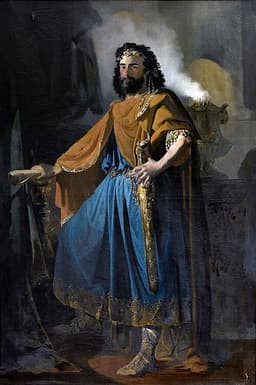
Euric
Emperor · Ancient
52.9Total

Menander I
Emperor · Ancient
58.3Total
Basic Information
Born
415
-180
Died
484
-130
Era
Ancient
Ancient
Nationality
Visigothic Kingdom
Indo-Greek Kingdom
Occupation
Emperor
Emperor
Civilization
Western
Indian
Score Comparison
Military (10%)
47.5
67.3
Political (20%)
68.0
68.0
Influence (20%)
56.4
61.0
Legacy (20%)
48.3
54.0
Leadership (15%)
40.0
40.0
Strategy (15%)
57.5
66.3
TOTAL
52.9
58.3
Euric — Complete Timeline
466 AD
Accession as Visigothic KingPolitical Action◆ Major
Euric became king of the Visigoths after assassinating his brother Theodoric II. His reign marked the beginning of Visigothic expansion and independence from the Western Roman Empire, as he consolidated power in Gaul and Hispania.
Visigothic KingdomSuccessionExpansion
Impact: regional
475 AD
Conquest of AuvergneWar◆ Major
Euric's forces besieged and captured the city of Clermont in Auvergne, a key stronghold of the Gallo-Roman aristocracy. This conquest extended Visigothic control over much of southern Gaul, weakening the remaining Roman authority in the region.
Visigothic KingdomConquestGaul
Impact: regional
Codification of the Code of EuricReform
Euric issued the Code of Euric, the first written law code of the Germanic peoples. It compiled Roman and Germanic legal traditions, governing both Visigoths and Romans in his kingdom. This code influenced later Visigothic legislation and legal development in early medieval Europe.
Visigothic KingdomLaw CodeLegal History
Impact: regionalconstructive
476 AD
Treaty with the Eastern Roman EmpirePolitical Action◆ Major
Euric negotiated a treaty with the Eastern Roman Emperor Zeno, which recognized Visigothic control over most of Gaul and Hispania. This formalized the Visigothic Kingdom as an independent state, ending any nominal allegiance to the Roman Empire.
Visigothic KingdomDiplomacyIndependence
Impact: regionalconstructive
Menander I — Complete Timeline
160 BC
Expansion of the Indo-Greek KingdomWar◆ Major
Menander I expanded the Indo-Greek Kingdom eastward into the Ganges River valley, possibly reaching as far as Pataliputra. This was the greatest territorial extent of the Indo-Greeks.
ExpansionIndiaIndo-Greek Kingdom
Impact: regional
150 BC
Conversion to BuddhismCultural◆ Major
Menander I converted to Buddhism, as recorded in the Buddhist text Milindapanha. He engaged in philosophical dialogues with the monk Nagasena, becoming a patron of Buddhism.
ConversionBuddhismGreco-Buddhist
Impact: regionalprogressive
Patronage of BuddhismCultural
Menander I supported the construction of Buddhist stupas and monasteries. His reign saw the flourishing of Greco-Buddhist art, blending Greek and Indian artistic traditions.
PatronageBuddhismArt
Impact: regionalconstructive
130 BC
Death in BattleWar◆ Major
Menander I died in a military campaign, according to some accounts. His death led to the fragmentation of the Indo-Greek Kingdom into smaller successor states.
DeathBattleIndo-Greek Kingdom
Impact: regionaltragic
This comparison has not been analyzed yet.
One-time AI generation (~1 minute). Scores and timeline are already available below.
Rankings
🥇
Menander ILeader
Mil: 67.3Pol: 68.0Inf: 61.0
58.3
🥈
Euric
Mil: 47.5Pol: 68.0Inf: 56.4
52.9
+5.4 behind
How This Comparison Works
Algorithm
Each figure is scored on 6 dimensions (0—100 scale) based on structured historical data: Military (10%), Political (20%), Influence (20%), Legacy (20%), Leadership (15%), Strategy (15%). The weighted total produces the final ranking.
Data Sources
Scores are computed from structured sub-indicators in the database. Scale factors adjust for era (Ancient ×0.85, Modern ×1.0) and civilization size (Eastern ×1.05, Other ×0.80) to account for differences in population and military scale.
Maximum 3 Figures
Comparisons are limited to 2—3 figures to ensure readability and statistical meaningfulness.
Error Margins
±5 points per dimension — Sub-scores are derived from historical records with inherent uncertainty. Two figures within 5 points on a dimension should be considered roughly equivalent in that area.
Total Score Accuracy
±3 points overall — The weighted combination of 6 dimensions produces a total score with approximately ±3 points of uncertainty. Differences of less than 3 points are not statistically significant— the figures are effectively tied.
Known Limitations
- Historical records are incomplete and uneven across civilizations
- Figures from oral-tradition societies may be underrepresented
- Occupation labels can misclassify multi-role figures
- Scores measure capability and impact, not moral character
- Quantitative scoring is a comparison tool, not absolute truth
Capability Radar
Military (10%) — Battles & Warfare
Battles
45
65
Win Rate
50
70
Expansion
50
70
Political (20%) — Governance & Reform
Reform
75
55
Diplomacy
55
65
Economy
50
60
Influence (20%) — Cultural & Global Reach
Cultural
55
70
Global
45
55
Legacy (20%) — Historical Impact
Historical
60
65
Longevity
50
60
Leadership (15%) — Power & Stability
Tenure
60
60
Stability
55
55
Strategy (15%) — Tactics & Innovation
Strategy
50
65
Tactics
40
60
Reform
55
50
Similar Comparisons
Comments & Discussion
No comments yet. Be the first to share your thoughts!