Loading...
Euric vs Julius Caesar
Julius Caesar leads by 29.9 pts · 2 figures compared
…
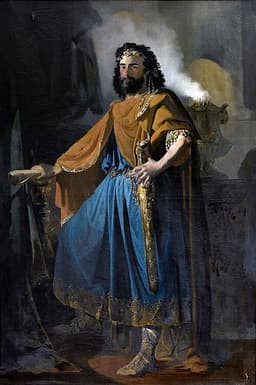
Euric
Emperor · Ancient
52.9Total

Julius Caesar
General · Ancient
82.8Total
Basic Information
Born
415
-100
Died
484
-44
Era
Ancient
Ancient
Nationality
Visigothic Kingdom
Roman Republic
Occupation
Emperor
General
Civilization
Western
Western
Score Comparison
Military (10%)
47.5
88.0
Political (20%)
68.0
78.0
Influence (20%)
56.4
85.0
Legacy (20%)
48.3
82.0
Leadership (15%)
40.0
80.0
Strategy (15%)
57.5
85.0
TOTAL
52.9
82.8
Euric — Complete Timeline
466 AD
Accession as Visigothic KingPolitical Action◆ Major
Euric became king of the Visigoths after assassinating his brother Theodoric II. His reign marked the beginning of Visigothic expansion and independence from the Western Roman Empire, as he consolidated power in Gaul and Hispania.
Visigothic KingdomSuccessionExpansion
Impact: regional
475 AD
Conquest of AuvergneWar◆ Major
Euric's forces besieged and captured the city of Clermont in Auvergne, a key stronghold of the Gallo-Roman aristocracy. This conquest extended Visigothic control over much of southern Gaul, weakening the remaining Roman authority in the region.
Visigothic KingdomConquestGaul
Impact: regional
Codification of the Code of EuricReform
Euric issued the Code of Euric, the first written law code of the Germanic peoples. It compiled Roman and Germanic legal traditions, governing both Visigoths and Romans in his kingdom. This code influenced later Visigothic legislation and legal development in early medieval Europe.
Visigothic KingdomLaw CodeLegal History
Impact: regionalconstructive
476 AD
Treaty with the Eastern Roman EmpirePolitical Action◆ Major
Euric negotiated a treaty with the Eastern Roman Emperor Zeno, which recognized Visigothic control over most of Gaul and Hispania. This formalized the Visigothic Kingdom as an independent state, ending any nominal allegiance to the Roman Empire.
Visigothic KingdomDiplomacyIndependence
Impact: regionalconstructive
Julius Caesar — Complete Timeline
58 BC
Gallic WarsWar◆ Major
Caesar, as proconsul of Gaul, launched a series of campaigns that conquered all of Gaul (modern France, Belgium, and parts of Switzerland). He fought numerous battles, including against the Helvetii, the Belgae, and the Gallic chieftain Vercingetorix. The wars brought immense wealth and a loyal army to Caesar.
Gallic WarsConquestRoman Expansion
Impact: regional
49 BC
Crossing the RubiconPolitical Action◆ Major
Caesar led Legio XIII across the Rubicon River into Italy, defying the Roman Senate's order to disband his army. This act triggered a civil war against Pompey and the Optimates, ultimately leading to Caesar's dictatorship and the end of the Roman Republic.
Roman Civil WarEnd of RepublicPower Struggle
Impact: global
48 BC
Battle of PharsalusWar◆ Major
Caesar's outnumbered army defeated the larger forces of Pompey the Great at Pharsalus in Greece. Caesar's tactical use of a reserve line to counter Pompey's cavalry charge proved decisive. Pompey fled to Egypt, where he was assassinated, leaving Caesar as the undisputed master of the Roman world.
Roman Civil WarBattleDecisive Victory
Impact: regional
44 BC
Appointment as Dictator for LifePolitical Action◆ Major
The Roman Senate appointed Caesar dictator perpetuo (dictator for life), granting him unprecedented personal power. This move concentrated military, legislative, and judicial authority in one person, effectively ending the Roman Republic's traditional system of checks and balances and alarming many senators.
DictatorshipEnd of RepublicPower Consolidation
Impact: regionaldestructive
Assassination on the Ides of MarchPolitical Action◆ Major
A group of Roman senators, led by Marcus Junius Brutus and Gaius Cassius Longinus, stabbed Caesar to death at a meeting of the Senate in the Theatre of Pompey. The assassination was intended to restore the Republic, but instead triggered another civil war that led to the rise of the Roman Empire.
AssassinationRoman PoliticsEnd of Republic
Impact: globaldestructive
Expert Analysis
euric-vs-julius-caesar
# The Dictator and the Lawgiver: Why Caesar Fell and Euric Endured
On the Ides of March, 44 BCE, Julius Caesar fell beneath the daggers of sixty senators, his blood pooling on the floor of the Pompeian Senate House. Four centuries later, in 484 CE, King Euric of the Visigoths died in his bed in Toulouse, his kingdom intact and his laws already spreading across Gaul and Spain. Both men seized power through violence. Both transformed the world they inherited. Yet one perished at the hands of his own elite, while the other passed his crown to his son. The difference lies not in their ambition—both were ruthless—but in how they understood the nature of power itself.
Origins
Caesar was born into the twilight of the Roman Republic, a world of aristocratic competition where glory was measured in triumphs and provinces. His family, the Julii, claimed descent from the goddess Venus, but they were politically marginal. Caesar’s father died when he was sixteen, leaving him to navigate a system where success required not just military skill but a network of debts, alliances, and carefully cultivated public image. He learned early that in Rome, appearances were everything.
Euric was born in a very different world. The Visigoths were a wandering people, a tribe forged in the chaos of the Hunnic invasions. They had sacked Rome itself in 410, then settled in southwestern Gaul as foederati—allies, technically, of the empire they had helped dismantle. Euric’s brother Theodoric II ruled before him, and when Euric decided to take the throne, he did so directly: he assassinated Theodoric in 466. There was no pretense of legality, no appeal to ancestral rights. Among the Visigoths, power was what you could take and hold.
Rise to Power
Caesar’s rise was a masterpiece of political calculation. He allied with Pompey and Crassus in the First Triumvirate, won command in Gaul, and spent eight years conquering a territory that made him fabulously wealthy and dangerously popular. When the Senate ordered him to disband his army, he crossed the Rubicon—a river that was also a line in the sand. The civil war that followed was not a tribal feud but a constitutional crisis. Caesar defeated Pompey, pursued him to Egypt, and returned to Rome as dictator.
Euric’s path was simpler. He killed his brother, took the throne, and immediately began expanding Visigothic territory. He did not need to justify his rule to a Senate or a people accustomed to republican traditions. His authority was personal, tribal, and absolute. Where Caesar had to manage a complex system of competing interests, Euric had only to prove that he could win battles and keep his warriors fed.
Leadership & Governance
Caesar’s genius was strategic and political. He conquered Gaul with a combination of speed, discipline, and calculated brutality—his siege of Alesia in 52 BCE remains a textbook example of military engineering. But he also reformed the calendar, extended citizenship to provincials, and began massive public works. He understood that Rome’s empire could not be governed by a city-state’s institutions. His reforms were visionary, but they threatened the senatorial class that had built its power on those very institutions.
Euric’s leadership was of a different kind. His military record is modest—the conquest of Auvergne in 475 was a siege, not a campaign against Hannibal. His true achievement was legal. In 475, he issued the Code of Euric, the first written law code of any Germanic people. It blended Roman legal principles with Gothic custom, creating a framework that allowed Romans and Goths to coexist under a single rule. This was not the work of a philosopher-king but of a practical ruler who understood that conquest alone could not hold a kingdom together. Where Caesar tried to reshape Rome’s ancient constitution, Euric gave his subjects something they had never had: clear, written law.
Triumph & Tragedy
Caesar’s greatest moment was also the seed of his destruction. After defeating his last rivals, he was declared dictator for life. He began to dress in royal purple, put his image on coins, and accept divine honors. Whether he actually wanted to be king is debated, but the perception was enough. On the Ides of March, a conspiracy of senators—many of them his former allies—stabbed him to death. His tragedy was that he had won everything except the trust of the class he needed to govern.
Euric’s triumph was quieter but more lasting. In 476, the same year the last Western Roman emperor was deposed, Euric negotiated a treaty with Emperor Zeno in Constantinople. The treaty recognized Visigothic control over most of Gaul and Spain. Euric had turned a tribal kingdom into a recognized state. He died eight years later, not at the hands of assassins, but in his own bed. His son Alaric II succeeded him peacefully.
Character & Destiny
Caesar was a gambler. He crossed the Rubicon, disbanded his bodyguard, and walked unarmed into the Senate. He believed that his personal brilliance and popularity would protect him. He was wrong. His character—daring, charismatic, contemptuous of enemies he considered inferior—drove him to take risks that killed him.
Euric was a builder. He did not seek glory in the Roman sense; he sought stability. He codified laws, secured borders, and negotiated peace with the empire he had once fought. His character was cautious and pragmatic. He knew that a kingdom held by force alone would collapse when the strongman died. He built institutions that could survive him.
Legacy
Caesar’s legacy is everywhere and nowhere. His name became a title—Kaiser, Tsar—but the Republic he tried to reform died with him. The empire that followed was his creation in form but not in spirit. He is remembered as a genius and a tyrant, a man whose ambition destroyed a thousand-year-old system.
Euric is barely remembered at all. But his Code of Euric influenced the legal traditions of medieval Europe. The Visigothic kingdom he built survived for another two centuries, until the Muslim conquest of Spain. He gave his people something they had never had: a written identity, a rule of law that outlasted any single ruler.
Conclusion
Caesar and Euric faced the same fundamental problem: how to hold power in a world of violence and ambition. Caesar tried to transform a republic into a monarchy by force of personality. He failed, and his failure became a legend. Euric tried to transform a tribe into a kingdom by force of law. He succeeded, and his success became invisible. Perhaps that is the deepest lesson. The men who change the world most profoundly are not always the ones who die dramatically. Sometimes they are the ones who die quietly, leaving behind not a story but a system.
Rankings
🥇
Julius CaesarLeader
Mil: 88.0Pol: 78.0Inf: 85.0
82.8
🥈
Euric
Mil: 47.5Pol: 68.0Inf: 56.4
52.9
+29.9 behind
How This Comparison Works
Algorithm
Each figure is scored on 6 dimensions (0—100 scale) based on structured historical data: Military (10%), Political (20%), Influence (20%), Legacy (20%), Leadership (15%), Strategy (15%). The weighted total produces the final ranking.
Data Sources
Scores are computed from structured sub-indicators in the database. Scale factors adjust for era (Ancient ×0.85, Modern ×1.0) and civilization size (Eastern ×1.05, Other ×0.80) to account for differences in population and military scale.
Maximum 3 Figures
Comparisons are limited to 2—3 figures to ensure readability and statistical meaningfulness.
Error Margins
±5 points per dimension — Sub-scores are derived from historical records with inherent uncertainty. Two figures within 5 points on a dimension should be considered roughly equivalent in that area.
Total Score Accuracy
±3 points overall — The weighted combination of 6 dimensions produces a total score with approximately ±3 points of uncertainty. Differences of less than 3 points are not statistically significant— the figures are effectively tied.
Known Limitations
- Historical records are incomplete and uneven across civilizations
- Figures from oral-tradition societies may be underrepresented
- Occupation labels can misclassify multi-role figures
- Scores measure capability and impact, not moral character
- Quantitative scoring is a comparison tool, not absolute truth
Capability Radar
Military (10%) — Battles & Warfare
Battles
45
95
Win Rate
50
92
Expansion
50
97
Political (20%) — Governance & Reform
Reform
75
90
Diplomacy
55
85
Economy
50
82
Influence (20%) — Cultural & Global Reach
Cultural
55
88
Global
45
94
Legacy (20%) — Historical Impact
Historical
60
95
Longevity
50
96
Leadership (15%) — Power & Stability
Tenure
60
75
Stability
55
60
Strategy (15%) — Tactics & Innovation
Strategy
50
94
Tactics
40
96
Reform
55
88
Similar Comparisons
Comments & Discussion
No comments yet. Be the first to share your thoughts!