Loading...
Erich Ludendorff vs Julius Caesar
Julius Caesar leads by 25.6 pts · 2 figures compared
…
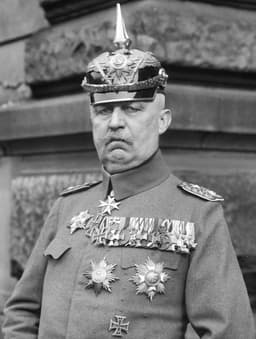
Erich Ludendorff
General · Modern
57.2Total

Julius Caesar
General · Ancient
82.8Total
Basic Information
Born
1865
-100
Died
1937
-44
Era
Modern
Ancient
Nationality
Germany
Roman Republic
Occupation
General
General
Civilization
Western
Western
Score Comparison
Military (10%)
80.0
88.0
Political (20%)
35.1
78.0
Influence (20%)
55.0
85.0
Legacy (20%)
52.0
82.0
Leadership (15%)
68.0
80.0
Strategy (15%)
70.0
85.0
TOTAL
57.2
82.8
Erich Ludendorff — Complete Timeline
1914 AD
Battle of TannenbergWar
As chief of staff to Hindenburg, Ludendorff planned the encirclement and destruction of the Russian Second Army. The victory established his reputation as a brilliant military strategist and made him a national hero.
World War IEastern FrontVictory
Impact: regional
1916 AD
Appointed Quartermaster GeneralPolitical Action◆ Major
Ludendorff was appointed First Quartermaster General of the German Army, effectively becoming the deputy to Hindenburg and the de facto military dictator of Germany. He directed all military and much civilian policy for the remainder of the war.
World War ICommandDictatorship
Impact: national
1917 AD
Unrestricted Submarine Warfare ResumedWar◆ Major
Ludendorff and Hindenburg convinced the German government to resume unrestricted submarine warfare, despite the risk of drawing the United States into the war. This decision led to the US declaration of war in April 1917.
World War INaval WarfareUS Entry
Impact: globaldestructive
1918 AD
Spring Offensive (Kaiserschlacht)War◆ Major
Ludendorff planned and launched a series of massive German offensives on the Western Front, aiming to win the war before American forces arrived. The offensives initially gained ground but ultimately failed due to Allied resistance and logistical problems.
World War IWestern FrontOffensive
Impact: global
Fled to Sweden After ArmisticePolitical Action
After the German collapse and armistice, Ludendorff fled to Sweden in disguise, fearing retribution. He later returned to Germany and became involved in far-right political movements, including the Kapp Putsch.
World War IExilePost-War
Impact: national
1923 AD
Participated in the Beer Hall PutschPolitical Action
Ludendorff marched alongside Adolf Hitler and other Nazis in the failed Beer Hall Putsch in Munich. He was later acquitted of treason charges, but his involvement linked him to the early Nazi movement.
Nazi MovementPutschFar-Right
Impact: nationaldestructive
Julius Caesar — Complete Timeline
58 BC
Gallic WarsWar◆ Major
Caesar, as proconsul of Gaul, launched a series of campaigns that conquered all of Gaul (modern France, Belgium, and parts of Switzerland). He fought numerous battles, including against the Helvetii, the Belgae, and the Gallic chieftain Vercingetorix. The wars brought immense wealth and a loyal army to Caesar.
Gallic WarsConquestRoman Expansion
Impact: regional
49 BC
Crossing the RubiconPolitical Action◆ Major
Caesar led Legio XIII across the Rubicon River into Italy, defying the Roman Senate's order to disband his army. This act triggered a civil war against Pompey and the Optimates, ultimately leading to Caesar's dictatorship and the end of the Roman Republic.
Roman Civil WarEnd of RepublicPower Struggle
Impact: global
48 BC
Battle of PharsalusWar◆ Major
Caesar's outnumbered army defeated the larger forces of Pompey the Great at Pharsalus in Greece. Caesar's tactical use of a reserve line to counter Pompey's cavalry charge proved decisive. Pompey fled to Egypt, where he was assassinated, leaving Caesar as the undisputed master of the Roman world.
Roman Civil WarBattleDecisive Victory
Impact: regional
44 BC
Appointment as Dictator for LifePolitical Action◆ Major
The Roman Senate appointed Caesar dictator perpetuo (dictator for life), granting him unprecedented personal power. This move concentrated military, legislative, and judicial authority in one person, effectively ending the Roman Republic's traditional system of checks and balances and alarming many senators.
DictatorshipEnd of RepublicPower Consolidation
Impact: regionaldestructive
Assassination on the Ides of MarchPolitical Action◆ Major
A group of Roman senators, led by Marcus Junius Brutus and Gaius Cassius Longinus, stabbed Caesar to death at a meeting of the Senate in the Theatre of Pompey. The assassination was intended to restore the Republic, but instead triggered another civil war that led to the rise of the Roman Empire.
AssassinationRoman PoliticsEnd of Republic
Impact: globaldestructive
Expert Analysis
erich-ludendorff-vs-julius-caesar
# The General and the Strategist: Caesar and Ludendorff, Two Paths to Power
On a January morning in 49 BCE, Julius Caesar stood at the banks of the Rubicon River, a small stream that marked the boundary between his province of Gaul and Italy proper. To cross with his army would be an act of war against the Roman Senate. He paused, then uttered the words that would echo through history: *“Alea iacta est”* — the die is cast. Two thousand years later, in the autumn of 1918, Erich Ludendorff sat in a hotel in Spa, Belgium, his nerves shattered, his grand offensives in ruins. He would soon flee to Sweden in disguise, a man whose ambition had outrun his judgment. Both were generals who sought to reshape the world through sheer will. Why did one become the father of an empire, while the other became a footnote in a tragedy he helped create?
Origins
Julius Caesar was born into the patrician Julian clan, but his family was not wealthy. The Rome of his youth was a Republic in decay, torn by civil wars between populists and aristocrats. Caesar learned early that in such a world, ambition required a mask: he cultivated alliances with the common people while never forgetting the power of the sword. He was a product of a system where personal glory and public service were entangled, and where a man could rise by conquering foreign lands and bringing home plunder.
Erich Ludendorff, by contrast, was the son of a Prussian landowner, raised in a Germany unified by Bismarck and hungry for its place in the sun. His world was one of rigid hierarchy, military discipline, and a near-religious faith in the state. Where Caesar grew up amid political chaos that rewarded cunning, Ludendorff grew up amid order that rewarded obedience. Yet both men shared a burning conviction that they were destined for greatness—a conviction that would drive them to extraordinary heights and abyssal depths.
Rise to Power
Caesar’s path was a masterclass in patience and opportunism. He served as a military tribune, then as a quaestor in Spain, and later as aedile, where he spent lavishly on games to win popular favor. His appointment as governor of Gaul in 58 BCE gave him the platform he needed. Over eight years, he conquered the vast territory, writing his own *Commentaries* to shape public opinion back home. When the Senate ordered him to disband his army, he chose civil war over submission.
Ludendorff’s rise was faster and more bureaucratic. By 1914, he was already a respected staff officer, but his moment came at the Battle of Tannenberg in August of that year. As chief of staff to General Hindenburg, he planned the encirclement that annihilated the Russian Second Army. The victory made him a national hero overnight. In 1916, he was appointed First Quartermaster General, effectively becoming the de facto military dictator of Germany. He did not seize power through a river crossing; he was handed it by a desperate Kaiser.
Leadership & Governance
Caesar ruled through a blend of clemency and calculation. After defeating his rivals, he pardoned many of his enemies—a policy he called *clementia*—and enacted reforms that stabilized Rome: land redistribution for veterans, calendar reform, and the extension of citizenship to provincial elites. His military genius lay in speed and adaptability, as seen in his siege of Alesia or his lightning campaigns in Gaul. Yet his governance was autocratic; he centralized power in himself, provoking the very conspiracy that would kill him.
Ludendorff’s leadership was that of a technocrat who believed war could be won by sheer organization. He orchestrated Germany’s total mobilization, commandeering industry, rationing food, and censoring dissent. His strategic vision, however, was flawed. In 1917, he insisted on resuming unrestricted submarine warfare, drawing the United States into the war. In 1918, he launched the Spring Offensive, a series of massive attacks that exhausted German reserves without breaking Allied lines. He was a brilliant tactician but a poor strategist, unable to see that military force alone could not win a war of attrition.
Triumph & Tragedy
Caesar’s greatest triumph was his conquest of Gaul, which doubled Rome’s territory and filled its treasury. His tragedy came on the Ides of March, 44 BCE, when senators stabbed him to death in the Theatre of Pompey. His final act—wrapping his toga around himself and falling at the base of a statue of his rival—became the archetype of the fallen hero.
Ludendorff’s triumph was Tannenberg, a victory that saved East Prussia and made him a legend. His tragedy was the collapse of the German army in 1918, which he blamed on everyone but himself—the politicians, the socialists, the Jews. After the war, he participated in Hitler’s Beer Hall Putsch in 1923, marching alongside the man who would later turn Germany into a dictatorship far more terrible than anything Ludendorff had imagined. He died in 1937, bitter and unrepentant.
Character & Destiny
Caesar was a gambler who understood that fortune favors the bold, but he also knew when to show mercy. His personality—charming, ruthless, and intellectually curious—allowed him to inspire loyalty while never trusting anyone completely. His assassination was the result of his own success: he had made himself so powerful that his enemies believed only murder could stop him.
Ludendorff was rigid, paranoid, and unable to accept failure. He saw the world in terms of enemies and conspiracies, and his post-war writings helped fuel the stab-in-the-back myth that poisoned German politics. Where Caesar’s ambition was tempered by pragmatism, Ludendorff’s was consumed by ideology.
Legacy
Caesar’s legacy is the Roman Empire itself. His name became synonymous with imperial rule—*Kaiser* and *Tsar* both derive from it. His military tactics are still studied, and his reforms reshaped Western governance for centuries.
Ludendorff’s legacy is more ambiguous. He is remembered as a brilliant staff officer whose strategic errors doomed Germany, and as a precursor to Nazism. His name appears in history books, but not as a founder—as a warning.
Conclusion
Standing by the Rubicon, Caesar knew that crossing meant he could never return. He crossed anyway, and the world changed forever. Ludendorff, in his hotel in Spa, faced a different choice: to accept defeat gracefully or to blame others. He chose blame, and the world paid the price. Both men were products of their times, but Caesar’s ambition built an empire, while Ludendorff’s ambition helped destroy one. In the end, the difference lay not in their skills, but in their wisdom: one knew when to stop, and the other never learned.
Rankings
🥇
Julius CaesarLeader
Mil: 88.0Pol: 78.0Inf: 85.0
82.8
🥈
Erich Ludendorff
Mil: 80.0Pol: 35.1Inf: 55.0
57.2
+25.6 behind
How This Comparison Works
Algorithm
Each figure is scored on 6 dimensions (0—100 scale) based on structured historical data: Military (10%), Political (20%), Influence (20%), Legacy (20%), Leadership (15%), Strategy (15%). The weighted total produces the final ranking.
Data Sources
Scores are computed from structured sub-indicators in the database. Scale factors adjust for era (Ancient ×0.85, Modern ×1.0) and civilization size (Eastern ×1.05, Other ×0.80) to account for differences in population and military scale.
Maximum 3 Figures
Comparisons are limited to 2—3 figures to ensure readability and statistical meaningfulness.
Error Margins
±5 points per dimension — Sub-scores are derived from historical records with inherent uncertainty. Two figures within 5 points on a dimension should be considered roughly equivalent in that area.
Total Score Accuracy
±3 points overall — The weighted combination of 6 dimensions produces a total score with approximately ±3 points of uncertainty. Differences of less than 3 points are not statistically significant— the figures are effectively tied.
Known Limitations
- Historical records are incomplete and uneven across civilizations
- Figures from oral-tradition societies may be underrepresented
- Occupation labels can misclassify multi-role figures
- Scores measure capability and impact, not moral character
- Quantitative scoring is a comparison tool, not absolute truth
Capability Radar
Military (10%) — Battles & Warfare
Battles
85
95
Win Rate
75
92
Expansion
60
97
Political (20%) — Governance & Reform
Reform
20
90
Diplomacy
25
85
Economy
15
82
Influence (20%) — Cultural & Global Reach
Cultural
40
88
Global
60
94
Legacy (20%) — Historical Impact
Historical
70
95
Longevity
55
96
Leadership (15%) — Power & Stability
Tenure
65
75
Stability
10
60
Strategy (15%) — Tactics & Innovation
Strategy
85
94
Tactics
80
96
Reform
70
88
Similar Comparisons
Comments & Discussion
LUDENDORFF'S GHOST IS A CRYPTO6/17/2026
Ludendorff wasn’t just strategically inept—he was a dangerous armchair mystic who ruined Germany twice. First as a tactician, then as a civilian. Caesar actually knew when to stop blitzing and start governing. His Gallic Wars proved logistics and diplomacy win empires, not just tank envy. Ludendorff’s Spring Offensive was pure suicide. He didn’t lose in 1918; he threw away Germany’s last good men.
古罗马钉子户6/17/2026
两个人都是往政治里掺和军事的灾难,但凯撒至少留了高卢战记当攻略,卢登道夫只留了份失败说明书。凯撒过卢比孔河前已经拿下整个高卢,卢登道夫连列日要塞都啃得磕牙。一个用军队抢下整个帝国,一个用帝国养废整支军队。你就说哪个更废吧。
SAY IT LOUDER FOR THE PANZER F6/17/2026
You revisionists love romanticizing Ludendorff as some tragic genius. Baloney. His "silent dictatorship" was a tantrum. He blamed Jews and socialists for his own logistical nightmares. Caesar? He crossed the Rubicon knowing the Senate was corrupt. He wrote his own narrative. Ludendorff wrote racist conspiracy theories in exile. That’s not a "fall from grace." That’s a loser finding a scapegoat.
数据拆穿神话6/17/2026
说卢登道夫是军事天才的,你们看过伤亡率吗?1918年春季攻势德军每前进一公里死一千人,物资缺口超过百分之四十。凯撒在阿莱西亚围城战中围攻高卢联军,以少胜多,后勤线清晰到能写在《高卢战记》里当教材。卢登道夫是权力幻想的牺牲品,凯撒是权力现实的玩家。一个把人当炮灰,一个把人当资源。高下立判。
CAESAR WAS A WAR CRIMINAL TOO6/17/2026
Fine, Caesar was brilliant. But let’s not pretend his "mercy" wasn’t calculated. He enslaved a million Gauls. Ludendorff’s atrocities were industrial, but Caesar’s were personal—he ordered the massacre of the Usipetes and Tencteri tribes during truce talks. Both were ambitious monsters. The difference? Caesar owned his brutality; Ludendorff whined about betrayal. Give me the honest butcher over the hysteric any day.