Loading...
Empress Jingu vs Sennacherib
Sennacherib leads by 18.3 pts · 2 figures compared
…
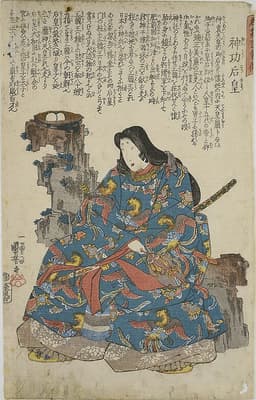
Empress Jingu
Emperor · Ancient
43.7Total

Sennacherib
Emperor · Ancient
62.0Total
Basic Information
Born
169
-705
Died
269
-681
Era
Ancient
Ancient
Nationality
Japan
Assyria
Occupation
Emperor
Emperor
Civilization
Eastern
Middle Eastern
Score Comparison
Military (10%)
55.0
85.0
Political (20%)
33.6
45.0
Influence (20%)
51.8
60.0
Legacy (20%)
44.2
54.0
Leadership (15%)
33.6
72.0
Strategy (15%)
41.0
75.0
TOTAL
43.7
62.0
Empress Jingu — Complete Timeline
200 AD
Conquest of the Three Korean KingdomsWar◆ Major
According to the Nihon Shoki, Empress Jingu led a naval expedition to the Korean peninsula and conquered the kingdoms of Silla, Baekje, and Goguryeo. This legendary campaign is said to have established Japanese dominance in Korea for several centuries, though archaeological evidence is lacking.
Korean CampaignLegendary ConquestYamato
Impact: regional
210 AD
Returned from Korea with TributePolitical Action
After her legendary conquest, Empress Jingu is said to have returned to Japan with tribute from the Korean kingdoms, including gold, silver, and textiles. This event is recorded as a triumph that enriched the Yamato court and solidified her reputation as a warrior ruler.
TributeDiplomacyWealth
Impact: nationalconstructive
Regency for Emperor OjinPolitical Action
Empress Jingu is said to have served as regent for her son, Emperor Ojin, after her husband's death. Her regency is credited with maintaining stability and continuing the expansion of Yamato influence, though the historical accuracy of her rule is disputed.
RegencySuccessionYamato
Impact: nationalconstructive
Sennacherib — Complete Timeline
701 BC
Siege of JerusalemWar◆ Major
Sennacherib besieged Jerusalem after Hezekiah of Judah rebelled. The Assyrian army captured many Judean cities but failed to take Jerusalem. Hezekiah paid heavy tribute, and the siege was lifted, possibly due to disease or divine intervention as recorded in the Bible.
JerusalemSiegeHezekiah
Impact: regional
700 BC
Construction of the Southwest Palace at NinevehCultural◆ Major
Sennacherib built the 'Palace Without Rival' at Nineveh, a massive complex with extensive reliefs depicting his campaigns. The palace included advanced water systems and gardens, making Nineveh a grand capital of the Assyrian Empire.
ArchitectureNinevehPalace
Impact: regionalconstructive
689 BC
Sack of BabylonWar◆ Major
Sennacherib ordered the complete destruction of Babylon after a rebellion. The city was flooded, its temples razed, and the statue of Marduk removed. This act shocked the ancient Near East and was later blamed for Sennacherib's assassination.
BabylonDestructionRebellion
Impact: regionaldestructive
681 BC
Assassination of SennacheribPolitical Action◆ Major
Sennacherib was murdered by his sons Arda-Mulissu and Sharezer while praying in the temple of Nisroch. The assassination was likely motivated by his choice of Esarhaddon as heir over his older sons. Esarhaddon then seized the throne.
AssassinationSuccessionEsarhaddon
Impact: regionaltragic
Expert Analysis
Origins
Empress Jingu, a legendary figure in Japanese history, is said to have been born around 169 AD, though her existence is debated among historians. According to the Nihon Shoki, she was the wife of Emperor Chuai and mother of Emperor Ojin. Her background is steeped in myth, with claims of divine ancestry and supernatural abilities. In contrast, Sennacherib (reigned 705-681 BC) was a historical Assyrian king, son of Sargon II. He was born into the ruling dynasty of the Neo-Assyrian Empire, receiving a thorough education in military tactics, administration, and statecraft. His family background was firmly established in the Assyrian royal lineage, giving him a clear path to power.
Rise to Power
Empress Jingu's rise came after the death of her husband, Emperor Chuai, during a campaign against the Kumaso tribe. According to legend, she was divinely inspired to invade Korea, and she led a naval expedition to the Korean peninsula, conquering the kingdoms of Silla, Baekje, and Goguryeo. Her regency for her son, Emperor Ojin, solidified her power. Sennacherib became king after his father's death in battle. He quickly faced rebellions, notably in Babylon, which he crushed. His rise was marked by military campaigns to secure the empire's borders and assert his authority.
Leadership & Governance
Empress Jingu's leadership is portrayed as divinely guided, with emphasis on her role as regent. She is credited with maintaining stability and expanding influence through the Korean conquest. However, her governance is not well-documented historically. Sennacherib was a pragmatic and ruthless leader. He reorganized the Assyrian military, introduced new siege techniques, and moved the capital to Nineveh, which he transformed into a magnificent city. His governance focused on centralization and suppression of rebellions, exemplified by the complete destruction of Babylon in 689 BC after a revolt. His leadership score of 72.0 reflects his effective but brutal rule.
Triumph & Tragedy
Empress Jingu's greatest triumph is the legendary conquest of the Three Korean Kingdoms, which brought tribute and influence to Japan. Her tragedy lies in the lack of historical evidence; her story may be more myth than fact, diminishing her tangible legacy. Sennacherib's triumphs include the sack of Babylon and the construction of the 'Palace Without Rival' at Nineveh, showcasing Assyrian power. His greatest tragedy was the failure to capture Jerusalem in 701 BC, despite besieging it. He also faced a devastating defeat in 691 BC at the Battle of Halule, which weakened his reputation. His assassination by his sons in 681 BC was a tragic end, likely due to his choice of a younger son as heir.
Character & Destiny
Empress Jingu is depicted as a determined and divinely favored leader, but her character is shrouded in legend. Her destiny is tied to the founding myths of Japan's imperial line. Sennacherib was known for his arrogance, cruelty, and religious piety. His decision to destroy Babylon and remove the statue of Marduk was seen as sacrilegious, leading to his assassination. Historians note that his character traits directly contributed to his downfall.
Legacy
Empress Jingu's legacy is primarily cultural and religious. She is enshrined in Shinto as a kami and is a symbol of female leadership in Japanese history. However, her historical impact is minimal due to the lack of evidence. Sennacherib's legacy is substantial: his military innovations, the transformation of Nineveh, and the destruction of Babylon influenced the region for centuries. The Assyrian Empire under him reached its zenith, though his assassination marked the beginning of its decline. His legacy scores 54.0 compared to Jingu's 44.2, reflecting his greater historical footprint.
Conclusion
While Empress Jingu holds a significant place in Japanese mythology, Sennacherib's impact on history is far greater. His military score of 85.0 dwarfs Jingu's 55.0, and his political and leadership scores are also higher. Sennacherib's actions had concrete, lasting effects on the ancient Near East, whereas Jingu's deeds are largely legendary. Therefore, Sennacherib had a greater historical impact.
Rankings
🥇
SennacheribLeader
Mil: 85.0Pol: 45.0Inf: 60.0
62.0
🥈
Empress Jingu
Mil: 55.0Pol: 33.6Inf: 51.8
43.7
+18.3 behind
How This Comparison Works
Algorithm
Each figure is scored on 6 dimensions (0—100 scale) based on structured historical data: Military (10%), Political (20%), Influence (20%), Legacy (20%), Leadership (15%), Strategy (15%). The weighted total produces the final ranking.
Data Sources
Scores are computed from structured sub-indicators in the database. Scale factors adjust for era (Ancient ×0.85, Modern ×1.0) and civilization size (Eastern ×1.05, Other ×0.80) to account for differences in population and military scale.
Maximum 3 Figures
Comparisons are limited to 2—3 figures to ensure readability and statistical meaningfulness.
Error Margins
±5 points per dimension — Sub-scores are derived from historical records with inherent uncertainty. Two figures within 5 points on a dimension should be considered roughly equivalent in that area.
Total Score Accuracy
±3 points overall — The weighted combination of 6 dimensions produces a total score with approximately ±3 points of uncertainty. Differences of less than 3 points are not statistically significant— the figures are effectively tied.
Known Limitations
- Historical records are incomplete and uneven across civilizations
- Figures from oral-tradition societies may be underrepresented
- Occupation labels can misclassify multi-role figures
- Scores measure capability and impact, not moral character
- Quantitative scoring is a comparison tool, not absolute truth
Capability Radar
Military (10%) — Battles & Warfare
Battles
20
85
Win Rate
25
80
Expansion
30
80
Political (20%) — Governance & Reform
Reform
5
65
Diplomacy
15
60
Economy
5
70
Influence (20%) — Cultural & Global Reach
Cultural
30
60
Global
20
60
Legacy (20%) — Historical Impact
Historical
35
70
Longevity
40
65
Leadership (15%) — Power & Stability
Tenure
20
75
Stability
10
55
Strategy (15%) — Tactics & Innovation
Strategy
15
85
Tactics
15
90
Reform
5
70
Similar Comparisons
Comments & Discussion
No comments yet. Be the first to share your thoughts!